DOUZE POINTS!
Director Ben A Williams, writer Juno Dawson and host Rylan are among those giving Lisa Gledhill a behind-the-scenes glimpse at how the all-singing, all-dancing Interstellar Song Contest was brought to life.
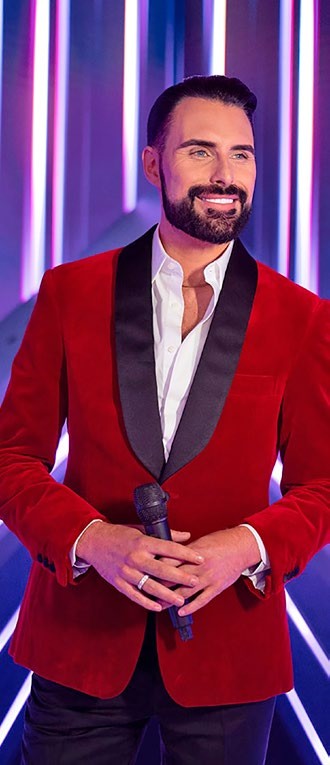
A huge welcome to your host: Rylan!
With great skill and attention to detail, the Doctor Who team have created a TV studio inside a TV studio. To my untrained eye, this set for The Interstellar Song Contest is very confusing. Is that lighting gantry part of the actual Wolf Studios lighting gantry or part of the scenery? Should those equipment storage cases be in shot or not? Or does it even matter? In a way it’s reassuring to see that TV production in the future hasn’t changed all that much, although it’s a bit of a surprise to see someone in hi-vis who looks like a crew member being given make-up touch-ups. At least the people playing ‘crew’ are wearing pink lanyards to differentiate them from the actual crew, otherwise this could get embarrassing. I’ve managed to find the real Sharon King, co-producer on this story, so hopefully she can straighten things out for me.
“It’s almost a duplication of what we have anyway but just that little bit more sci-fi,” she explains. I wonder aloud if it wouldn’t have been easier to get the real crew to play themselves but “Everyone has their place,” Sharon tells me, before leading me on a short tour through the borderlands between the real and the fictional.

Sharon King.
This studio-based story is making use of more than half the soundstages at the Cardiff production hub. One area is set up for stunts and wirework, then there’s the control room set, ‘backstage’ sets, acres of green drapery and the mandatory Doctor Who corridors. One of the largest sets ever used in the series is the main Harmony Arena, where performers from across the galaxies belt out their songs, in front of an audience of thousands. Creating that audience has been a bit of a task for visual effects because Doctor Who’s budget doesn’t quite run to 100,000 supporting artists. Instead, more than 100 people in eccentric outfits and make-up, have been scanned and recorded in different parts of the arena, and digital models have been created to fill the whole space with cheering fans.
“It’s very much a collaboration,” says visual effects on-set supervisor Nicky Walsh, “They’re trying to do a lot here [in studio] and we’re trying to augment it where possible and help it in the right direction. Things like that are very cool, they’re very nice shots to get your teeth into.”
Sharon explains that all the ‘on stage’ elements of the fictional song contest need to be recorded first because these will be shown on the monitor screens in the control gallery set. This means that for the Doctor Who crew, it’s been like making two separate shows, a light entertainment live broadcast followed by a studio-based drama.
“It feels like there’s double the amount of work, like double the intensity of it all,” says Sharon. “It’s basically putting on a completely different production.”
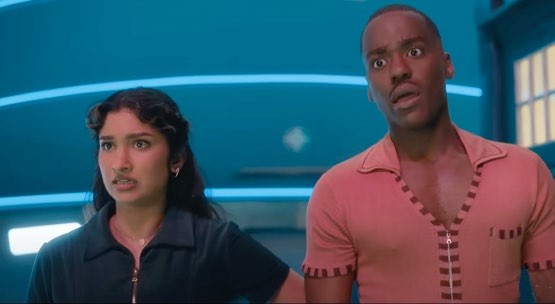
“Oh, we’re so staying.”

Rylan’s co-host Sabine (Julie Dray).
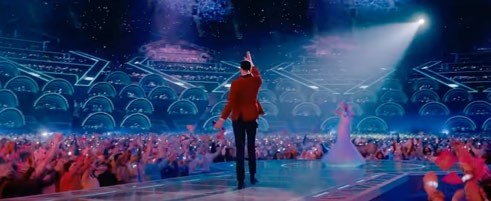
The Harmony Arena with “100,000 extras”.
Most episodes for the last two seasons have been created in pairs, with one director working on both stories. This one is so complicated, Ben A Williams will be focussing all his attention on it, with Makalla McPherson taking care of the other episode in production block 4, The Story & the Engine.
“I feel really lucky,” says Ben. “I’ve never done a job like it. We’ve spent the last four days shooting elements for the show within a show, so we’ve been choreographing, designing light shows, recording songs, choosing different planets that people might have conceivably come from – it’s just mad. And now, after spending a week filming a light entertainment show, we’re back into the day-today scene work which has also been extraordinary, and quite fast.”
This level of fast-paced fantasy is something new for Ben and he says he’s enjoying the change, although he admits: “I feel like a bit of a fraud because I haven’t seen every episode of Doctor Who.”