DIVIDE AND CONQUER
Weighing up the delicate imbalance of asymmetrical multiplayer
By Niall O’Donoghue
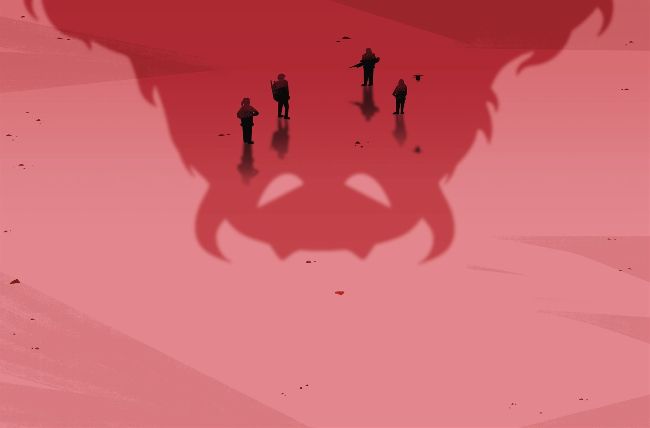
Illustration Ollie Hoff
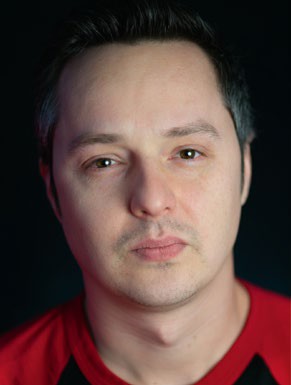
Brandon Yanez, design director at Turtle Rock
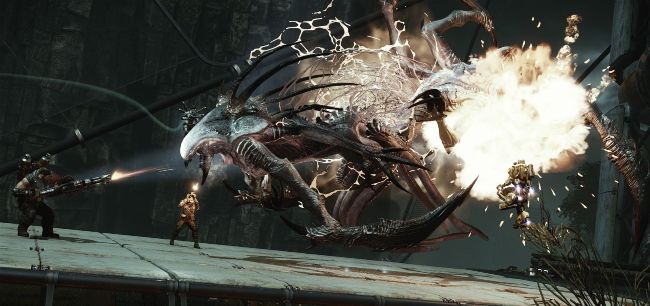
Evolve stands out as a big-budget asymmetric game. “When you start doing triple-A quality, you can’t have sloppiness, because any sloppiness is your weakest link,” according to Yanez Mathieu Côté, game director, Dead By Daylight
H
umans, to borrow a cliché from horror and sci-fi, are the real monsters. It was a phrase that Turtle Rock took to heart when developing
Evolve,
the studio’s first game after parting ways with Valve following the development of
Left
4
Dead.
Like that game, this 2015 creature feature had four players, in classic FPS mode, working together against a monstrous foe: a lone kaiju, piloted in thirdperson view by a fifth player. This brought a marked change of pace for both sides – there’s no mistaking the difference between fighting an AI monster and one controlled by another human.
In some ways, Evolve was a high-water mark for asymmetrical design – an entire game built out of the principles of L4D’s Versus mode, which saw players controlling zombies in a firstperson perspective, coming from a major publisher, 2K. It was successful, too, shipping 2.5m copies in the first few months after release, with 2K declaring it a “key long-term franchise”.
Yet part of the reason it remains a high-water mark is that, today, asymmetry is firmly the exception rather than the rule in videogames – something that might be attributed to Evolve itself. In the end, 2K’s big plans never came to fruition, and the game abandoned its upfront cost in 2016, transitioning to a free-to-play model before being delisted in 2018.
Of course, this isn’t the only kind of asymmetry available to multiplayer designers. Take, for example, Total War: Warhammer, whose fantastical setting allows Creative Assembly to clearly distinguish each faction. Or, indeed, the roster of a Street Fighter game, where characters’ different specialisms are expressed through input styles (think of Ryu’s quarter-circles versus Guile’s charge moves) and one-off mechanics (such as SF6’s Jamie, able to power up his moves by pausing to drink from a flask). This might be thought of as a kind of second-order style of asymmetry, however – one where all players share most of the same design essentials, but given their own flavour depending on their chosen character.
Designing for Evolve’s monsters, however, was an entirely different kettle of fish. “You have different expectations, there are different animation requirements, movement requirements – there’s quite a bit of consideration between the two [camera perspectives],” says studio design director Brandon Yanez. “You’ll spend a lot of time making a firstperson shooter feel really good, and then it takes almost an equal amount of time to make a thirdperson camera feel really good.” Reflecting on the game now, he acknowledges the flaws that resulted from this strict design challenge. Hunters, he feels, are too reliant on perfect harmony: if just one player fails to do their part well, the whole team falls apart. Yet, when facing off against a well-drilled squad, monsters can feel bullied.
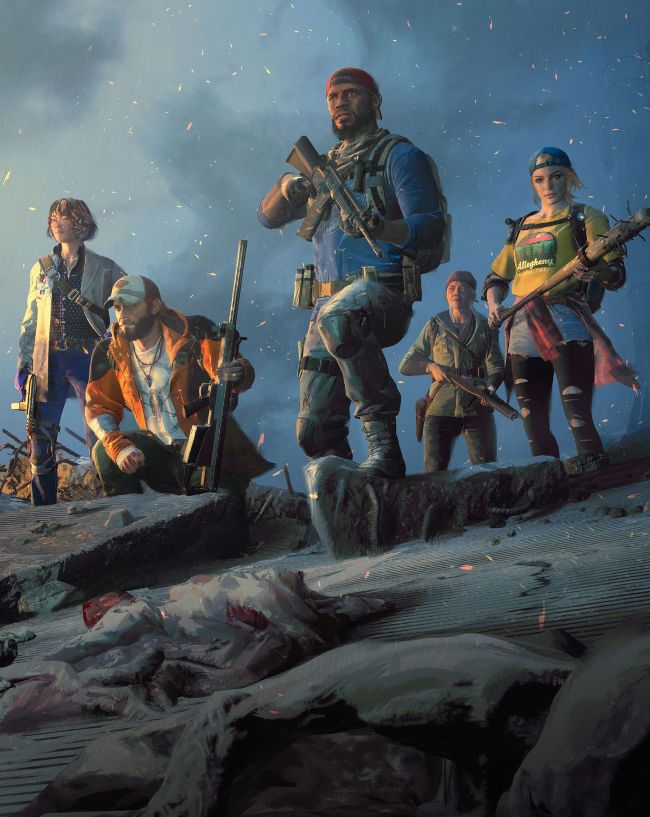
Brandon
Yanez
was
inspired
by
Dota when creating monsters in Back 4 Blood, ensuring that each fit an archetype: for example, Stingers act as a ranged class of sorts.
Nonetheless, Yanez still speaks passionately about Evolve, and eagerly jumped back in when the game’s servers were reactivated last year at the request of fans. (The game, however, remains delisted on Steam.) But the spirit of Evolve lives on in Turtle Rock’s Back 4 Blood, which features its own asymmetrical mode pitting teams of human ‘cleaners’ against hordes of ghoulish ‘ridden’, the latter controlled from an over-the-shoulder camera. Players take turns duking it out in arenas custom built to accommodate both viewpoints.