REDEMPTION SONG
After Us explores the difficulty of telling stories of apocalypse and reparation through the lens of an action game
By Edwin Evans-Thirlwell
Despite the title, there are humans everywhere in After Us. They fill the game’s urban and industrial wastelands from end to end – arace of petrified, naked giants, trapped in an endless pilgrimage through the world they’ve destroyed. Strewn along the game’s critical path, usually travelling in the same direction as you, they give this allegorical thirdperson platformer a distinct emotional cadence. There’s dread as you approach each ogre from behind: their stooped silhouettes recall both Attack On Titan and the work of Francisco Goya, and not all are inanimate. But then you pass by, spin the camera and see, well, people: old, young, thin, fat, male- or femalepresenting though devoid of genitalia, their faces riven by yearning and despair.
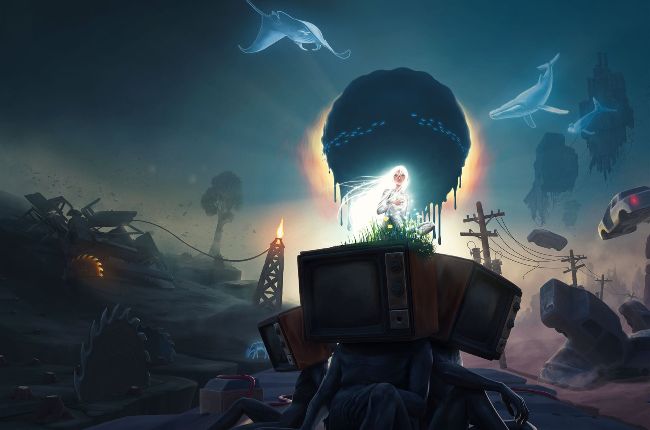
After Us builds whole platforming levels out of rusted, floating car hulks, all packed tight with something that could be either polystyrene foam or congealed cooking fat
Game After Us
Developer/publisher Piccolo Studio
Format PC, PS5, Xbox Series Release 2023
MUMMY ISSUES
It’s not clear whether After Us Zelda’s Great Deku Tree aside, Gaia’s mother puts us in mind of Dormin, the insinuating, bodiless voice from the temple in Shadow Of The Colossus. harbours a named antagonist, but you might find it close to home. Gaia’s mother is both her support, as an ignorant child, and a source of resistance. She supplies the depressing historical context for all the things Gaia learns during her discovery of this broken universe. “There isn’t really any conflict, but [we wanted] another voice that presented all the facts and seems to say that hope is not reasonable,” Ministral says. “And she needs to be hopeful against that voice.” We’d like the game to flesh this idea out:
Alexis Corominas, game director
The landscapes themselves are sumptuous but not mind-blowing. Ranging from weedy underwater skyscrapers to hills of TV screens that double as teleporters, they could be spaces from any number of videogame apocalypse fables. But the presence of the humans is transformative, in that exploration becomes an unpacking of mixed feelings towards characters who are portrayed as both “Devourers” and victims of their own appetites. It’s hard not to marvel at them, even as you scour each linear but roomy biome for the ghosts of the animals they’ve driven to extinction. “We want to explore that grey zone in which we are, at the same time, agents of destruction but we can write the most beautiful poetry,” says Alexis Corominas, game director. “That’s who we are. We kill for pleasure, as a species. And at the same time, we make music.”