RETRY.EXE
Inside the long and gruelling journey of Lunar Software's sinister sci-fi horror
BY ED SMITH
Game Routine
Developer Lunar Software
Publisher Raw Fury
Format PC, Xbox Series
Release 2025
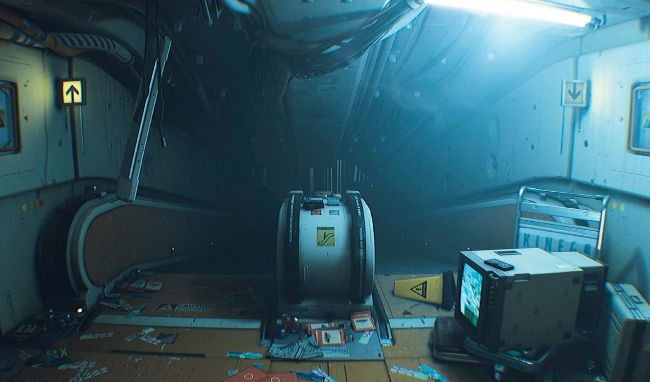
Even before it was struck by the mysterious disaster, the Moonbase was a bleak, dying place
The Cosmonaut Assistance Tool, or CAT, is a multifunctional electronic device, housed within a large, rectangular, white plastic casing. Its battery life is short; using the CAT for even its most rudimentary applications will quickly drain its power supply. The viewfinder screen, which is mounted on the rear, is roughly the same size as – and has a similar image resolution to – Casio’s 470 portable television, released in 1991. If you aim the CAT and move it from side to side, it produces a delay effect on the monitor, as the device’s sluggish internal processor struggles to quickly convey images from the lens to the display. Any environmental magnetism will also significantly disrupt the device’s capabilities, meaning it has to be manually degaussed regularly.
Slow, hard to work and evocative of a particular technological era, the CAT is an encompassing metaphor for not only the world and style of Routine but the story of its long and arduous creation. The first trailer for the game was released in 2012, with the full launch originally scheduled for the following year. After 2013 came and went, Routine was pushed back to 2017, but again, that date passed by. For five years afterwards, the sci-fi horror game and its creator, Lunar Software, went almost totally silent. At Gamescom 2022, Routine reemerged – but then, for a third time, it sunk back into obscurity. It wasn’t until this August, at the same convention in Cologne, Germany, that the game broke cover once more.
This time, however, it was apparently here to stay. Backed by Raw Fury, publisher of the excellent Blue Prince, Routine had a new trailer and an imminent release date: it’s scheduled for launch before the end of 2025. For Lunar, it’s been an intensely difficult journey; although she’s explaining the role of the CAT in Routine’s mechanics, assistant lead artist and designer Jemma Hughes could easily be describing the game’s storied and complex production. “It’s chunky. It’s cumbersome,” she says. “The CAT embodies a lot of things about Routine.”
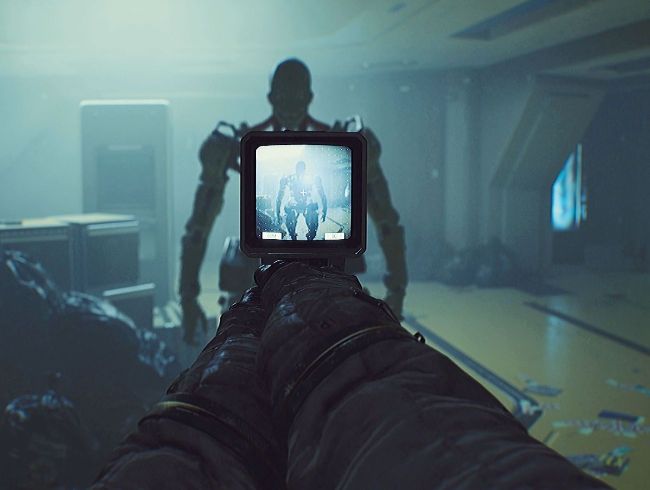
A fully charged shock from the CAT will stun malevolent droids for a short time, but it’s a better idea to run from them
“I HAD THIS IDEA ABOUT STAYING POWER. I WANTED IT TO BE SOMETHING YOU WERE SO PASSIONATE ABOUT, YOU COULDN’T LET GO”
The story of the game’s creation extends back to 2008, when lead designer Aaron Foster left university. After graduation, Foster took a job at Eurocom, the now-defunct studio behind the remake of GoldenEye for Nintendo’s Wii and the less-fondly remembered 007 Legends. He was earning a wage, but his artistic ambitions weren’t being entirely fulfilled.
A devotee of ’70s and ’80s sci-fi and a committed archivist, Foster’s original vision for Routine was inspired by old photographs from NASA. “I had this idea about staying power,” he says, “about seeing something through, even if it wasn’t supporting you financially. I wanted it to be something you were so passionate about, you couldn’t let go. I’m not technically shy, but I’m not a programmer, so I also wanted to design something where the art could carry it.”
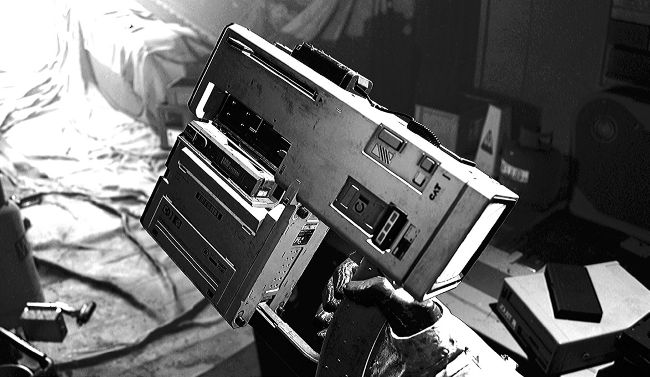
Compared to the one in the original version of
Routine
, the finished CAT is much more detailed and interactive
While the finished game feels closer to Alien: Isolation or Amnesia: The Bunker, in its earliest form Routine was more like The Chinese Room’s Dear Esther, a short-form, purely visual experience in which players explored a bleak, retrofuturistic space station. An experienced modder, Foster shared screenshots from his extracurricular project on ModDB and game development forums. The images quickly gathered a lot of attention. “People started to resonate with it,” Foster remembers. Among those people were Pete Dissler, who would become lead programmer, and Hughes herself. After exchanging some ideas, concepts and ambitions for Routine, and pooling their cash, the trio rented a flat together in Preston, marking the beginning of Lunar Software. While Dissler would later move out (“he got a girlfriend – and a life,” Foster jokes), Foster and Hughes remain in the original Preston flat to this day, and are themselves a couple.