GODS AMONG US
In our regular series, we pay tribute to the towering, mega-watt stars who still roam Hollywood
The eternally charming, ever alluring king of the comebacks JOHN TRAVOLTA
WORDS ADAM SMITH
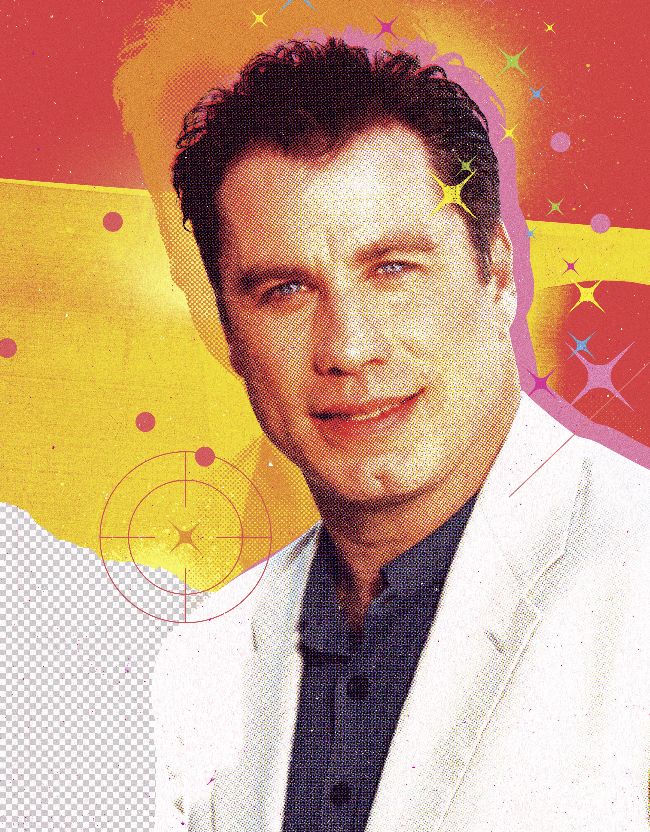
ILLUSTRATION CHRISTOPHER LEE LYONS
IT IS THE evening of 24 November 1992, and a drama worthy of a Hollywood development meeting is playing out 41,000 feet over Washington, DC. A tiny Gulfstream jet, callsign N728T, is rocketing through the sky. The cabin and cockpit are both in complete darkness.
A few hours into the jet’s scheduled flight, the tiny aircraft’s primary electrical generator has suddenly failed. The plane has automatically switched to its secondary generator, but the resulting power surge has now knocked out that system, too.
In the cockpit, the pilot stares in alarm at the plane’s rapidly dimming instruments.
Thick clouds below obstruct the view of any landmarks, and with no instrumentation, he is essentially flying blind. With only a torch for illumination, a magnetic compass and a battery-powered emergency attitude indicator, the pilot begins what anyone familiar with aircraft will tell you is a risky manoeuvre: a blind rapid descent through 11,000 feet of cloud cover. In such situations pilots are told to ‘fly the instruments’, to avoid the spatial disorientation that has resulted in more than one catastrophe, but the pilot of N728T doesn’t have any instrumentation.
Ten minutes later the Gulfstream punches out of the clouds, barely 1,000 feet above the ground. With only limited brakes, the landing is fast and hard: all four tyres blow out almost immediately. N728T finally skids to a halt at the junction between Washington Airport’s two main runways. “That was a squeaker,” a safety official later told The Washington Post.
“I thought it could have gone either way.”
But then, maybe things were fated to turn out just fine in the end. If there was anyone who knew about turbulence, about negotiating tricky situations, about, well, staying alive, it was N728T’s pilot: one John Travolta. He has, after all, always been a kind of walking miracle, a born survivor. Even his most ardent fans would admit that the misses outnumber the hits by some margin. After an incendiary early career — stratospheric TV fame with Welcome Back, Kotter, the decade-defining Saturday Night Fever, the evergreen Grease — he plunged into a years-long career slump. All seemed lost, before a single supporting role led to the most spectacular comeback in Hollywood history.
A mere bit of unplanned ‘plummeting’ wasn’t the kind of detail that was going to derail that kind of destiny.
Through it all — the career catastrophes, unexpected revivals, personal tragedies, near airplane crashes and Battlefield Earth — Travolta endures, his apparently undimmable appeal more in tune with the ancient gods of Hollywood’s previous era than the Method actors who are his angsty contemporaries.
More than perhaps any modern star, audiences are drawn to him more than they are to any character he happens to be playing. There’s something open, generous, irresistibly vulnerable about his screen presence.
Take the reaction of notoriously waspish critic Pauline Kael, who responded with protective horror when approached by aspirant
Travolta biographer Nigel Andrews. “But you wouldn’t write anything negative about him, would you?” Andrews reports the alarmed Kael as saying. The most acute and occasionally brutal critic of her generation had been reduced to a kind of maternal goo by the idea of any Travolta muck being raked. And the secret to all of this?