DIANA DECONSTRUCTING
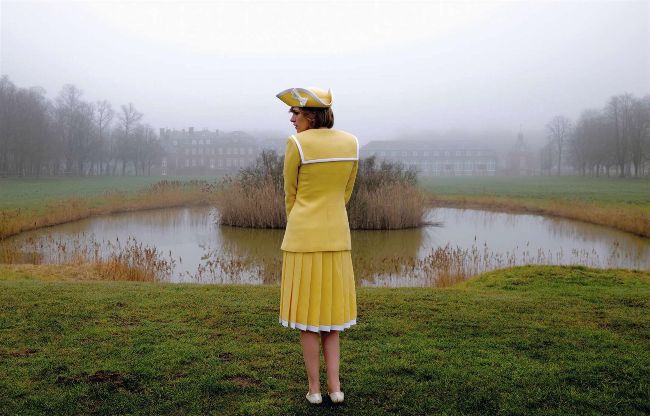
Diana (Kristen Stewart), alone in the gardens of Sandringham. Above right: Director Pablo Larraín with Stewart in the frame.
THE WRITER STEVEN KNIGHT
HE’S NEVER WATCHED The Crown, but Steven Knight knew his Diana screenplay would be nothing like it. “It’s not because I don’t think it’s fabulous — I’m sure it is — but it was a matter of principle [that] I was not immersed in Diana folklore,” he says. Knight had no plans to make a film about her until producer Paul Webster (who worked with him on David Cronenberg’s Eastern Promises) introduced him to director Pablo Larraín in London. But Knight wasn’t unprepared — Diana’s funeral had haunted him. “I heard this noise I never thought I would hear from British people, behaving in a way British people didn’t normally behave,” he remembers. “Some people thought she was fantastic, some were cynical, but I just thought, ‘You can’t be cynical about this. This is people wailing.’”
Knight’s goal was to unpack that incredible connection Diana made with people. “She represented someone who doesn’t fit in, and who doesn’t want to be known while everyone wants to know her,” he says. His research process avoided reading much — choosing instead to listen to those closest to her. “I spoke to people in the house at the time, who served and observed, and there was a real kinship between them and her,” he recalls. “They were unanimously sympathetic.”
Spencer centres on three days at the Queen’s Sandringham country estate, a decade into Diana’s time as a royal, as she realises during a decidedly un-merry Christmas that her marriage has no hope. Knight’s story embraces a distortion of reality by calling itself, as the film begins, “a fable based on a true tragedy”. But where do you draw the line for Diana? What was true of this pivotal weekend, when she realised she had to get out? “With adapted stories, the most unbelievable things are usually true,” Knight says. Still, fact was secondary to feeling. “If one assumes her view of reality was skewed by the pressure, I wanted to see how it might have been from inside her head.”
Knight describes the film as a “jailbreak” movie, telling the story of Diana as a person “imprisoned by circumstances and tradition”. These circumstances go further than the job she was given, with the writer blaming “the appetite of other people” for her ultimate sadness.