GB
  
You are currently viewing the United Kingdom version of the site.
Would you like to switch to your local site?
19 MIN READ TIME

Q&A

YOUR QUESTIONS ANSWERED

... COULD DINOSAURS HAVE HAD SYMBIOTIC

RELATIONSHIPS WITH OTHER ANIMALS?

... WHAT’S THE BEST WAY TO DRY CLOTHES INDOORS?

... WHY DO COMPUTERS AND CONSOLES NEED TO

RESTART TO INSTALL UPDATES?

... HOW DOES DENDROCHRONOLOGY WORK?

... ARE THERE REALLY DINOSAURS IN FOSSIL FUELS?

... HOW DO ROBOT VACUUM CLEANERS NAVIGATE?

... WHY DOES BAD NEWS MAKE ME FEEL SICK?

... WHAT GIVES CLOUDS THEIR SHAPE?

... DO WEIGHTED BLANKETS REALLY WORK FOR

ANXIETY AND INSOMNIA?

... HOW DO ROCKS STAY ON THE SURFACE OF DIMORPHOS?

Email your questions to questions@sciencefocus.com or submit on Twitter at @sciencefocus

OUR EXPERTS

PETE LAWRENCE Astronomy expert

AMY ARTHUR Science writer

DR NISH MANEK GP and medical expert

DR CLAIRE ASHER Science journalist

DR HELEN PILCHER Biologist and science writer

LUIS VILLAZON Science and tech writer

PROF STEVE BRUSATTE Veteran palaeontologist

PROF PETER BENTLEY Computer scientist

DR CHRISTIAN JARRETT Psychologist and author

DR ALASTAIR GUNN Astrophysics lecturer
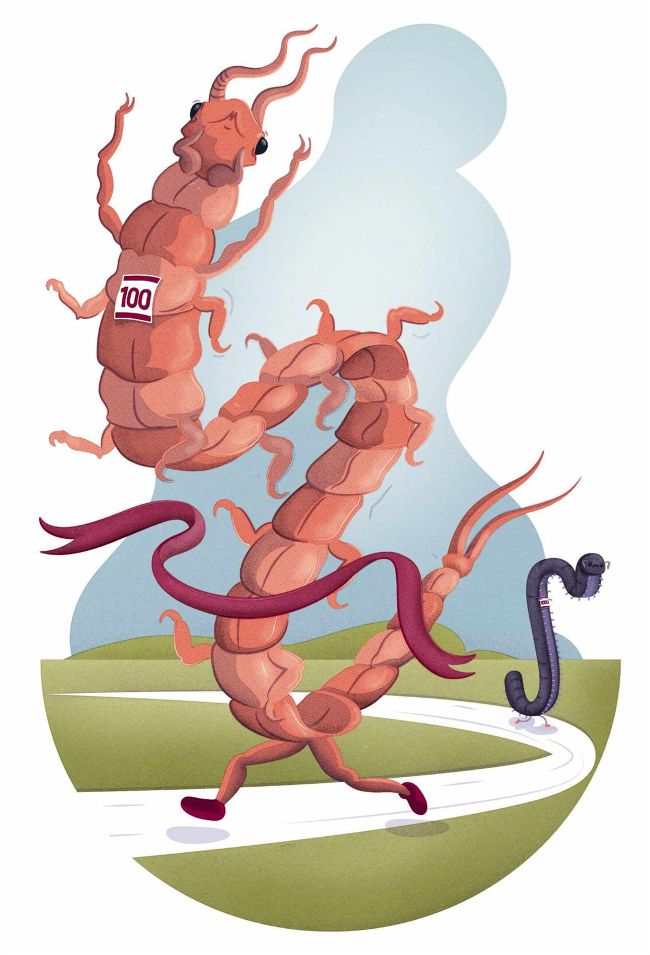
ILLUSTRATION: DANIEL BRIGHT

CHARLOTTE EDWARDS, CHELTENHAM

WHICH WOULD WIN IN A RACE, A CENTIPEDE OR A MILLIPEDE?

Centipedes are much faster. Precise figures are hard to come by, but common centipede species run at comparable speeds to a spider, whereas millipedes move more at the pace of an ant. The reason for this has nothing to do with their different numbers of legs – the leggiest centipede species have 384 legs, which is more than a typical garden millipede. But almost all centipedes are hunters and have evolved legs that splay out sideways from their body, which allows a rapid rowing motion as they chase prey.

Millipedes have shorter legs tucked underneath their bodies to give them better traction as they push their way through soil and leaf litter. LV

NATURE’S WEIRDEST CREATURES...

HARPY EAGLE

The harpy eagle is one of the largest and most powerful raptors on earth. Native to the rainforests of Central and South America, it is named after the harpies of Greek mythology; malevolent wind spirits with the face of a woman and the body of a vulture. The harpy eagle is an apex predator. Its broad and relatively short wings enable it to fly almost straight up, so it can navigate the understory of the forest, and attack from below as well as above. Monkeys, sloths and opossums beware; the harpy eagle can snatch prey weighing up to 8kg. Its curved black talons, which can grow up to 13cm long, can exert over 50kg of pressure, so it kills its victims by crushing them.

Cloaked in demure shades of grey, the harpy eagle is crowned with a double crest of slate-coloured feathers, which fan out whenever the bird feels threatened. A smaller ring of lighter feathers around the face creates a disc that is thought to help focus soundwaves, while the bird’s eyesight is impeccable: it can spot an object less than 2cm in size from a distance of 200 metres. The harpy eagle is bold, beautiful, and sadly under threat – its conservation status is classified as ‘vulnerable’ with logging, poaching and habitat destruction largely to blame. HP

FREDDIE WILLIAMS, LONDON

COULD DINOSAURS HAVE HAD SYMBIOTIC RELATIONSHIPS WITH OTHER ANIMALS?

Many plants and animals in nature live together in long-term interaction. This is called symbiosis. It might be mutually beneficial, or one of the organisms may be a parasite on the other. There are many examples in nature today, from the algae that live inside corals, to fungi that grow on the roots of plants (mutualistic relationships), to many types of parasites such as worms and bugs preying on their hosts. There is evidence that dinosaurs like Tyrannosaurus rex were affected by parasites, as some fossil bones are pitted with lesions that resemble those caused by protozoan parasites in modern-day birds. Evidence for mutualistic symbiosis between dinosaurs and other species is not so clear, as such evidence is unlikely to fossilise. But just like birds that help pick the teeth of crocodiles today, it is easy to imagine that dinosaurs must have had similar relationships, perhaps with their bird descendants, in the past. SB

Unlock this article and much more with
You can enjoy:
Enjoy this edition in full
Instant access to 600+ titles
Thousands of back issues
No contract or commitment
Try for 99p
SUBSCRIBE NOW
30 day trial, then just £9.99 / month. Cancel anytime. New subscribers only.


Learn more
Pocketmags Plus
Pocketmags Plus

This article is from...


View Issues
BBC Science Focus Magazine
March 2023
VIEW IN STORE

Other Articles in this Issue


Editorial
FROM THE EDITOR
COVER: ANDY POTTS THIS PAGE: BBC/WARWICK SLOSS/ NATUREPL.COM
REGULARS
Eye in the sky
BURSA, TURKEY
Small but mighty
MAUI, PACIFIC OCEAN
Think your TV is big?
LONDON, UK
CONVERSATION
YOUR OPINIONS ON SCIENCE, TECHNOLOGY AND BBC SCIENCE FOCUS
DISCOVERIES
“If we miss this emissions goal, the ice
THE JWST HAS UNEARTHED EVIDENCE OF ANCIENT GALAXIES THAT SHOULDN’T EXIST
The presence of such massive galaxies lurking in the early Universe contradicts current cosmological models
ENDANGERED MALE QUOLLS ARE CHOOSING SEX OVER SLEEP – AND IT MAY BE KILLING THEM
The finding could explain why males usually only survive for one mating season, while females can live through several
NEANDERTHAL GOURMETS REGULARLY FEASTED ON ROASTED CRAB
The discovery of cooked crab shells in a Lisbon cave is further evidence that the early hominids had a sophisticated culture
WORLD FACING IRREVERSIBLE AND CATASTROPHIC CONSEQUENCES IF NET ZERO CARBON NOT REACHED BY 2060
Computer models show melting ice sheets in Greenland and Antarctica could cause 100cm of sea level rise in the next 130 years
A FOURTH ‘WHITE’ TRAFFIC LIGHT WOULD HELP DRIVERLESS CARS TO EASE CONGESTION, SCIENCE SAYS
The extra light would indicate that autonomous vehicles had taken over control of the traffic flow at busy junctions
GENIUS COCKATOOS USE TOOLSETS TO COMPLETE TASKS LIKE LITTLE, FEATHERY HANDYPEOPLE
It is as yet unclear how many sugars they take in their tea
LOOKING TO BURN MORE BODY FAT? START YOUR DAY WITH A MORNING WORKOUT
Taking exercise in the morning may help to boost the metabolism and burn more body fat
EARTH’S CORE
The solid-iron core at the centre of our planet is slowing down, according to a new study… and it’s making our days longer
RARE GREEN COMET SEEN RACING THROUGH THE SKY FOR THE FIRST TIME IN MORE THAN 50,000 YEARS
The comet, C/2022 E3 (ZTF), last passed by when Neanderthals walked the Earth
THE FUTURE’S BRIGHT…
As a remedy for all the bad news out there, let us prescribe you a small dose of feel-good science. Each issue, we’ll give you a rundown of the latest breakthroughs that aim to solve humanity’s biggest problems. From e-skin that can allow long-distance hugs to blood tests that detect tumours, here you’ll find many reasons to feel hopeful for our future…
COULD THE NEW GENERATION OF ANTI-OBESITY INJECTIONS BE A GAME-CHANGER?
UK chemists will soon be selling the weight-loss jabs
THE SCIENCE OF HAPPINESS: RESEARCH-BACKED WAYS TO BOOST YOUR WELLBEING
We could all use a little joy in our lives…
CAN CHATBOTS ENCOURAGE PEOPLE TO BE NICER TO EACH OTHER?
The new wave of conversational AI takes cues from social psychology to push back against toxic language
THE LAST OF US: COULD FUNGAL INFECTIONS TURN US ALL INTO ZOMBIES?
How realistic is the fungal pandemic depicted in the hit TV series?
SOLARIS: ESA’S PLAN TO GENERATE POWER IN SPACE
Could building a network of orbital power stations help us solve the energy crisis?
BIRD FLU: WHAT IS THE H5N1 VIRUS AND HOW WORRIED SHOULD WE BE?
The largest-ever outbreak of avian influenza has started to jump species to infect other animals
INNOVATIONS
PREPARE YOURSELF FOR TOMORROW
Meta Quest Pro: a VR headset for an unknown customer
The Meta Quest Pro is powerful and full of features, but, as Alex Hughes discovers, unless you’re already a full believer in the metaverse, it’s probably not for you
Best smart lighting systems
Bring voice control, mood lighting and a simulated sunrise to your home,
Ideas we like…
Our pick of the month’s smartest tech
3 ISSUES FOR £5
INTRODUCTORY OFFER!
THE EXPLAINER THE AMAZON
THE WORLD’S BIGGEST, MOST BEAUTIFUL, AND MOST BIODIVERSE RAINFOREST
CROSSWORD
PENCILS AT THE READY! PETER ADAMS ACROSS 1
NEXT ISSUE
DOWN ON THE FARM Meet the robots that
Is hyperspace travel possible?
When will we be zipping round the cosmos like Baby Yoda and co?
FEATURES
THE MYSTERY OF THE BIGGEST BLACK HOLE IN THE UNIVERSE
Black holes are big. Very big. But physics makes it almost impossible for them to grow. Here’s how one black hole defied the odds to swell to gargantuan proportions
THE WONDERFUL WORLD OF SLIME
Runny noses, slipper y sea creatures and that impossible-to-clean bit behind your sink all have one thing in common: slime. While it might make us cringe, life on Earth would be ver y different without it
HOW PROCESSED FOOD HARMS YOUR MOOD
Mental health problems are on the rise. Yet there is growing evidence that the food we eat may be a vital ingredient to help us feel better
Chat
X
Pocketmags Support