GB
  
You are currently viewing the United Kingdom version of the site.
Would you like to switch to your local site?
8 MIN READ TIME

EXPLAINER

VAGUS NERVE THE EXPLAINER

THE BODY’S INFORMATION SUPERHIGHWAY THAT TELLS YOUR ORGANS HOW TO REST
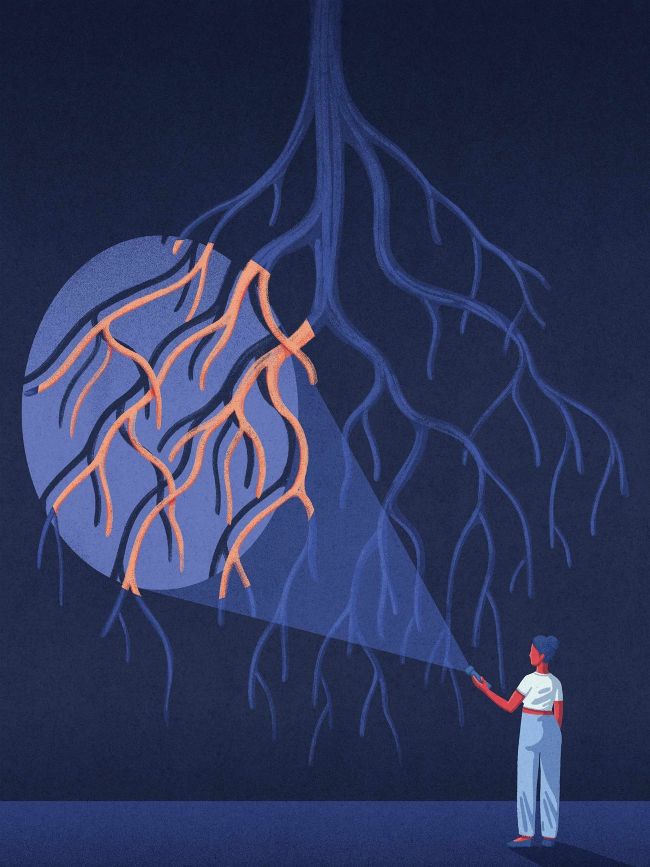
ILLUSTRATIONS: MYRIAM WARES

What is the vagus nerve?

Your brain is connected to your body through a set of 12 crucial nerve networks that descend through your spine and branch out into your body. Of these, the vagus nerve is probably one of the most important. Its tendrils influence digestion, your heart, your reflexes and your breathing. So you can see why scientists are so interested in what it does – especially when you consider how all of the above affect your mood. You could call the vagus nerve a superhighway between our brains and bodies.

In contrast to the rapid ‘fight or flight’ responses that are under the control of the sympathetic arm of the nervous system, the vagus nerve is responsible for many of the slower,

‘rest and digest’ responses that we collectively call the parasympathetic arm. The nerve itself is actually two thick bundles of individual neurons (nerve cells) that originate in the brain and pass out to the rest of the body through left- and right-sided openings at the bottom of the skull.

Most of the individual neurons that make up the vagus nerve are sensory ones – about 100,000 on each side of the body in humans – which pass messages from the organs to the brain, and are activated by sensory input from the environment. The remainder are motor neurons, which send messages in the opposite direction, from the brain to organs, and directly control all of our muscle movements.

Why is the vagus nerve so important?

The vagus nerve is a sort of polymath of the parasympathetic nervous system, getting involved in everything from breathing, heart rate, swallowing, sneezing, digestion, appetite, immune responses and even orgasm. The vagus nerve’s wide-ranging skill set comes from having a diverse array of neuron cell types at its disposal. These allow the nerve to pick up different types of sensory signals from different organs. Some, for instance, sense chemical signals like oxygen levels in the blood or the secretions of bacteria in the intestine, while others sense mechanical signals like stretching of the blood vessels and gut.

Unlock this article and much more with
You can enjoy:
Enjoy this edition in full
Instant access to 600+ titles
Thousands of back issues
No contract or commitment
Try for 99p
SUBSCRIBE NOW
30 day trial, then just £9.99 / month. Cancel anytime. New subscribers only.


Learn more
Pocketmags Plus
Pocketmags Plus

This article is from...


View Issues
BBC Science Focus Magazine
Sep-22
VIEW IN STORE

Other Articles in this Issue


Editorial
FROM THE E DITOR
COVER: MAGIC TORCH THIS PAGE: GETTY IMAGES X2,
REGULARS
Catching waves
VIRGO INTERFEROMETER, CASCINA, ITALY
Promise of life?
PERSEVERANCE ROVER, MARS
CONVERSATION
YOUR OPINIONS ON SCIENCE, TECHNOLOGY AND BBC SCIENCE FOCUS
GENETICISTS AIM TO RESURRECT THE TASMANIAN TIGER
The marsupial, also known as a thylacine, could be brought back from extinction within the next decade
NEED PATCHING UP? HOW ABOUT AN ULTRASOUND BANDAGE THAT CAN SEE INSIDE YOU
A new era of wearable imaging technology will ensure we can keep a closer watch over our bodies
GIANT PANDAS ROAMED EUROPE SIX MILLION YEARS AGO
Teeth found in Bulgaria in the 1970s confirm a new species of ancient panda
NEW IMAGE OF CARTWHEEL GALAXY SHOWS US HOW STARS ARE BORN
This stunning image released by the James Webb Space Telescope reveals the inner workings of a rare ring galaxy in unprecedented detail
OUR GUT MICROBIOMES ARE BEING STARVED OF FIBRE
Modern low-fibre diets could increase the risk of cardiovascular disease, digestive disorders and colon cancer, but supplements could help
THE ITSY BITSY SPIDER DREAMED OF A WATERSPOUT
REM-like sleep behaviour has been observed in arachnids for the first time
GENE THERAPY HEALS MALFUNCTIONING CELLS IN EAR
The findings could offer hope to people with hearing loss
DESPITE DELAY, NASA’S ARTEMIS PROGRAMME IS SET TO PUT HUMANS BACK ON THE MOON
A s BBC Science Focus went to print,
HOW BETTER WATER MANAGEMENT COULD HELP US COPE WITH DROUGHT IN THE FUTURE
HORIZONS
THE FUTURE’SBRIGHT...
As a remedy for all the bad news out there, let us prescribe you a small dose of feel-good science. Each issue, we’ll give you a rundown of the latest breakthroughs that aim to solve humanity’s biggest problems. From pigskin eye implants to faster transatlantic flights, here you’ll find many reasons to feel hopeful for our future…
IF MUSIC BE THE CURE FOR PAIN, PLAY ON
What if music could help boost the power of our painkillers?
THERE’S A REASON WHY WE ALL PREFER R2-D2 TO C-3PO…
Humanoids have long been regarded as the ‘holy
TRANSLATION ERRORS COULD SEND INNOCENT PEOPLE TO JAIL
Using interpreters in police interviews can distort how suspects and witnesses are evaluated, leading to incorrect convictions
BELLY FAT: CAN YOU TARGE T IT WITH PILLS AND EXERCISE, LIKE THE ADS SAY?
Is there an easy way to battle middle-aged spread or is it simply a case of fat chance?
BRITAIN’S TEMPERATE RAINFORESTS: CAN WE PROTECT THEM?
These unique, ancient ecosystems are home to a wealth of biodiversity that is worth preserving
SPACE JUNK: AM I LIKELY TO BE HIT BY A PIECE OF OLD SPACESHIP?
The amount of debris in orbit around the Earth is a growing issue… 
Nothing Phone 1: More than just a gimmick
A solid smartphone wrapped up in a distracting
Dominate the sport of drone racing with advice from a world champion
Evan Turner is a three-time drone-racing world champion. Alex Hughes gets his tips on how to break into the sport
EVAN TURNER’S TOP DRONE RECOMMENDATIONS
DIY drone “A typical racing drone in its
Ideas we like…
Our pick of the month’s smartest tech 
IDEAS WE DON’T LIKE...
…A TV THAT’S TRYING WAY TOO HARD How
Q&A
YOUR QUESTIONS ANSWERED ... WHY ARE OUR KNEES
ASTRONOMY FOR BEGINNERS
GETTY IMAGES X3 ILLUSTRATIONS: PETE LAWRENCE, DANIEL BRIGHT
CROWDSCIENCE
Every week on BBC World Service, CrowdScience answers
NATURE’S WEIRDEST ANIMALS…
THE HONEYPOT ANT Bees aren’t the only insects
DEAR DOCTOR...
HEALTH QUESTIONS DEALT WITH BY OUR EXPERTS
QUESTION OF THE MONTH
ALAMY, GETTY IMAGES, NASA/STSCL ILLUSTRATION: DANIEL BRIGHT IF
CROSSWORD
PENCILS AT THE READY! ACROSS 1 Cyril’s lost
MEET THE BLOODSUCKERS
GETTY IMAGES PLUS WHY CAN’T MEN MAKE FRIENDS?
buysubscriptions
www.buysubscriptions.com
Could Star Wars blasters exist?
Pew pew pew! Delve into the science of how a Stormtrooper’s weapon of choice could work
FEATURES
WELCOME TO NEMO’S GARDEN
DIVE BENEATH THE TURQUOISE WAVES OFF NOLI, ITALY, AND YOU’LL FIND BIOSPHERES JUST METRES UNDER THE SURFACE. WITHIN THESE DOMES, RESEARCHERS LOOK AFTER HERBS, STRAWBERRIES, TOMATOES AND TOBACCO, IN ORDER TO EXPLORE THE LIMITS OF FARMING ON EARTH, WITH THE HOPE THAT THEY MAY ONE DAY BE ABLE TO DO THE SAME IN SPACE
INTO THE UNKNOWN
A new epoch of spaceflight is upon us. Here, we explore the next generation of spacecraft that will take us to parts of our Solar System that we’ve never seen before
SEARCHING THE SKIES
If you want to cover a lot of ground, the best way is to take to the sky
CRUISING ON STORMY SKIES
Inflatable manta rays could scull through the acid clouds of Venus 
IN DEEP, DARK DEPTHS
Piercing through the crust of Europa to explore its hidden ocean
INTO THE SHADOWS
Life on other planet s is likely to be found underground,where there is shelter from radiation
EXPANDING INTO THE SOLAR SYSTEM
Trying to cram a kilometre-sized structure into a metre-wide rocket is no easy feat
THE MYSTERY OF MIGRAINES
According to the NHS, around 10 million people aged 15 to 69 in the UK suffer from migraines. But our understanding of them is still incomplete, and there isn’t even a pill to make them go away
BBC Science Focus
INTRODUCTORY SUBSCRIPTION OFFER! SAVE 40%
EASY WAYS TO ORDER ONLINE buysubscriptions.com/ SFP382 PHONE
Chat
X
Pocketmags Support