GABRIEL BATISTUTA
BATIGOL BIG GAME HUNTER
When Gabriel Batistuta had the goal in his sights, he rarely missed. FFT honours one of football’s deadliest marksmen, 30 years on from his move to Europe...
Words Martin Mazur
"Jorge, what exactly have you seen in this kid?”
When Marcelo Bielsa was introduced to Gabriel Batistuta, he couldn’t have been more suspicious. Jorge Griffa, the eminent scout, had invited the young striker to join Newell’s Old Boys. For Bielsa, he was an enigma. A chubby enigma.
“He scores goals with ease, Marcelo. Give him a chance.”
Before he became a superhero, Gabriel Batistuta was just an ordinary citizen of Reconquista, a small agricultural city 800km north of Buenos Aires. Unlike in most tales of wonder, his daily routine provided no hint of any footballing superpower whatsoever. He had no clue of what was about to happen.
On the verge of finishing secondary school, the 17-year-old son of Gloria and Omar was thinking about what to do next. He didn’t like the idea of working with the crops, as his dad did every day, waking up at 4am. He fancied becoming self-employed. Maybe he could be a mechanic, he thought. He could set up his own workshop, open late, take naps, fix cars. That sounded good. Perhaps even a doctor.
He was extremely shy, but also capable of leaving roses by the front door at Irina’s house. The girl he liked would later become his wife, and the mother of four sons – and the roses were from her front garden, which didn’t impress Irina’s mother. “Can’t this kid cut someone else’s roses?” she would ask.
In the early years of Batistuta, football was never part of the picture – at least, not an important one. He liked a kickabout with his friends, just as he liked to go fishing or play basketball, but he was never hugely into football. Batistuta would watch only the games in which he was playing. When asked about a striker he admired, he would answer Mario Kempes – but the last time he’d seen Kempes in action was probably back in 1978, when Batistuta was nine. Watching football on television was nearly impossible outside of a World Cup. He supported Boca Juniors, but he couldn’t name their starting line-up.
While Dennis Bergkamp, also born in 1969, joined Ajax at the age of 11, Batistuta arrived a virgin to the top flight when he was 19. His story is as intriguing as it is anachronistic: it’s hard to believe today that as recently as 1988, such a late starter could become a world-class player in less than three years.
“Personally I never wanted to become a football player – it just happened,” he told El Grafico in 2003. “When I was a kid, I never dreamed of being a ball boy at football stadiums, nor did I chase footballers, asking them for autographs. In fact, I’d never been to a football match as a spectator.”
Everything changed the day a national youth team toured the province of Santa Fe, and asked the locals to put up a team. That team ended up winning, thanks to two goals from a slightly overweight striker. Watching, Griffa knew he had found a raw, unpolished gem. How much potential did this kid have? He invited Batistuta to Rosario to find out.
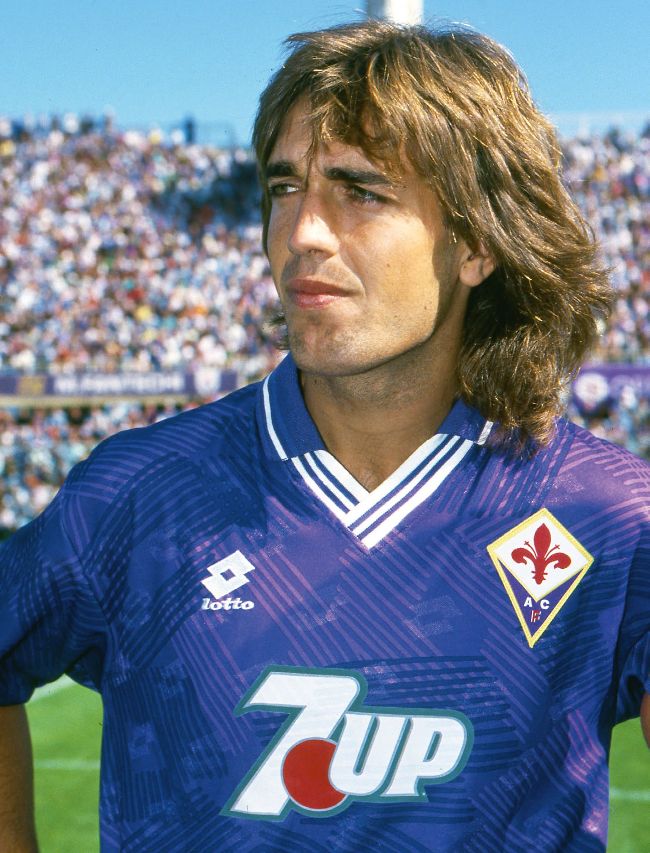
"Oh, is there a camera on me? I hadn’t noticed...”
Batistuta had managed to start dating Irina in Reconquista, and he was scared of leaving. Eventually he decided to go; “If she loves me, she will love me tomorrow, even if I leave,” he said. Perhaps, with the basic wages he would receive, he could even afford to pay for his university studies. In Argentina, football was often seen as an excuse not to study. In Batistuta’s mind, it was the opposite.
IN THE BATTLE, A 22-YEAR-OLD BATISTUTA GRABBED A CAMERA AND USED IT TO DEFEND HIMSELF