In The Studio With | Drew McDowall
Drew McDowall
Ex-Psychic TV and Coil member Drew McDowall solidifies his reputation as an industrial outlier with his latest album Agalma. Danny Turner discovers his longstanding addiction to modular
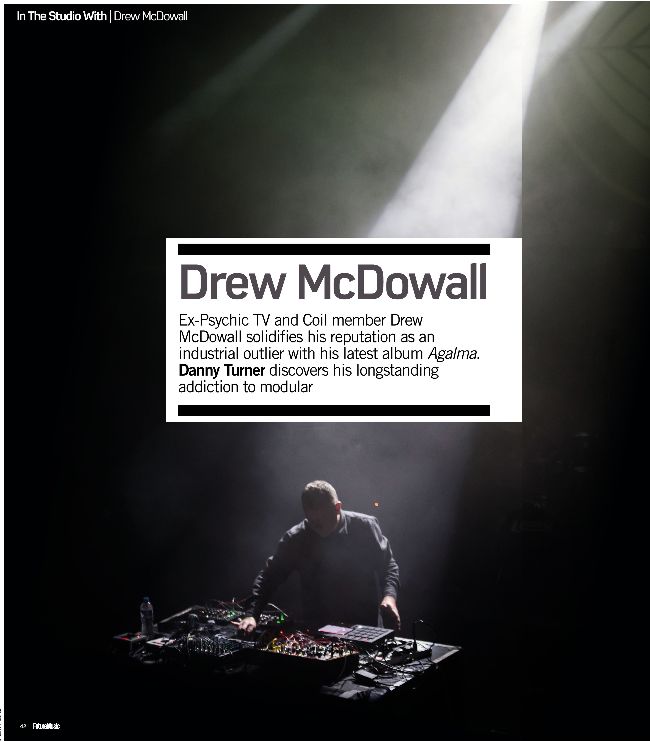
© Gordon Haswell
Scottish musician Drew McDowall formed the art-punk trio Poems in 1978 before spending a brief spell with boundary breaking Throbbing Gristle offshoot Psychic TV. The band split in several directions and McDowall’s own studio experiments never saw the light of day. However, he eventually became an integral member of post-industrial band Coil from 1994 until the tragic death of founding member John Balance.
Modular synthesis has fascinated McDowall since the early eighties and, remarkably, the influential producer would not release his debut solo Collapse until 2015 – an album itself based on a series of live experiments with modular equipment. Further releases Unnatural Channel and The Third Helix swiftly followed, setting the stage for McDowall’s latest collaborative release Agalma, a starkly beautiful juxtaposition of acoustics, found sounds and eerie ambient-industrial soundscapes.
Does your environmental upbringing attract you to the darker side of electronic music?
“A lot of it was serendipity, but the environment I grew up in on the periphery of Glasgow in the ’70s was pretty rough. I loved pop music – it wasn’t an either/or situation to like noise or industrial to the exclusion of anything else. Maybe pop music would be the escape and industrial would be the full-on unmitigated reality, but I liked a mixed bunch of stuff when I was a kid, from soul music to Krautrock, but nothing obsessive. Punk happened when I was 16 and in very short order I got into bands like Throbbing Gristle, who were probably the key that unlocked the door to what ostensibly could be considered the darker side of music. When I saw Suicide they blew me away and made me realise the barrier to entry was super low because you could do a lot with just a couple of pedals and a tape deck.”
How did you get involved with bands like Psychic TV and Coil?
“I knew Alex Ferguson from Psychic TV because he was from Scotland and did something for a band called Strawberry Switchblade. My ex-wife, Rose, was in that band and we also had a band called The Poems. Alex introduced us to Genesis P-Orridge and we really hit it off, but my tenure in Psychic TV was very brief. I spoke to Gen about that a few years ago and she said, ‘If I say you were in Psychic TV, then you were in Psychic TV!’.”
Was the sense of chaos and disorder in that music a reflection of their lifestyles as much as their art, and was that ever a challenge?
“I’ve always been pretty anarchistic and chaotic, but I’m not sure about disorder. Psychic TV was actually pretty disciplined in its approach. Some of their stuff could be sublime and other times downright nice with poppy tropes. But Psychic TV emerged out of Throbbing Gristle. As they said at the time, ‘the mission is terminated,’ and Chris & Cosey went in a different direction. John Balance and Peter Christopherson had already left to form Coil and I’d had a falling out with Gen, as many people did back then. Someone introduced me to John and we hit it off immediately. This was around 1987, but I didn’t officially become a member of Coil until 1994.”