WORDCOLOUR
Nicholas Worrall tells Matt Mullen about the collaborative processes and detailed sound design behind his immaculate new album
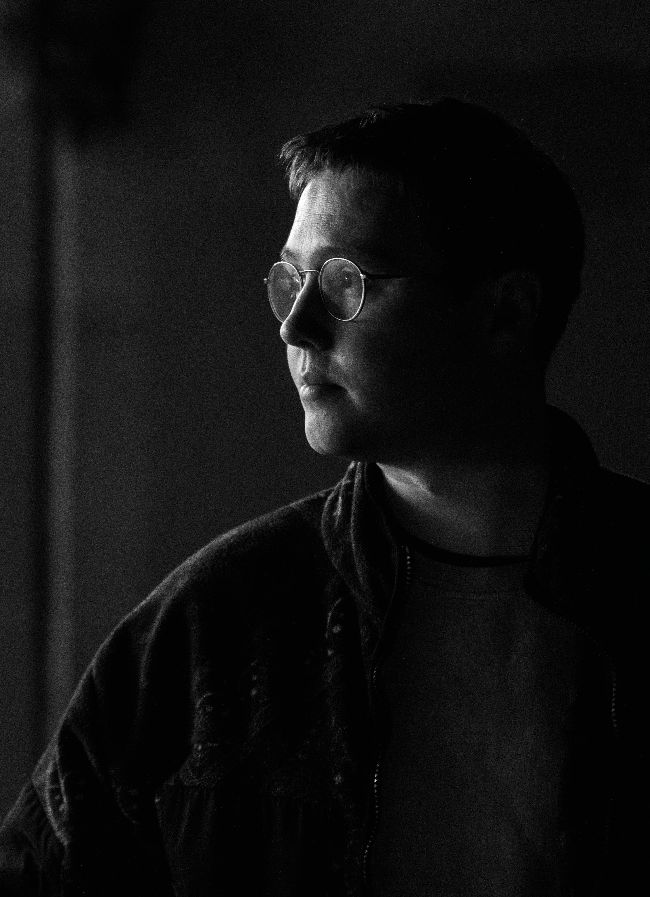
© Jemima Yong
There’s a moment in Nicholas Worrall’s new record – The trees were buzzing, and the grass – where you hear a sampled voice say the word “plunge”. Suddenly, it’s as if you’ve plunged underwater – the track’s submerged into an unmistakably aqueous low-pass filter, the sound of bubbles circling the stereo field. This moment neatly captures the feeling of listening to the gloriously strange IDM-concrète that Worrall records as Wordcolour. By sourcing, processing and recontextualising unfamiliar and unexpected samples, dexterously threading them between hyper-detailed layers of glistening synths and amphetaminic breaks, he creates thrilling moments of displacement, instantaneous shifts in perspective, that are not unlike the bracing exhilaration of being suddenly immersed in ice-cold water.
“I’M INTERESTED IN FILM SOUND EFFECTS, AND PARTICULARLY FOLEY. SOUNDS THAT SOUND LIKE THEY’RE REAL, NATURALISTIC SOUNDS, BUT THEY’RE NO T”
Consider people can you hear me?, the album’s climax, which samples an unnamed rockstar revelling in the peak of a stadium performance, praising the crowd’s energy amid rapturous applause, shredding and celebratory drum fills. Or take the track I am sixty years old and trying salvia for the very first time, which centres around a recording of what sounds like a previously uninitiated man experiencing the effects of the psychedelic herb Salvia divinorum. Embedded in a pillowy atmosphere of gossamer pads and softly articulated percussion, the sample creeps its way into the track about halfway through. It’s not clear why it belongs here, or why it works, but there’s no doubt that it does, elevating the track into a realm that – much like the psychedelic experience it depicts – is oddly meaningful in a contextless, inexplicable way.
This process of displacement was inspired by cinema, Worrall tells us. “In one sense the album is quite cinematic. Not in the sense that it is big or epic, but in the way it is structured,” he says. “At times the music literally cuts like a camera – moving the listener from one acoustic environment to another.” The filmic influence operates on more than just a structural level, too – Worrall’s inspiration came from Foley, film sound effects and the concept of hyper-reality, a term used to describe the way sounds designed to imitate reality can become over-exaggerated in their authenticity, resulting in a kind of aural uncanny valley.
In the spirit of hyper-realism, every sound on the record, from collaborator Michael Anklin’s flurries of percussion to the single-word utterances of a chorus of spoken word contributors, is presented immaculately. The overall mix is crystalline and gorgeously lucid, giving all the more emphasis to the album’s sonic oddities and strangely affecting moments. Worrall tells us that his music is, at its core, all about the way that he combines sounds, toying with the creative potential of dissonance and juxtaposition, while ultimately bringing disparate elements together to produce a singular and extraordinary whole.