10 FUTURE PROG LEGENDS
Meet 10 players who are shaping prog today… and tomorrow.
TOM MONDA
(THANK YOU SCIENTIST)

DEVIN BARNES
What does prog mean to you?
I always thought prog was more of an ethos than a genre. I think of it as an umbrella term for artists who are willing to do weird and/or exciting things.
Who are your guitar heroes?
Too many to list, but a few that come to mind: Lenny Breau, Allan Holdsworth, Bill Frisell, Ed Bickert, Scott Henderson, Charlie Hunter, Ralph Towner.
What are your favorite pieces of gear?
My Vigier Surfreter fretless.
What do you try to achieve to make your style and sound unique?
Just getting out of my own way and trying to play as honestly as I can.
What song in your catalog best exemplifies your approach to the guitar?
The song “Terraformer” off of the new Thank You Scientist album of the same name. It’s performed entirely on the fretless guitar and uses some unique extended techniques involving harmonics.
YVETTE YOUNG
Covet’s guitar virtuoso brings melody and emotion to progressive shred.
BY RICHARD BIENSTOCK
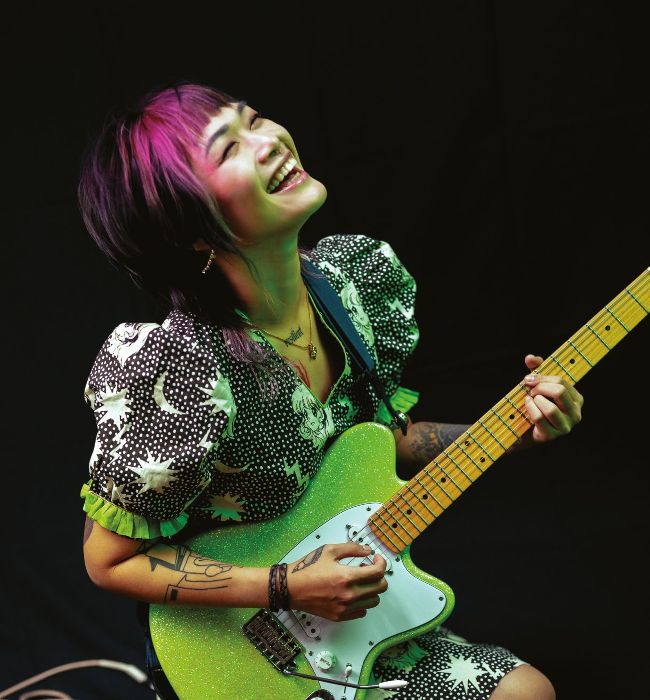
HOWIE CHEN
“I CALL IT ‘CHASING MELODIES.’ THERE’S NO WAY TO GET COMFORTABLE, AND I LIKE THAT”
AS THE INSTRUMENTAL guitar maverick in Covet, Yvette Young takes a polyphonic, pianistic approach to her instrument. She employs alternate tunings, fingerpicking, two-handed tapping and plenty of effects to put an ethereal and ambient spin on progressive playing.
How did you approach your guitar work on Covet’s new record, Technicolor?
I occupy this zone in the progressive “shred” guitar world, but I feel like a phony there because I’ve been chasing melodies my whole life. So for this record, I wanted to focus on conveying emotions and telling stories with melodies. It’s definitely a more “wet” record, meaning that I’m using more effects on it. I’m toeing the line between being in this weird post-rock/shoegaze world and having one foot in the prog world, because of the odd-time meter stuff and the intricacy of the playing.
You’ve talked about taking a pianistic approach to the guitar, and indeed, you often play with two hands on the fretboard, much like you would lay your fingers on the keys of a piano.
I grew up playing piano and violin, so a lot of the way I think about melody is still polyphonic. On piano, you know, you’re splitting up a melody between two hands. Your left hand is often implying root notes, and your right hand has what would be considered more of a lead guitar role, playing more of the main melody. I think about it the same way on guitar. And I tap because it feels like how I would do runs on a piano.
Another big component of your style is your use of alternate tunings and open strings. How does that help you express yourself on the instrument?
What I really enjoy about alternate tunings is, yes, they make certain shapes more accessible. But I also feel like I’m never writing with shapes or theory in mind, because you can’t really memorize chord shapes when you’re constantly changing your tunings around. So I sing all of my parts first with my voice and then I find them in the alternate tunings. I call it “chasing melodies.” There’s no way to get comfortable, and I like that.