Frankenstein formation
Name Miranda Planet Uranus Size 27x smaller than Earth Discovered 1948
On the surface Miranda looks like a patchwork moon. However, its lunar looks are the result of hundreds of miles of rocky ridges. There are three giant features called coronae that span Miranda’s surface. These are large oval or trapezoid ranges of troughs and ridges that are each at least 124 miles wide. The three coronae on Miranda are called Arden, Elsinore and Inverness, which are all names of locations in some of Shakespeare’s plays.
There isn’t a consensus among scientists as to what processes might be responsible for Miranda’s coronae, but some believe that its surface is the result of many collisions with space debris. Others have suggested that the coronae originally formed as domes of ice on the surface, causing the rock beneath to collapse and form coronae. Scientists still don’t know what the whole moon looks like. So far only the southern hemisphere has been captured by NASA’s Voyager 2 spacecraft.
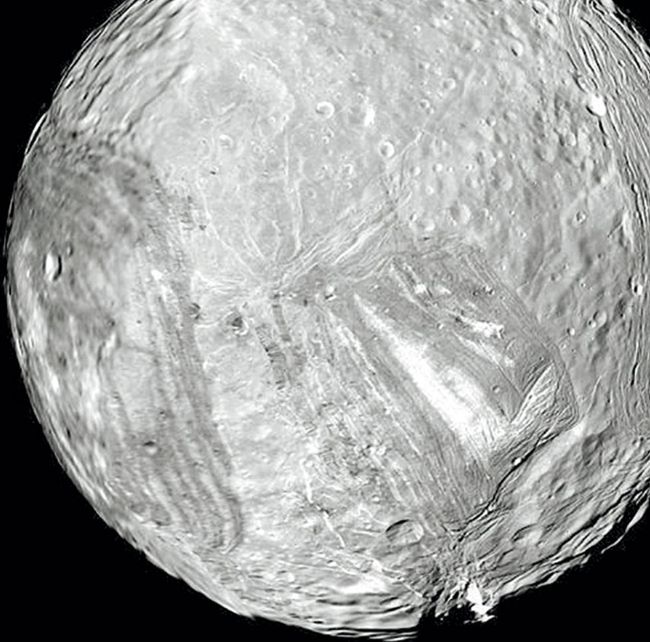
An image of Miranda captured by NASA’s Voyager 2 probe, 24 January 1986