TEN BIG TERRESTRIAL TELESCOPES
These giant Earth-based structures serve as our eyes, peering far into space
WORDS AILSA HARVEY
HOBBY-EBERLY
Location: Texas Type: Optical Diameter: Ten metres
10 Before its success as one of the world’s largest optical telescopes, Hobby-Eberly’s design was unique. One element that helped make it stand out from existing telescopes is that its mirror is always tilted 55 degrees up from the horizon. This might sound restricting, but its rotating mechanism means it can still observe 70 per cent of the visible sky.
The telescope’s mirror has 91 hexagonal segments to collect visible light.
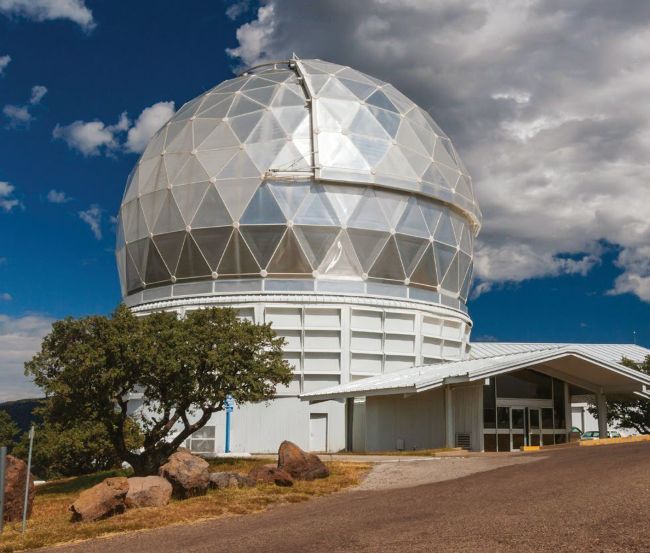
Hobby-Eberly saw first light in 1996
The most noteworthy discovery by Hobby-Eberly was observing light that originated from a quasar so far away that Earth was only an eighth of its current age when this light began travelling towards us. A quasar is an incredibly bright object that gains its energy from a supermassive black hole.
DID YOU KNOW?
If our eyes had the viewing power of the GTC, we would be able to see car headlights in Australia from Spain
SOUTH AFRICAN LARGE TELESCOPE (SALT)
Location: Karoo, South Africa Type: Optical Diameter: 11.1 by 9.8 metres
9SALT’s design appears almost identical to Hobby-Eberly’s because it was inspired by the success of its predecessor. SALT has the same number of hexagonal panels as Hobby-Eberly, but was redesigned to improve its field of view and image quality. The mirrors also have higher sensitivity to short wavelengths due to the additional layers of metal added to them. Among SALT’s top discoveries is the first white dwarf pulsar, a fastspinning stellar remnant.