COULD A SUPERNOVA ENGULF EARTH?
We put some intriguing, baffling and bizarre space questions under the spotlight
WORDS ANDREW MAY
A supernova is what happens when a large enough star explodes. Such explosions are among the most dramatic of all astronomical events,
and the resulting remnant can be a spectacular sight thousands of years later. Fortunately, supernovae are relatively rare, and we’re very unlikely to get caught up in one. The most disastrous thing from our perspective would be if our own Sun went supernova, but this will never happen. Only two types of star are capable of exploding in such a dramatic fashion: super-dense white dwarfs orbiting larger companion stars, which can produce Type I supernovae, or stars with at least eight times as much mass as the Sun, which end their lives as Type II supernovae. Our Sun isn’t in either of these categories.
Even so, this doesn’t mean that Earth can never be harmed by a supernova – in theory, at least. As well as producing the visible remnant, a supernova creates a burst of high-energy radiation that travels outwards at the speed of light. This radiation, particularly the highest energy gamma rays, could damage Earth’s biosphere if it came from the explosion of a nearby star. A sudden burst of gamma rays hitting the upper atmosphere could convert nitrogen and oxygen into smog-like nitrogen oxides, as well as damaging the ozone layer that protects Earth’s surface from the deadliest frquencies of ultraviolet radiation.
DID YOU KNOW? The Crab Nebula, the remnant of a supernova seen to explode in the year 1054, is about 6,500 light years away
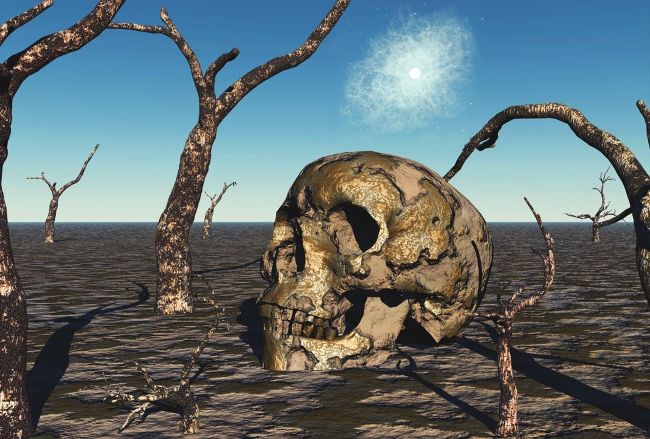
Afanciful depiction of what Earth’s surface might look like after a nearby supernova
© Getty / Alamy
These effects would be particularly catastrophic for marine life. Scientists have speculated that just such a gamma-ray burst around 450 million years ago caused the Late Ordovician mass extinction, which saw the death of around 60 per cent of all oceanic life on Earth.
The big question is how close a supernova has to be to produce effects like these on our planet. There’s plenty of uncertainty around the exact figures, but the graphic on this page shows the current best guess as to the danger zone. Fortunately, astronomers aren’t aware of any imminent supernovae close to us. The best known star likely to produce a Type II supernova any time soon is Betelgeuse, which is a perfectly safe 642 light years away. The closest of all the known ‘supernova progenitor candidates’ is a star called IK Pegasi B, which could potentially create a Type I supernova – but even this is a borderline-safe 150 light years away.