SPACE
WHY WE STUDY SPACE DUST
Long ignored by scientists, cosmic dust is becoming an increasingly important field of study
WORDS
ANDREW MAY
Did you know?
Tanpopo is Japanese for ‘dandelion’
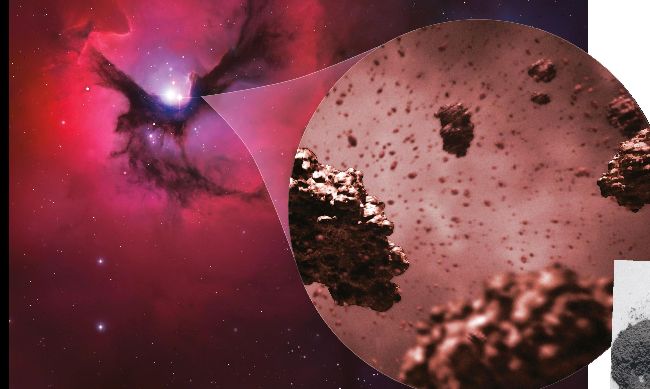
Interstellar dust grains are usually less than one thousandth of a millimetre in diameter
D ust gets everywhere – and that’s true in space as well as on Earth. It can be found on the Moon and Mars, on asteroids and comets and in the seemingly empty space between planets and stars. In fact, until very recently, astronomers wished there wasn’t so much dust in interstellar space, because it blocks their view. Although individual dust grains are microscopically small, when they congregate in clouds they can obscure anything that lies on the other side. Before the true nature of these dust clouds was discovered, early in the 20th century, they were believed to be “holes in the heavens”, as astronomer William Herschel described them.