“He’ll Get You Scared Stiff!”
Giant scorpions unearthed by an earthquake threaten to attack New Mexico in The Black Scorpion. Gregory Kulon looks at the making of this classic 50s creature feature...
In a decade known by many for its giant monster movies, arguably the person most responsible for the genre was a late comer to the party. Willis O’Brien had designed the special effects in The Lost World (1925) and King Kong (1933). To do this he had to overcome many technical obstacles while effectively creating a new film style.
Even with a recent Oscar on his shelf for the effects for Mighty Joe Young (1949), work was scarce for O’Brien in the 1950s. The poor box office performance of Joe was making even moderate budget stop-motion animation pictures look like a thing of the past. OBie, as he was known to most of his friends and colleagues, was still looking to work on quality studio productions whereas the 1950’s was primarily dominated by low budget efforts.
At the beginning of the decade, he worked with Kong’s creator and co-director Merian C. Cooper in an attempt to develop a Cinerama feature on Kong.
Unfortunately, that project would not proceed far.
For what a Cinerama King Kong would cost to develop, many smaller monster pictures could not only be produced, but done so on a schedule that allowed the investors a quick return.
The amazing success of the 1952 re-release of King Kong is generally attributed to fuelling the giant monster film craze of the era, and one of the first and best films to come out of that process was The Beast From 20,000 Fathoms (1953) with special effects by OBie’s protégé Ray Harryhausen. The film was originally made as an independent production by Mutual Productions Corporation under Hal Chester and Jack Dietz. However, having spent approximately $250,000 to make it, some of the investors, including Dietz, got cold feet about the box office response with such an investment. Dietz ended up arranging the sale of the picture to Warner Brothers for at least $400,000 (other sources indicate higher numbers.) Thus, the film turned a quick profit for Dietz and the others at Mutual before it went on to turn a major profit for Warner Brothers when they released it with only minimal changes.
The film had been directed by Eugène Lourié, who had to sell himself to get his directorial debut. Before directing Beast, Lourié had a solid CV as an art director/ production designer. He was particularly known for his work on multiple films with Jean Renoir including the classic La Grand Illusion (1937). Having already been hired by Mutual as an art director, he had convinced Hal Chester he could do the directing job as well.
Always a shrewd producer, Chester knew that he could pay Lourié less for this project than he would have to pay for both a qualified director and art director at the same time. He also knew Lourié was motivated to do a good job. In this assessment he was correct. Dietz may have worried about his initial investment on Beast, but a few years later other giant monster movies were showing there was money to be made. This included giant insect films, especially Warner Brothers’ giant ant film Them (1954) and Universal’s Tarantula (1955). Given the market, Dietz decided it was a good time to make another giant monster film, this time with scorpions.
EXCITING THINGS FOR SCORPIONS
There is some question around who first initiated The Black Scorpion (1957). In the telling of the story from most sources, Dietz initiated the project with his producing partner at the time, Frank Melford. However, an alternative story puts the origination of the project with OBie and Pete Peterson. Peterson had worked with OBie and Harryhausen on the animation for Mighty Joe Young and, like OBie, was looking for further work.
The alternative version of the story is mentioned by Bill Warren in his book Keep Watching the Skies:
American Science Fiction Movies of the 1950s (Volume I, McFarland 1982). Warren writes that “According to several special effects experts, the film grew out of a test reel created by Willis O’Brien and his assistant, Pete Peterson. In the movie, there’s a sequence in which a scorpion the size of a bus scuttles swiftly out of hiding under a bridge, chases and smashes a truck, then grabs a man off a telephone pole, stinging him to death and presumably eating him. This reel so impressed Frank Melford and Jack Dietz that a screenplay was written that would employ the footage as well as devise other exciting things for the scorpions to do.”
Warren himself partially downplays the story, noting that the test reel is not mentioned as part of the genesis of the project by Don Shay in his then latest version of his OBie biography published in “Focus on Film” Number 16 in the Autumn of 1973. However, OBie and Peterson did produce early test footage of the aforementioned scorpion attack before the film was given a go ahead.
As documented in the undated screenplay for the film, the shot of the telephone linesman, shot 124, is very illuminating. The shot description ends with the following: “Note: The only live action necessary for the above scene will be the linesman on the pole and a CLOSE SHOT of the prop pincer encircling him.
Everything else has been photographed.”
Clearly, OBie and Peterson had done early scorpion test footage. It is not clear if the footage and entire concept originated with OBie, or if he developed the footage to prove he could dynamically and affordably film the scorpions for Dietz. I expect the former is correct, but it is not possible to prove without further evidence.
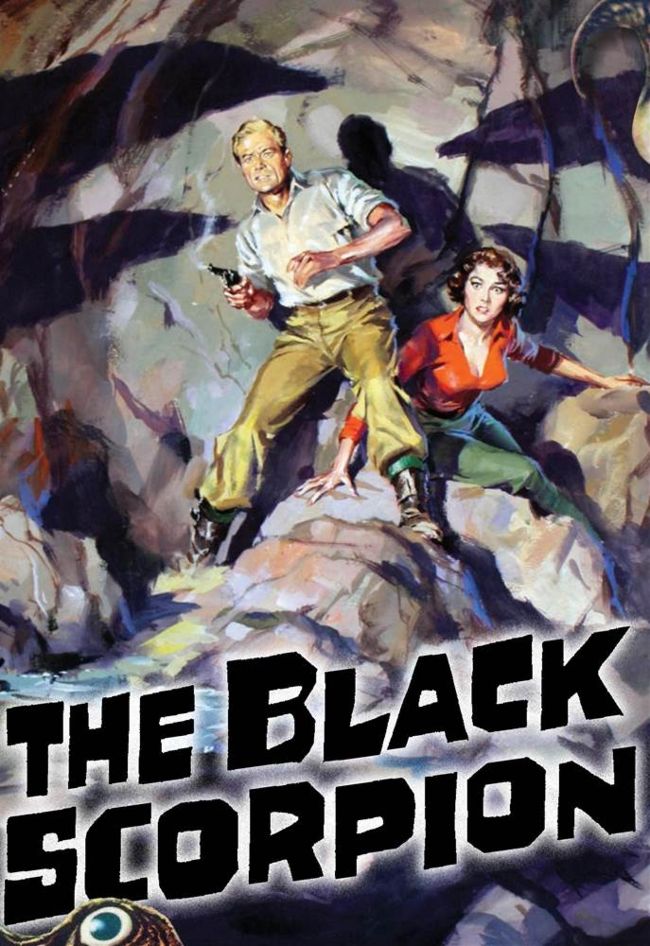
Italian poster art by Averardo Ciriello for The Black Scorpion
Other items in the story, from the Mexican location, ranchers afraid of a demon bull, and the child character all bear similarities to other OBie story concepts from that period. Even the spider and worm creatures allude to past designs by OBie. It also seems highly likely that OBie had direct involvement in the development of the screenplay, as there are many technical notes in the document calling for the use of miniatures, miniature projection, process shots, and practical effects. These notes are more detailed, and representative of the final product, than what one would normally find from something developed by a screenwriter alone.
Dietz and Melford hired Paul Yawitz to flesh out the story. Yawitz had over 25 story or screenplay credits in the previous two decades, although he would seem an unlikely choice given most of his work seemed to be straight drama. The Black Scorpion would be his final credit, and his only one for a science fiction film.