THE FLINTSTONES
YABBA DABBA DOO!
Before The Simpsons aired in 1989, the world record The Flintstones held as the longest running animated television series. Richard Holliss takes a closer look at the first-ever Neolithic sitcom…
On September 30th 2020, The Flintstones, one of the most successful shows on American prime time television, celebrated its 60th Anniversary. Set in the Stone Age 10,000 years BC, this hilarious parody on American family life was the brainchild of film producers and ex-MGM animators William (Bill) Hanna and Joseph (Joe) Barbera (the talented duo behind the Academy Award-winning Tom and Jerry series). Earning a place in the coveted Nielsen Ratings’ Top Twenty, The Flintstones ran for six seasons between 1960 and 1966, and clocked up an incredible 166 episodes. At its peak, the show attracted an audience of 150 million viewers across 45 countries.
Three years prior to The Flintstones’ television debut, Hanna and Barbera had set up an independent film company called HB Enterprises in the former Charlie Chaplin Studios in Los Angeles. Hiring some of their original staff from MGM, they divided the company workload. Barbera dealt with the networks, writers and voice artists, while Hanna supervised the layout artists, animators and music.
Their first production was a new cartoon series for television called The Ruff and Reddy Show. Picked up by Screen Gems, the television subsidiary of Columbia Pictures, the animated adventures of Ruff, a clever cat, and Reddy, a slightly dim-witted dog, was sold to the NBC network in December 1957.
To keep the overall budget to a minimum, The Ruff and Reddy Show was filmed using a technique called limited animation. A theatrical seven-minute cartoon normally required as many as 25,000 individual drawings. With limited animation this could be reduced to a mere 3,500 drawings for a similar running time. Limited animation techniques were nothing new, however, having been successfully employed by other cartoon studios such as Terrytoons, UPA and (in the UK) Halas and Batchelor. Hanna-Barbera also had the foresight to make the series in colour. With the demise of black and white broadcasts, this was a shrewd move on behalf of the studio and guaranteed additional revenue from repeat screenings.
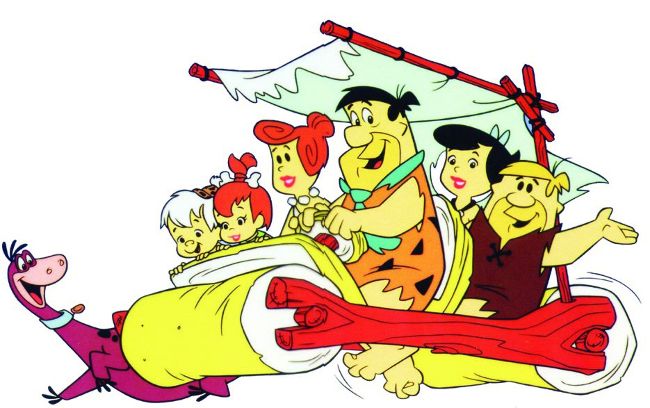
Bedrock as seen in a 1961 show
Sponsored by breakfast cereal manufacturer Kellogg’s, The Huckleberry Hound Show followed in 1958. With his happy-go-lucky persona, bright blue fur, red bow tie and North Carolina accent, Huckleberry Hound was the master of ceremonies in a series that each week featured three separate cartoon shorts, including the adventures of the irascible cat Mr. Jinks and two wise-cracking mice called Pixie and Dixie, and Yogi Bear (the scourge of Jellystone National Park) and his diminutive companion Boo-Boo. Winning an Emmy Award in 1960, The Huckleberry Hound Show was sold directly into syndication and attracted an audience of 16 million viewers; 65 percent of who were adults.