TOY TEMPEST! SELLING STINGRAY
Right:
Stingray was undoubtedly a huge draw for readers in picking up TV21. It was the freshest Supermarionation series on TV at the time, and Stingray was very much the lead story on the first handful of issues
In a sign of Supermarionation’s growing sophistication, Oink was thankfully quietly retired after just five further episodes.
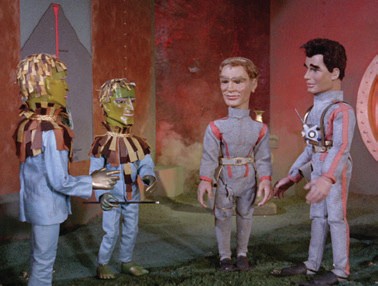
Adding to their onscreen appeal, the main cast now had a set of interchangeable heads that allowed them to express happiness with their ‘smiler’ heads, or brave intense drama and peril with their ‘frowner’ faces.
What really brought the characters to life was the voice cast, with recording sessions carried out fortnightly over numerous Sundays, with Sylvia Anderson directing.
Sylvia, who had voiced Venus in Fireball XL5, took a step back from performing this time out to concentrate on producing, delivering just two cameo roles over the whole series.
With American voices preferred, with an eye (ear?) on foreign sales, Canadian Don Mason provided Troy Tempest’s measured tones, while American actor Robert Easton coined both Phones’ laconic Southern drawl and X20’s creepy voice, based on Hollywood movie villain Peter Lorre.
Australian Ray Barrett played not just Commander Sam Shore and his occasional Marineville Tower assistant Sub-Lt John Fisher but also the mighty Titan, with his sharp features and Barrett’s ripe delivery both hinting at Laurence Olivier in his stage heyday.
Rounding out the main cast was Canadian Lois Maxwell as Lt Atlanta Shore, with the actress then becoming increasingly famous after playing the faithful Miss Moneypenny in the first two James Bond movies to date.
Ray Barrett and David Graham were the workhorses of the voice cast however, the pair sometimes providing as many as four guest voices each in some episodes.
COMIC STRIP PLOTS
Stingray’s genuine comic strip sensibility meant action-packed tales of escape and capture, missile launches, countdowns and deadly secret weapons. This was perhaps not surprising as 24 episodes, almost two-thirds of the series, were written by TV Comic’s veteran comics writer Alan Fennell, who had switched from writing comic strip tie-ins of Supercar for print to writing for the Andersons for real, opening his TV screenwriting career on Fireball XL5 (Dennis Spooner would write the remainder of the series).