Encountering Moving Dinosaurs and Monsters…
It’s sheer prehysteria as Greg Kulon looks back at the way dinosaurs have been depicted on film - and in theme parks around the world!
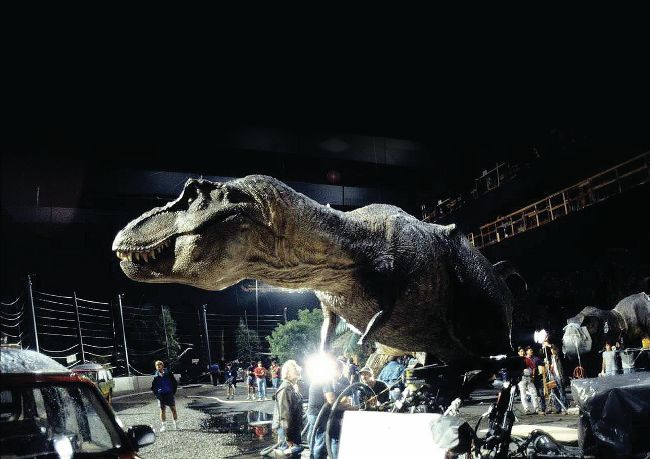
A full-Size tyrannosaurus Rex on set for Jurassic Park (1993); Gertie the Dinosaur (1914), animated by Winsor McCay; Crystal Palace Iguanadons; an animatronic T-Rex ready for the Holidays at London’s Natural History Museum
When Jurassic Park hit cinemas in the summer of 1993, it changed forever people’s views on dinosaurs and encouraged a whole new generation to enter the field of palaeontology. Based on the 1990 Michael Crichton novel, the film depicted dinosaurs resurrected into modern times through genetic engineering of dinosaur DNA recovered from insects trapped in prehistoric amber. The movie is rightfully considered to be the breakthrough film for the use of computer-generated special effects recreating living creatures. However, the film also updated the state of the art of animatronic creatures. It skilfully intercuts between computer-generated images and full-size live action dinosaurs to provide its thrills.
Since the original release of Jurassic Park, animatronic dinosaurs have become a major draw in all kinds of different venues besides films. Want to confront a full-sized mechanical tyrannosaurus Rex as he growls at you? You can see one at London’s Natural History Museum, and if you come during the right time of year, you may even see him in his finest holiday sweater. Animatronic dinosaur displays can now be seen as attractions in museums, zoos, theme parks, shopping malls, sports arenas, and just about anywhere else with enough room and proximity to a paying crowd.
With all the excitement, you would think that viewing life-size dinosaurs and watching them move was something new. However, today’s attractions are just the latest in a progression of depicting dinosaurs and fanciful creatures in action both on film and in person that dates back over a century.
EARLY RECONSTRUCTIONS
Although fossils of dinosaurs and other prehistoric animals seem to have been known (and misunderstood) throughout most of recorded human history, the term “dinosaur” wasn’t defined until 1841 when it was first introduced by Sir Richard Owen. Owen was also instrumental in having dinosaurs included in the world’s first real public display of recreations of prehistoric life. Sculpted by Benjamin Waterhouse Hawkins, the sculptures were unveiled in 1854 in Crystal Palace Park in the Greater London area. Although far from scientifically accurate, the static sculptures are a fascinating piece of history that can still be viewed today.
By the early twentieth century, museums began exhibiting skeletal displays of dinosaurs, some composed of actual fossil bones while others were casts. On February 16, 1905, the first public display of a full-size dinosaur skeleton, in this case a brontosaurus, opened at the American Museum of Natural History in New York. They barely beat out Industrialist Andrew Carnegie who had a cast of his Diplodocus skeleton unveiled in London in May of that year. Casts of Carnegie’s dinosaur would soon be seen across the world at museums in Paris, Vienna, Berlin, Madrid and Mexico City among others.
The actual fossil bones wouldn’t be displayed themselves until Carnegie’s new Dinosaur Hall was opened in 1907 in Pittsburgh. It would take a few more years before a museum first displayed a tyrannosaurus Rex skeleton in 1915.
EARLY FILMS
As the public was drawn to the museum displays, dinosaur popularity grew significantly which further drove the fossil hunters to fund even more expeditions to uncover new individuals and species. The craze would soon spread into the early film industry. 1914 would be a banner year for dinosaurs in films. D. W. Griffith’s live action short Prehistoric Man (1914), aka Brute Force, included two types of dinosaurs in its story and in doing so would set some early precedents for dinosaurs in film. One of the creatures, seen only briefly, is clearly a live lizard with added “features” to make it look prehistoric. The second creature seen in the film resembles a horned ceratosaurus and appears to be an early example of a large-scale puppet/animatronic.