7 FACES OF DR. LAO
A dazzling and macabre masterpiece of dark fantasy in the tradition of Ray Bradbury’s Something Wicked This Way Comes, Charles G. Finney’s The Circus of Dr. Lao was turned into an equally memorable film by George Pal, as Mike Hankin recalls…
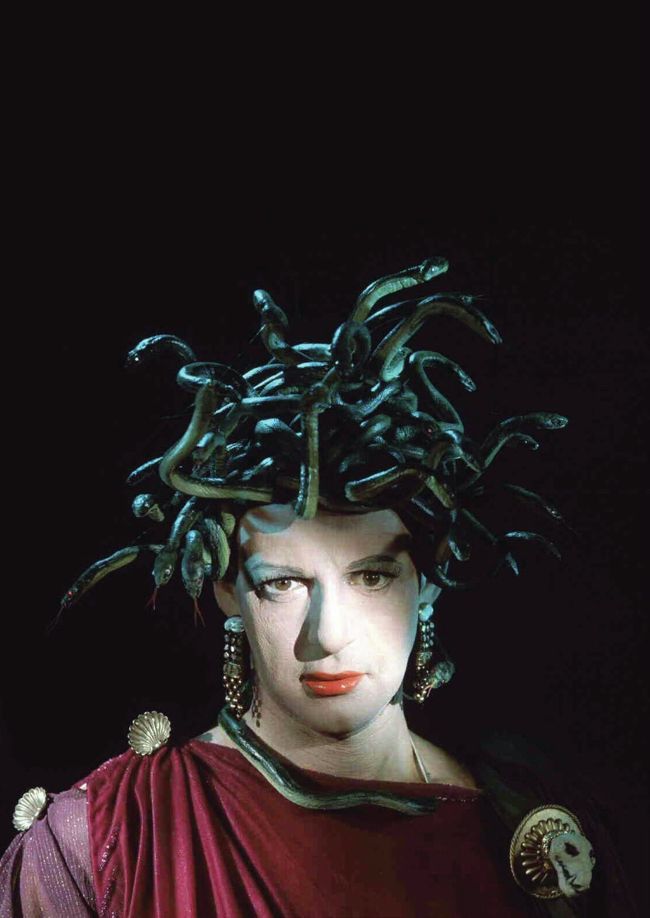
Tony Randall as Medusa. Randall shaved his head for the role of Dr. Lao. It also made it easier to apply the make-up for the different characters he played
Producer/director George Pal had something of a reputation for taking on film projects that were a little unusual, and also of not trying to repeat past successes. He tried it once, when he made the 1955 film Conquest of Space, in an effort to capture a little of the magic of his first excursion into science-fiction, Destination Moon (1950), but although the film was visually impressive, it didn’t capture the imagination as much as the earlier film. Moreover, the poor critical response brought to an end his association with Paramount Pictures, that had begun with signing a deal to distribute the Pal Puppetoons in 1940 then resuming with When Worlds Collide (1951) and continued with the very successful War of the Worlds (1953), Houdini (1953) and The Naked Jungle (1954). It would seem that the executives at Paramount had short memories.
It was only because Pal promised MGM that he could bring in his longtime pet project, tom thumb (1958), at a less-than-expected budget by filming in the U.K., and producing a critically and financially successful film, that a new partnership began.
This subsequently resulted in the classic and very profitable, The Time Machine (1960), then the problem-ridden Atlantis, The Lost Continent (1961) and was followed by one of the two dramatic stories presented in the original 3-strip Cinerama, The Wonderful World of the Brothers Grimm (1962) (the other being How the West Was Won, released the same year). This last film was a massively expensive and a technically difficult undertaking, which despite becoming one of MGM’s top-grossing films of the year, the complex filming and presentation issues (the visible joins were never completely conquered) proved to be the end of dramatic storytelling in the 3-strip format.
A casual glance at Pal’s cinematic history reveals that he had many more unrealised projects than were actually made. What stands out in the list of what-might-have-beens is the diversity of the subjects, so it shouldn’t come as any surprise that his follow-up project to Brothers Grimm is quite unlike anything that had come before.
The story that formed the basis of 7 Faces of Dr Lao (1964) was brought to Pal’s attention by one of the scriptwriters on the previous film, Charles Beaumont. Pal, instinctively asking the writer if there were any story ideas that he thought would make good cinematic material, was not only instantly answered with The Circus of Dr. Lao, written in 1935 by the fairly obscure novelist, Charles G. Finney, but that he had already completed a script.
The oft-quoted advice to any writer to ‘write about what you know’ was never more true than with Charles G. Finney, who not only drew from his time serving with the United States 15th Infantry in Tientsin, China, but also the area he called home, Arizona. Most of his literature centres around the two places. The original Lao story was set in the contemporary period to when written in 1935, with the Beaumont script following this concept by setting the story in the then present day (the early 1960s) America. This was something that Pal would quickly change to an earlier part of the century.