BEYOND QUATERMASS
Nigel Kneale is still best-known for his Quatermass serials, but there was so much more to his screen work that often bridged the gap between the supernatural and the scientific, as Brian J. Robb reveals…
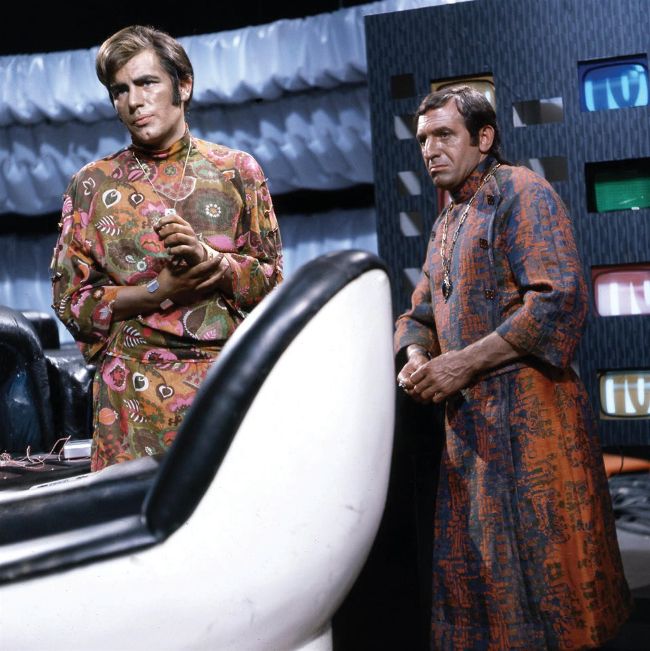
Main image:
Brian Cox and Leonard Rossiter, in
The Year of the Sex Olympics
(1968)
Opposite: Author Nigel Kneale
For many, the career of screenwriter Nigel Kneale can be handily summed up in just two words: Professor Quatermass. It’s a neat shorthand, but there was so much more to Kneale’s output—even only considering his fantasy, horror, and science fiction credentials. That trio of ahead-of-theirtime thriller serials featuring Bernard Quatermass and the exploits of the British Rocket Group initially made Kneale’s name.
Broadcast on the BBC between 1953 and 1959, the three serials—The Quatermass Experiment (1953), Quatermass II (1955), and Quatermass and the Pit (1958-59)—had a huge impact. All three were adapted as feature films by Hammer, and the story was rounded out with a belated 1979 finale in Quatermass (AKA The Quatermass Conclusion, screened both as a four-part television serial and in cinemas as a 100-minute movie). Long before that final Quatermass (there was also a live version of The Quatermass Experiment broadcast in 2005), Kneale explored various haunting scenarios, the existence of the Yeti, the exploration of the moon, and even predicted the rise of ‘reality’ television. There was in fact much more to Nigel Kneale than just Professor Quatermass.
Thomas Nigel Kneale was born on 28 April 1922 (the same year the BBC was created) in Barrow-in-Furness, but his family came from the Isle of Man and they returned there in 1928 when Kneale was just six. His father was a journalist and editor of the local newspaper, The Herald, in the capital city of Douglas. After his schooling, Kneale set out to become a lawyer but ultimately abandoned that. He attempted to join the Army at the advent of the Second World War, but was deemed unfit for active service. Kneale turned to writing, and had his first success in 1946 with BBC Radio. He tried his hand at acting and had short stories published. Known as Tom to friends and family, Kneale adopted ‘Nigel Kneale’ as his screen credit.
His writing career took off, largely thanks to his 1949 collection Tomato Cain and Other Stories (which won the prestigious Somerset Maugham Award for writers under 35). In 1954 he married fellow writer Judith Kerr (she died in 2019, aged 95) and the pair would go on to have two children.
Kneale focused on the new medium of television, and was recruited as part of the first intake of staff writers for the BBC. His earliest efforts in the early-1950s saw Kneale function as a jack-of-all-trades writer, adapting books and theatre works for the new small screen medium, as well as dipping his toes into general entertainment and work aimed at younger audiences. Kneale was a natural writer for television, but he was increasingly frustrated by the way the BBC operated, believing that the output lacked visual ambition, aspiring to be little more than televised theatre. Collaborating with director Rudolph Cartier, Kneale set out to show what the new medium could achieve in the field of drama. The result was the critically acclaimed and widely watched The Quatermass Experiment, produced to plug an unexpected gap in the Saturday night schedules.
ENTER BIG BROTHER
After working with Cartier again on a television version of Emily Bronte’s Wuthering Heights (1953) as part of the BBC’s Sunday Night Theatre strand, the pair turned to adapting George Orwell’s controversial dystopian novel Nineteen Eighty-Four (1954, itself influenced by Orwell’s experiences at BBC Radio). It was the success of the Quatermass serial that prompted the BBC’s Head of Drama Michael Barry to assign the pair to Orwell’s novel, purchased by the BBC for adaptation shortly after publication in 1949. No one had yet cracked the script, but Kneale was able to deliver a 100-minute teleplay fairly quickly. Cartier proceeded with casting, lining up Peter Cushing as Winston Smith, Donald Pleasence as Syme, and Yvonne Mitchell as Julia, with future Quatermass (in the BBC’s Quatermass and the Pit) Andre Morell as O’Brien.
Broadcast live—with filmed inserts shot on location—on 12 December 1954, the play was controversial, resulting in viewer complaints about scenes of horror (as when Winston endured the horrors of Room 101) and saw questions raised in Parliament as to whether Orwell’s work was suitable material for home viewing on television as it ‘pandered to sexual and sadistic tastes’.
Partly in an act of defiance and partly to capitalise on the controversy, the BBC remounted the live production on 16 December—it was this second, more polished performance that was captured on 35mm film and can be seen today, preserved as one of the earliest examples of British science fiction television drama. The 1954 original wasn’t seen again until 1977 (a new production had been screened in 1965), while a planned 1986 rebroadcast for the BBC TV’s 50th anniversary was nixed by the producers of the 1984 John Hurt-starring feature film version. It later appeared on BBC2 in 1994, and most recently in 2003 on BBC4.
Unlike Nineteen Eighty-Four, Kneale’s 1955 play The Creature— broadcast as part of the BBC’s Sunday Night Theatre—no longer exists in the archives. Inspired by the 1953 ascent of Everest by Edmund Hillary and his team as well as a following 1954 expedition sponsored by the Daily Mail to the Himalayas in search of the elusive Yeti, Kneale speculated about what might be found there. Kneale pitched two members of a similar newspaper-sponsored trek against one another, with Dr. Rollason (Nineteen Eighty-Four’s Peter Cushing) approaching things from a scientific point of view while mercenary Tom Friend (Stanley Baker) is simply out to ‘bag’ a Yeti, like a big game hunter. In titling his work The Creature, Kneale made it ambivalent who he was referring to—the elusive Yeti, or the selfish humans determined to track down the shy and retiring ‘monster.’