GROWING
THE 3 WORLDS OF GULLIVER
Mike Hankin enters The 3 Worlds of Gulliver and revisits Ray Harryhausen’s 1960 screen version of the classic Jonathan Swift tale...
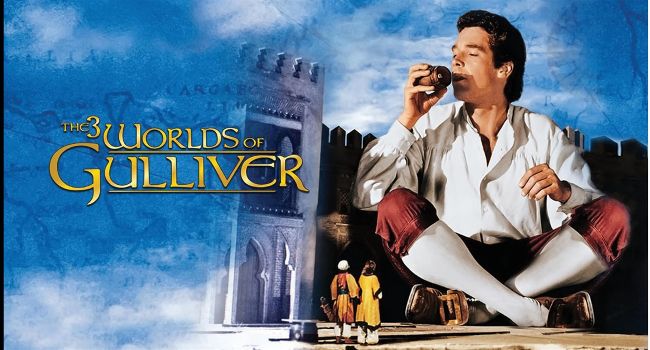
Kerwin Mathews as Gulliver. Andrew Keir played his father in Hammer’s The Pirates of Blood River (1962), even though Mathews was three months his senior in real life!
The 3 Worlds of Gulliver tends to come some way down the list of most fans’ favourite Harryhausen film, but for producer Charles Schneer and special effects creator Ray Harryhausen this production was a life-changer. The enormous success of The 7 thVoyage of Sinbad (1958) had woken Columbia’s executives to the potential of the Schneer and Harryhausen partnership and so began to look for new projects for them. Two had been under consideration at the studio, a version of Jules Verne’s 1875 novel, Mysterious Island, because of the growing interest in the author’s works, and Jonathan Swift’s 1726 satire, Gulliver’s Travels, both of which were passed on to Charles Schneer for consideration.
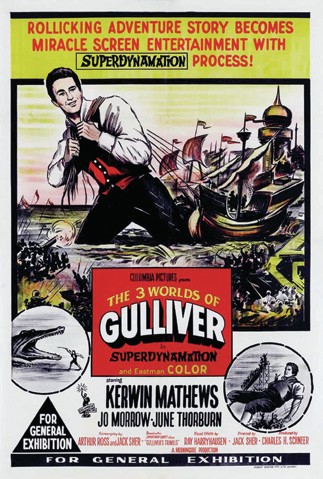
The Gulliver story, with the initial script written by Arthur Ross, had been in development as a TV project at NBC, then at Universal Studios. Even after considering the use of inexpensive perspective photography, developed in Europe by Eugen Shüftan (an incamera effect using a deep-focus lens, for which the person to appear large is close to the camera and those wanted small can be up to 200 feet in the distance), the perceived cost of the extensive effects work and the building of large-scale props made the project stall.
Writer Jack Sher became attached to the proposal and took the idea to Columbia, where producer Bryan Foy initially showed interest. With thoughts of converting the story into a musical vehicle for star, Danny Kaye, Foy went as far as commissioning two songs from George Dunning and Ned Washington, What a Wonderful Fellow is Gulliver and Gentle Love, but with Kaye dropping out very quickly, Foy’s interest soon waned, although the songs would remain with the project.
I think it is fair to say that a lot of people believe they know the story of Gulliver’s Travels, of him being shipwrecked on the island of Lilliput and meeting its diminutive inhabitants.
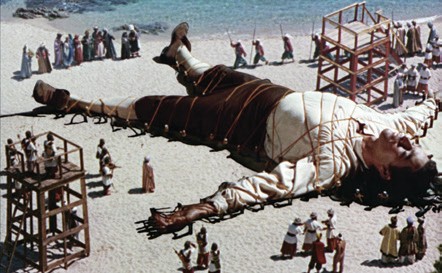
Gulliver is washed ashore on Lilliput, a land of tiny humans who see him as a threatening giant. The Lilliputians are afraid of Gulliver and tie him down with stakes to the beach, but he eases their fears by performing several acts of kindness
This idea is often based on the filmic, simplified view of Gulliver’s journey. This is hardly surprising, as the Russian-made The New Gulliver (1935), with a live-action actor and hundreds of model-animated figures, concentrated on the Lilliput episode, as did the 1939 Fleischer Brothers cartoon film, Gulliver’s Travels.
The instantly forgettable 1977 musical mixture of live-action and drawn cartoon, Gulliver’s Travels, with Richard Harris, did conclude with a brief appearance of a giant Brobdingnagian, but there would be no continuing adventures. It was only the 1996 TV mini-series with Ted Danson and Mary Steenburgen that covered the whole story. Yet, without seeing this TV version or reading the original book, the average person is unaware of the hero’s adventures in the land of the large people, the Brobdingnagians, the flying island of Laputa, the University of Weird Science, the Island of the Magicians, or the talking horses, the Houyhnhnms and the savage, human-like Yahoos.