THE BR UTA LIST.
DRUTE FORCE
FOR YEARS, BRADY CORBET HAS BEEN CHIPPING AWAY AT HIS AUDACIOUS ARCHITECTURAL EPIC, AS HE AND HIS CAST TELL US, MAKING IT WAS AN APPROPRIATELY MONUMENTAL TASK
WORDS JOHN NUGENT
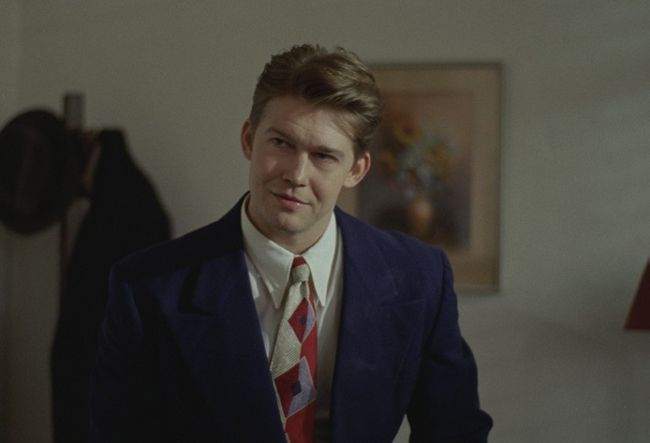
Left:
Capitalist Harrison Lee Van Buren Sr (Guy Pearce) and, below, his entitled son Harry (Joe Alwyn).
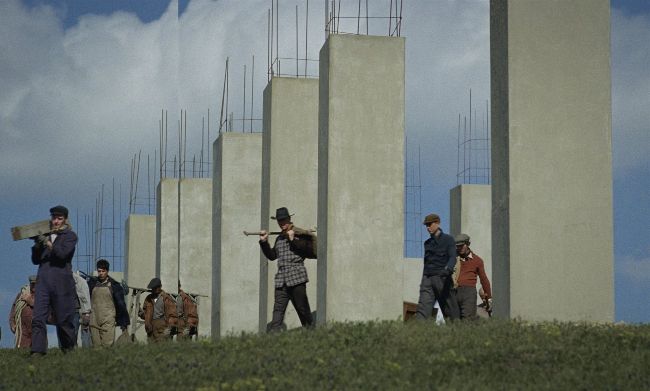
Main:
The Van Buren community centre starts to take stark shape.
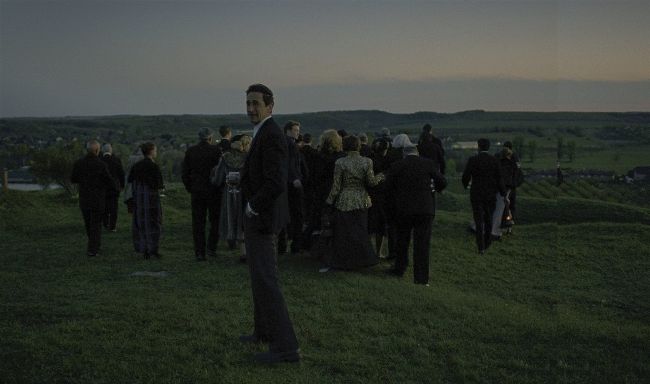
Right:
A new horizon.
“There are so many parallels,” says Brady Corbet, “between making a film and building a building.”
Films, like buildings, are big endeavours. They can often be miraculous undertakings, sometimes ruinously expensive, demanding a unique mix of an artist’s vision and a wealthy benefactor’s wallet. Their creation can require a leap of faith. But they also tell us much about ourselves, and the time in which they were made.
Nearly a decade ago, Corbet began construction on his biggest project to date: The Brutalist. Set between 1947 and 1980, the 215-minute film —which includes a 15-minute intermission —tells the story of fictional architect László Tóth (Adrien Brody), a Hungarian Jew who escapes war-ravaged Europe to seek a new life in the United States. Fleeing fascism, he instead encounters capitalist corruption in the form of millionaire patron Harrison Lee Van Buren (Guy Pearce), who enlists him to create a community centre in his small Pennsylvania neighbourhood. Soon, inevitably, the American dream curdles. It is a film as ambitious as a skyscraper. Even Corbet himself struggles to pin it down.
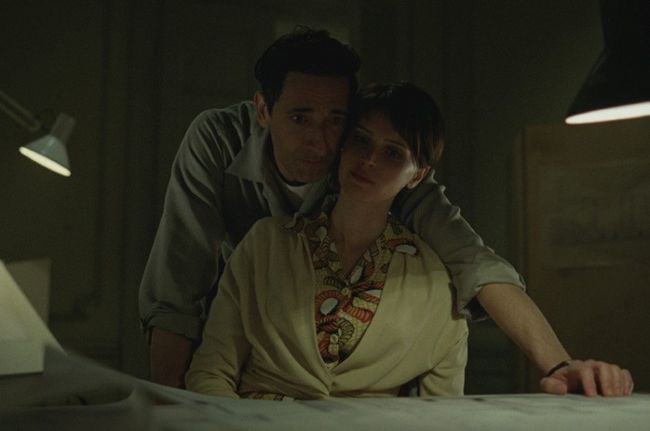
Above:
László Tóth (Adrien Brody) and wife Erzsébet (Felicity Jones).
“I had wanted to do a film on the artistpatron dynamic,” he explains of the initial impulses that set him and his co-writer (and wife), Mona Fastvold, on this journey. “We were interested in architecture. We were interested in making a movie about the creative process. We were thinking about immigration stories. And we were interested in writing something about a relationship that weathers all of the professional and personal chaos of a lifetime.” He ponders it all. “This film is a sort of an opera. Taken to mythological heights.”
Not exactly modest ambitions, then. But the gambit appears to have paid off. The reactions since the film’s Venice Film Festival premiere back in September have been nothing short of extravagant. So what is it about this three-anda-half-hour independent film about architecture that has people tripping over themselves to offer effusive praise? And what does it tell us about ourselves?