THAT MAN BOLT
Doug Young interviews his uncle, Derek Young, who shot to fame -literally - as Bernie the Bolt on the classic Bob Monk-house game show, The Golden Shot!
“Up a bit……down a bit…… left a bit…..fire !” and “Bernie, the Bolt” will be two phrases only too familiar to readers of a certain age who would have enjoyed tuning into the ATV hit prime time “live” television game show
The Golden Shot
, which was on our TV screens for 6 seasons and over 300 episodes between 1967-1975; at its peak it regularly attracted 16 million viewers.
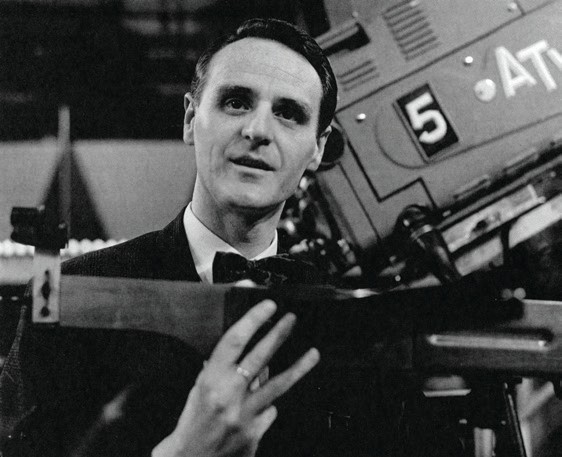
Bernie as he is today
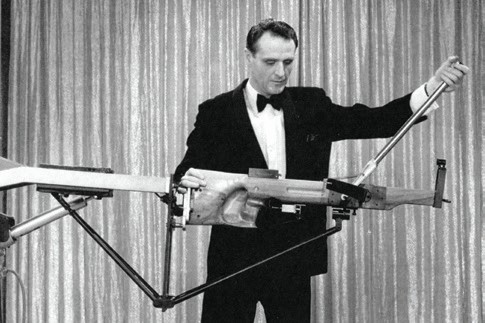
The premise of the game was for contestants to operate, via various means, a stand-mounted high powered crossbow firing metal tipped “bolts” at targets in a number of rounds to see who would get the chance to have a go at winning the big prize at the end of each show.
The operating methods included the contestants using the crossbows for themselves, or via a remote control device linked to a television monitor or by giving verbal instructions to a blindfolded crossbow operator via a phone link.
They would be aiming at targets, both moving and static, mounted on amusing cartoon style backgrounds, which in the early days of the show were based on drawings by host Bob Monkhouse. The most fondly remembered targets would have to be the apple, which if hit dead centre would explode, and the final target which required that show’s winning contestant to cut a fine wire running through the middle of a target releasing a treasure chest full of ‘gold’ coins which would cascade to the floor.
Today the first prize of £500 plus £100 of Premium Bonds might sound rather stingy, but back in the late 60’s that was a very significant amount, since the average annual income of a manual worker was around £1200.
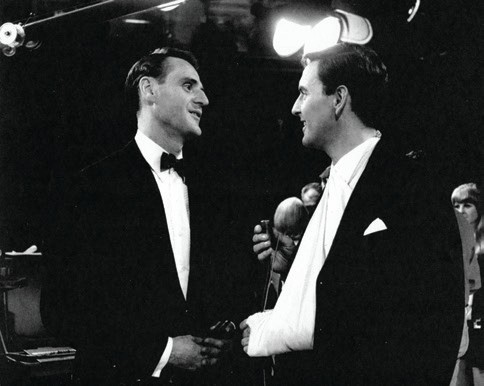
With Bob Monkhouse on The Golden Shot - and the actual bolt!
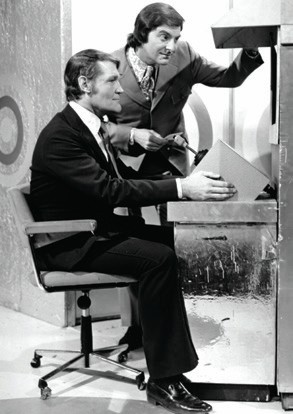
Bob Monkhouse with Patrick Allen
Some of the lesser prizes awarded to losing contestants as the rounds progressed included £20 for failing to cut the wire to the treasure chest, holidays, a water bed, bunk beds, circular beds, tea services, portable TVs, radios and a record player with four albums! When The Golden Shot started I was seven years old but I only started watching the show when my parents told me that my Uncle Derek (my late father’s younger brother) would be appearing on the show every weekend in the guise of Bernie the Bolt. Looking back on it, my childhood was very special as apart from my Uncle being on the telly, my dad was a Pathe News cameraman who covered all the major world and sporting events you could care to name during the 1960s including NASA’s early manned missions, the 1966 World Cup, Royal tours and occasions, flying in formation with and filming the fledgling Red Arrows, going on board the UK’s first nuclear submarine and filming the Beatles in concert and backstage.
What follows is the first in depth interview that my Uncle Derek has ever given regarding his time working on The Golden Shot and in which he explains how he became Bernie the Bolt.
Please tell me about your early career and how you came to work in television, and also how you became involved with special effects ?
I left school aged sixteen in 1948 and worked as a trainee electrician until I saw an advert for a probationer projectionist at the Palladium cinema in Ealing in West London, which I applied for and got. Over time I progressed to being in charge of the projection room and, being an ambitious young man, I then pursued a career as a cinema manager as the promotional side of that role really appealed to me.
I went through the Rank training system and got my first post in Liverpool before moving back down south after I got married. Whilst I enjoyed the job the extremely long hours and irregular meal times took a toll on my health, which led to me having to resign.
I then returned to being a technician and joined the film department at Shepperton Studios as a projectionist showing rushes and working on post-synch sessions, music and effects recording, and also the final dubbing of the picture. I then had an offer via a contact for a higher paid job in the West End (of London) in newsreel and dubbing at a small recording studio where we recorded commentary, music and effects on magnetic film and then dubbed and transferred it onto optical film for processing at the labs. This was mostly for TV, cinema adverts and documentaries.
Leggete l'articolo completo e molti altri in questo numero di
Infinity Magazine
Opzioni di acquisto di seguito
Se il problema è vostro,
Accesso
per leggere subito l'articolo completo.
Singolo numero digitale
Issue 86
Questo numero e altri numeri arretrati non sono inclusi in un nuovo
abbonamento. Gli abbonamenti comprendono l'ultimo numero regolare e i nuovi numeri pubblicati durante l'abbonamento.
Infinity Magazine
Abbonamento digitale annuale
€29,99
fatturati annualmente