Dream On!
Acid, improv, cosmic coincidences and an attempt to assassinate Richard Nixon via telekinesis - all in a nacht's work for Tangerine Dream, the biggest band of Germany's '70s sonic revolution. As the prime movers in the group's rise tell Christoph Dallach in his new Krautrock oral history, "Anything could happen at any moment."
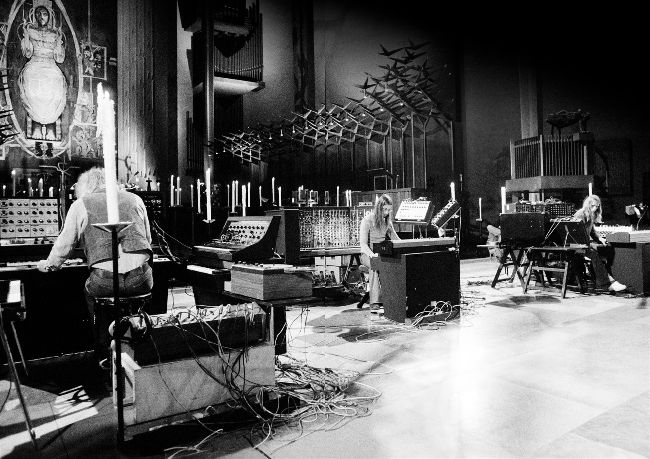
Holy communion: Tangerine Dream (from left) Edgar Froese, Christopher Franke and Peter Baumann performing at Coventry Cathedral, Warwickshire, October 4, 1975.
Photograph: Michael Putland
ON WEST BERLIN’S LATE-’60s SCENE, where left-field musicians gathered to smoke weed and blow minds at Kreuzberg’s Zodiak Free Arts Lab, burly, moustachioed guitarist Edgar Froese cut a forbidding figure. Between 1965 and 1967 he had led beat group The Ones, but moved between psych and jazz into free rock as early line-ups of his Tangerine Dream waxed and waned.
The first TD album, 1970’s Electronic Meditation, featured Froese, drummer Klaus Schulze and multi-instrumentalist Conrad ‘Conny’ Schnitzler, and alternated meditative balms with intense pile-ups of guitar and organ. As the ’70s progressed, Froese’s group replaced their more conventional instrumentation – notably, the organ of Steve Schroyder, then Peter Baumann – with electronics, pioneered initially by drummer Christopher Franke. Their albums on the German Ohr label, and then Virgin Records, grew the band into a surprise fixture in the higher reaches of the UK charts – where their 1974 classic Phaedra peaked in the Top 20 – as they became synonymous, along with Kraftwerk and Jean-Michel Jarre, with the cutting edge of electronic music.
What was epic in their sound suited unconventional live music spaces, and some of the band’s most talked-about shows in the early to mid-’70s were in places of worship, the cathedrals of Reims, York, Liverpool and Coventry. In the ’80s and after (Franke left after 1987’s Tyger LP), Tangerine Dream retained an avid audience, and continue even now with a line-up (Thorsten Quaeschning, Hoshiko Yamane and Paul Frick) endorsed by Edgar Froese, who passed in 2015.
However, the Tangerine Dream chapter of Christoph Dallach’s Neu Klang book, from which the following is extracted, concentrates on the group’s 1968-75 phase, when ‘the Tangs’ were at their most ground-breaking, culturally impactful and, frankly, bananas.
Jean-Michel Jarre: I once had a debate with Edgar Froese about which of us had started making electronic music first. I was certain Tangerine Dream came before me but Edgar said it was me, and Tangerine Dream had still been playing prog rock at the time when I was already working electronically. It was a funny argument – neither of us wanted to have come first.
Irmin Schmidt (Can): I went out with a schoolfriend in Berlin one time, the painter Peter Sorge. One night he dragged me along to the Zodiak, said there was a great group there, the musicians all completely barmy, and the guitarist in particular was amazing. So we head over, sit around there for ages, and nothing happens. Someone kept coming and saying they’d be starting any minute now. But then it was a good hour before Edgar Froese came on stage on his own with a guitar and made this grumpy announcement: “My band’s left me. I’m gonna play on my ownsome!” And then he played guitar all alone for two hours, the wildest free rock, really getting his anger out. I was incredibly impressed. Afterwards we had a bit of a chat but he was still far too angry for a long conversation. That was at the end of 1967, and then we lost track of each other for a while. Then when I had the idea to start Can and was thinking about guitarists, the first one that came to mind was Edgar. But before I could make contact, Holger [Czukay] suggested Michael Karoli as a guitarist. I met Michael and was really into him right from the first second. But it would have been exciting with Edgar Froese as well. Then there wouldn’t have been any Tangerine Dream, and Can would have turned into a very different band.
Klaus Schulze (TD drummer): [Conrad] Schnitzler and I used to have day jobs with the post office, delivering telegrams to pay the rent. Edgar was still painting buses at the time, painting ads on them; he’d studied graphic design. Everyone in Tangerine Dream had day jobs. You’d get DM50 a night for playing in small clubs like the Magic Cave or the Silver Apple, and you couldn’t live on that, even in Berlin. We never even thought of being commercial, because then we’d have had to adapt our music and there was no way we wanted to do that.