IT
  
Attualmente si sta visualizzando la versione Italy del sito.
Volete passare al vostro sito locale?
3 TEMPO DI LETTURA MIN

News & Views

What explains the bright colouration of tarantulas?
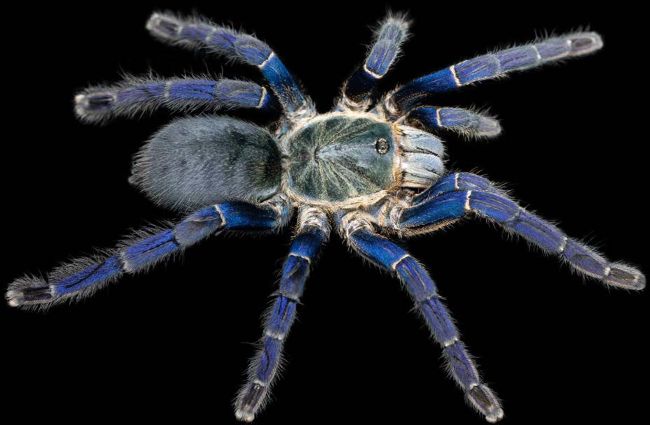
A cobalt blue tarantula (Hapolpelma lividum), with brilliant cobalt blue hair-like setae on its legs.
Image provided by Bastian Rast.

Just why are some tarantulas so vividly coloured? Scientists have puzzled over the possible reasons that these large, hairy spiders, which are active primarily during the evening and at night-time, would sport such vibrant blue and green colouration - especially as they were long thought to be unable to differentiate between colours, let alone possess true colour vision.

Now however, researchers from Yale-NUS College and Carnegie Mellon University (CMU) in the USA may well have solved this puzzle: their conclusions are that these vibrant blue colours may be used to communicate between potential mates, while green colouration confers the ability on these tarantulas to conceal themselves amongst foliage.

Leggete l'articolo completo e molti altri in questo numero di Practical Reptile Keeping
Opzioni di acquisto di seguito
Se il problema è vostro, Accesso per leggere subito l'articolo completo.
Singolo numero digitale Issue 130
 
€4,99 / issue
Questo numero e altri numeri arretrati non sono inclusi in un nuovo abbonamento. Gli abbonamenti comprendono l'ultimo numero regolare e i nuovi numeri pubblicati durante l'abbonamento. Practical Reptile Keeping
Abbonamento digitale annuale €39,99 fatturati annualmente
Risparmiare
33%
€3,33 / issue
Abbonamento digitale di 6 mesi €21,99 fatturati due volte l'anno
Risparmiare
27%
€3,66 / issue
ABBONAMENTO ALLA STAMPA? Disponibile su magazine.co.uk, la migliore offerta di abbonamento a una rivista online.
 

Questo articolo è...


View Issues
Practical Reptile Keeping
Issue 130
VISUALIZZA IN NEGOZIO

Altri articoli in questo numero


Practical Reptile Keeping
Welcome
Putting this issue together, I seem to have been experiencing
Regulars
Major revision of reptile evolution
Featuring stories this month about remarkable insights
Climate change threatens the Komodo dragon
The world’s largest lizard, the Komodo dragon (Varanus
Killer disease more widespread than previously thought
In a major collaborative effort between scientists
Early snake bonds in Egypt
Three mummified animals from ancient Egypt have been
Genetic data vital to save endangered species
In parts of southeast Asia, illegal wildlife trafficking
New butterfly found within the Arctic Circle
An isolated population of the rarest Palaearctic butterfly
Rattlesnakes relatively unaffected by the cold
Most reptiles move more slowly when temperatures drop
Korean wasp gives hope for new antibiotic treatments
A team led by scientists in the Perelman School of
Evidence of a megapredator
Some 240 million years ago, a dolphinlike ichthyosaur
Lighting Corns
Email your queries to practicalreptilekeeping@gmail.com.
Looking for smaller boas?
Please advise on smaller boas that we could keep, as
Breeding advice for small boas
Can you give me some advice on breeding smaller boas
AMPHIBIAN IN FLIGHT
When award-winning photographer Stephen Dalton began
The digestive system of snakes
Given their tube-like body shape, snakes have had to undergo some pretty radical adaptions to their anatomy in order for them to survive and thrive in this state. Unsurprisingly, their digestive system is no exception to this rule, as Paul Donovan explains.
Whatever happened to the migo? The monster of Lake Dakataua
In his column this month, Dr Karl Shuker investigates strange reports of an unidentified large creature from a remote lake on a Pacific island.
YOU & YOUR Reptiles
I f you have a favourite photograph of one of your
SUBSCRIBE ONLINE TODAY!
ALSO EVERY BACK ISSUE AVAILABLE
NEW THOUGHTS ON LEOPARD GECKOS
John Courteney-Smith MRSB looks at recent advances
Features
help fellow enthusiasts!
Just as the veterinary care of reptiles has advanced significantly over recent years, so have the diagnostic tools available, to prevent, identify and treat cases of illness. David Alderton investigates this vital yet often rather overlooked area, and acquires some useful practical tips.
Insights into the leopard gecko
John Courteney-Smith MRSB of Arcadia Reptile looks at what we know about the universally popular leopard gecko from the wild, and how this information can be best utilised to care for these lizards in vivarium surroundings.
How to keep turtles properly
In the past, pond sliders in the guise of the related yellow-bellied and red-eared (Trachemys scripta) were commonly kept, but other more suitable species are now available. Always check the likely adult size of any turtle that appeals to you, before acquiring it as this is a very important consideration.
Sticks on fire
Not all stick insects are muted shades of green or brown, but bright colours signal danger, as shown by the case of the Peruvian fern stick insect. Ed Baker reports.
A year in the life of a tortoise
Dr Joanna Hedley, BVM&S, DZooMed (Reptilian), DECZM (Herpetology), MRCVS outlines key issues to bear in mind as the seasons change.
Magnificent milksnakes
Their vivid natural colouration ensures these snakes have a beautiful appearance, of the type that breeders of colour morphs in other genera crave. Better still, milksnakes are relatively inexpensive and not difficult to look after, as enthusiast Holly Brigden explains.
Fruit beetles
These beautiful beetles make an ideal introduction to keeping invertebrates, particularly for children, and also have plenty to offer the specialist too, as Paul Donovan explains.
Chat
X
Supporto Pocketmags