RAILWAYS ABROAD
THE STREETS OF SAN FRANCISCO
Still climbing ‘halfway to the stars’, San Francisco’s cable cars have survived natural disaster and political animosity to reach their 150th year, as Tom Ingall reports.
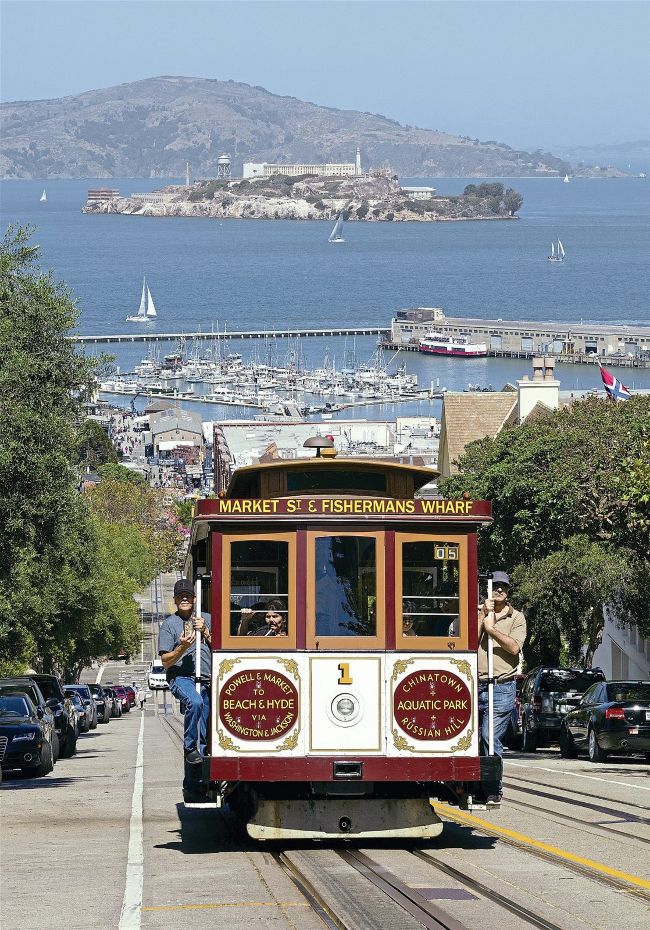
A classic view of San Francisco on September 4, 2016, as cable car No. 1 climbs Hyde Street away from Beach Street with Hyde Pier and Alcatraz Island in the background.
THOMAS WOLF (CC BY-SA 3.0
)
SAN Francisco has an eclectic mix of ways to get around: buses and trolley buses, light rail and metro trains, vintage trams, and even driverless cars. But the city’s distinctive cable cars have – quite literally – climbed above all others to attain iconic status, and this year sees them notch up 150 years of operation.
The cable cars are used more by tourists than commuters, becoming an international symbol of the city as all good public transport should – much like London’s Tube and roundels, except Tony Bennett never crooned about the Northern Line.
In 1889, Rudyard Kipling sailed in from India through the (yet to be bridged) Golden Gate strait, and one of first observations upon disembarking was: “I proceeded till I found a mighty street… Here a tram-car, without any visible means of support, slid stealthily behind me and nearly struck me in the back. This was the famous cable car of San Francisco, which runs by gripping an endless wire rope sunk in the ground.”
I immediately need to dispute the great writer. The cable cars generate far too visceral a rattle to be considered ‘stealthy’. Their bells are as synonymous with the Bay City as its fog horns and, seemingly, just as loud. They clatter through the streets and, even when out of sight, the hum of the cable, inches below road level, is ever present.
The experience vibrated into the bones of today’s rider would be instantly recognisable to millions of passengers over decades past. You can still sit sideways to the direction of travel, on an open bench unencumbered by the comfort of a partition between you and the street flashing past. The brave can hang onto an upright pole, standing on a footboard. The top speed of 9.5mph (the rate the cable moves) sounds sedate until you are tilting up and down, as if possessed by a malevolent switchback.
“Hallidie’s cable cars are an anachronism, not just persisting but thriving after a century-and-a-half”
At the front, the ‘gripman’ must orchestrate control seemingly from chance, throwing heavy levers back and forth, standing above an open hole, keeping one step ahead of the permanent way. The cable beneath might always be moving, but there are stops to make, heavy traffic to work around and line crossings and curves to be coasted through.
In short, the whole thing is a quixotic, thrilling delight.
The story begins in the mid-1800s. Andrew Smith Hallidie was born in London, the son of a Scot who held a patent for wire rope (thin strands of wire wound together to make a thicker cable). Father and son emigrated to California where the younger man was involved in mining, bridge building and pioneering aerial ropeway technology, before establishing a wire rope manufacturing business in San Francisco. These were heady days when the gold rush was busy transforming the city.

The logo marking 150 years of San Francisco’s cable car system this year.
Right man, right place, right time
It is said that in 1869, Hallidie witnessed horses being whipped and struggling to haul a streetcar, uphill over wet cobbles before slipping and being dragged to their death. Whether fanciful or not, Hallidie was a man with the right expertise in the right place. Just four years later on August 2, 1873, he and engineer William Eppelsheimer began trials of their cable-hauled streetcars, the cable being driven by a stationary steam engine in a remote powerhouse. The Clay Street Hill Railroad opened to the public a month later. At a little over half-a-mile in length and running dead straight, it might have been modest but was quickly a success. It was to inspire others at home and around the world.