Take three colours
Learn how to work with a limited palette before depicting stonework, trees, rocks and reflections in a single painting, by Stephen Coates
LEARNING OBJECTIVES
■ How to represent stonework
■ Paint the reflection of an archway in water
■ Paint highlighted rocks and simple silver birch trees
JARGON BUSTERS
• A mix is a combination of two pure pigments of colour to create a new colour. Adding water to a pure colour doesn’t create a mix, but a wash.
• A wash is simply a mixture of water and paint – the more water in the pure paint or mix, the weaker the wash.
I used three tubes of paint for the following demonstration painting: light red, raw sienna and ultramarine blue. The chart (right) shows how different shades can be created from these three colours. Light red is extremely strong and should not be used as a base colour; instead, it should only be used as an ‘additive’ – added to the base colour. Raw sienna and ultramarine blue are always the base colours for mixing.
Follow the chart to mix the colours you will need. For example, greens are mixed using raw sienna as the base colour; ultramarine blue is then added in differing quantities to achieve different shades of green.
Prepare your palette
Before you start, make sure you have all the colours ready for each stage of your painting. Mix plenty of paint. It is better to have a bit left over than to have to stop painting halfway through a stage to mix more. For example, if you are halfway through a sky and you run out of paint on your palette, you simply won’t have time to mix any more before your sky dries – disaster! LP
TIP
Raw sienna can vary in shade from one brand to another, and sometimes can be darker in colour. If yours looks darker than the one shown here, you may need to use yellow ochre instead.
WATER AND FLUIDITY
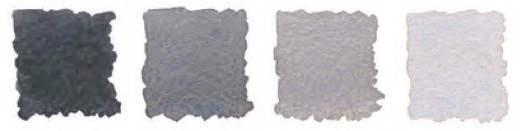
Adding water to grey mix
Whether you are using a pure watercolour directly from the tube, or have created a mix, the amount of water in it will determine its fluidity and shade. In the example above, the grey swatch on the far left has a ‘thick’ consistency and has the fluidity described as that of ‘olive oil’. As you add water to it, the colour weakens as the consistency becomes runnier and more of the paper shows through.