Roundup
Raspberry Pi 5 killers
Industrial and professional single-board computer use can be a hairy business. Tam Hanna has seen it all, though, and guides you along.
Raspberry Pi 5 killers WE COMPARE TONS OF STUFF SO YOU DON’T HAVE TO!
Orange Pi 3B Udoo Vision Rock 5B Raspberry Pi 5 Asus Tinker Board R2.0
Tam
Hanna used thousands of SBCs in an automotive application and lived to tell the tale.
Single-board computers are the bee’s knees. Having the power of a full S Unixoid operating system at hand makes many tasks much easier. For example, one of this author’s clients ran not only an advanced text-to-speech system, but also a complex offline navigation system on an automotive system by embedding a process computer into his application.
This, however, is but one of many possibilities. For example, cloud computing costs can be greatly reduced if a process computer is used instead – think of jobs such as the provisioning of network-accessible memory or an issue tracker. While the setup process of the single-board computer might cost a bit of additional time, the complete elimination of hosting fees tends to amortise the outlay in a relatively short period.
Finally, single-board computers can, of course, also be used as a general-purpose workstations for tasks that have few demands for the underlying hardware.
In short, single-board computers can greatly reduce total cost of ownership, not to mention offering various possibilities to play around with a fascinating bit of technology.
This Roundup is looking at alternatives to the venerable Raspberry Pi, which has just received an upgrade. The options can be superior not only in terms of availability, but also in terms of price or advanced features.
HOW WE TESTED…
Selecting the perfect singleboard computer (SBC) is exceedingly difficult. The following test categories were thus somewhat subjective.
However, we attempted to follow best practice as far as possible. We’ve taken the key specification points and tried to assess their useability and performance when deployed in various scenarios. We used the latest available OS build and for benchmarking ran the widely available Sysbench for fully-threaded processor performance and memory bandwidth tests. Where measurements were required, they were taken using by and large the same equipment. Finally, of course, the author’s industry experience was also brought into play. Each process computer was evaluated as though it were to be used in an industrial application intended to control an automotive tracker.
Nevertheless, some level of subjectivity is to be expected – keep your mind alert when reading the following pages in order to find out more about what suits you best.
Total maximum memory capacity
Some process computers provide much more than others…
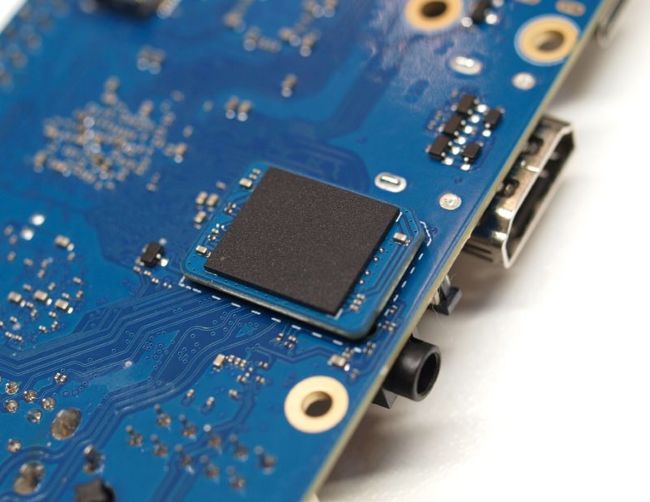
This memory module increases the robustness of the Orange Pi 3B.
emanent memory fulfils two different but interrelated tasks. It is usually responsible for booting the operating R system. This means that its loss – commonly caused by vibration – renders the system unfit for use. The second role involves storing information.