Linux in space! IN-DEPTH
LINUX IN SPACE!
From a shaky start, Linux is becoming much more established in astronautics. Mike Bedford looks at its success to date and its future prospects.
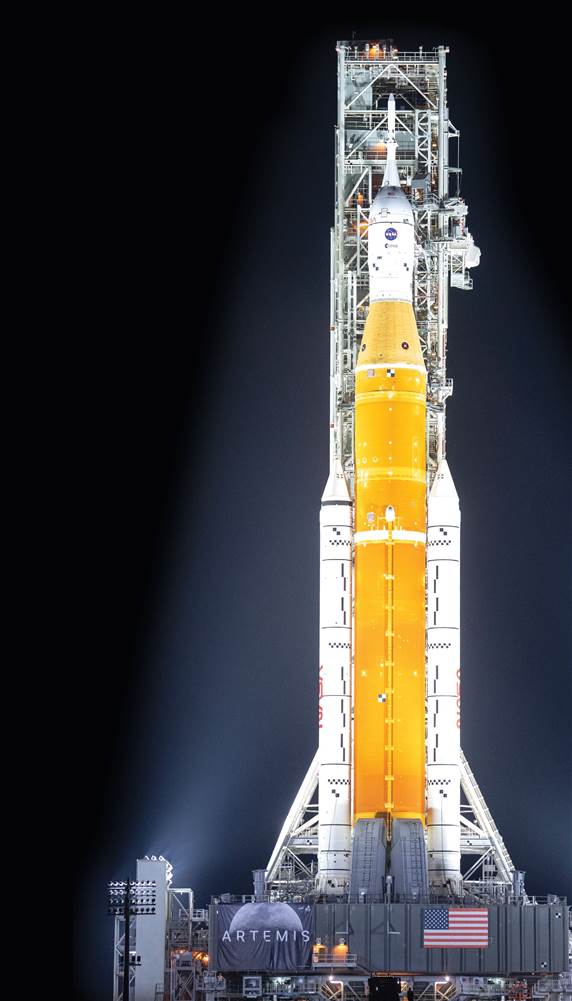
NASA’s upcoming Artemis programme, which will use this SLS rocket, doesn’t have onboard Linux machines, but back on Earth Linux is critical to pre-launch simulations.
Credit: NASA
Why do astronauts use Linux?
Because you can’t open Windows in space. Joking aside, the truth is that the heavens aren’t full of Linux-toting computers. But all that’s changing, so we’ll be looking at how Linux is becoming an important facilitator in space exploration. And that takes us from NASA’s supercomputers here on Earth, through to laptops in orbit on the International Space Station (ISS) and flight control computers on SpaceX’s launch vehicles and spacecraft, to a single board computer empowering a helicopter flying on Mars.
As well as looking at where and how Linux is used in astronautics, we’ll also delve into why it’s used. The migration of Linux into space is a recent phenomenon, though, and it’s still far from universal. So, we’ll also investigate what’s held Linux back in space and, to a significant degree, continues to do so today, and what the prospects are for it to boldly go where no operating system has gone before.
OSes beyond the Earth
We’re going to be looking at where Linux is being used in space exploration. But first we need to consider space-based computing platforms and, in general terms, how they’ve influenced the operating system of choice.
Take, for example, the ISS, which was launched over 20 years ago. With Linux being the new kid on the block back then, it wouldn’t have been given serious consideration, and upgrading now would barely be feasible. Much of the in-built computer hardware wouldn’t support modern distros, and upgrading the hardware and software would be a costly and high-risk strategy.
But even some much more recent space missions have failed to embrace Linux. The Perseverance Martian rover touched down in February 2021 and it’ll continue to explore the Red Planet for quite some time yet. But its main onboard computer uses a PowerPC 750 processor – achip that launched back in 1997. Actually, to be rather more accurate, it uses a variant of the 32-bit PowerPC 750 called the RAD750, and this brings us to a key point. Processors don’t fare too well in space. Because of the radiation they constantly have to endure, they’re much more likely to suffer occasional glitches, or even catastrophic and permanent failures, than their Earth-bound cousins. For this reason, processors used in space are usually radiation hardened to withstand the rigours of life beyond Earth’s atmosphere. These specialist processors aren’t cheap. Reportedly RAD750s cost US$200,000 each – so we can barely imagine how much they cost to develop.