JAMES MARSH
Teri Saccone visits artist James Marsh, whose transformations of the natural world graced Talk Talk’s records throughout their career.
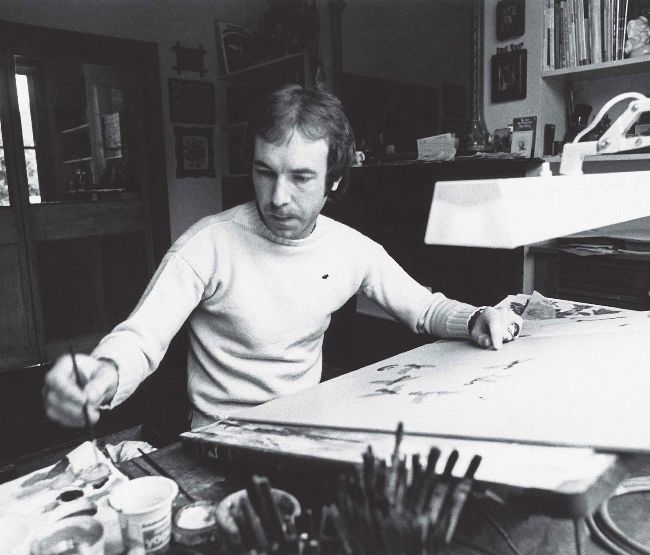
James Marsh in his Iveley Road, London workspace in 1979

James at home in Kent, 2018
A native Yorkshireman, James Marsh began his artistic career in the mid 1960s and continues to undertake varied projects to this day. He has worked extensively across the music, publishing, editorial and advertising industries, and masterfully created Talk Talk’s mesmerising album covers; his quasi-surrealistic depictions of the natural world for the eclectic, indefinable band are a true fusion of sound and visuals.
We speak in Marsh’s spacious studio on the Kent coast. He has a reserved manner, yet is clearly energised by his work: art populates his environs, with assorted sculptures, graphics and paintings adorning the spaces. “My work is all around the house. By living alongside my work, it helps me become more objective about it,” Marsh says. “The house is like a gallery in some respects, not only for my art, but also for the various objets d’art and eclectic items I’ve accumulated over the years. I enjoy surrounding myself with things that interest or stimulate me.”
Marsh’s objective with his art is an emotive one: “I hope to get people engaged with it.” Yet he’s a self-described visual “problem solver”. His career was not heavily strategised. Instead, his path was due partially to a perceptive secondary school advisor. “I didn’t think I was particularly talented at school, as far as art was concerned, but always gravitated towards anything practical, such as woodwork and metalwork. In my final year, a career oficer enquired about what we wanted to do after leaving school. I honestly had no idea whatsoever. He intuitively judged my glazed expression, and after a while, probed about my interests to gain some further insight. So, quite naturally, I mentioned art classes. He must have approached the art teacher, who I’m eternally grateful to, for instigating my enrolment at Batley School Of Art & Design. It later transpired I was the first person from my school to make such a transition. After the first basic year, I opted for the three-year design course over fine art, mainly because it offered more career opportunities.”