GB
  
You are currently viewing the United Kingdom version of the site.
Would you like to switch to your local site?
18 MIN READ TIME

CORONAVIRUS vs. THE GIANT COMPUTER

How Folding@home took time off from curing cancer to tackle a pandemic

Coronavirus doesn’t stand a chance against the might of Folding@home.
© GETTY IMAGES/KATERYNA KON/SCIENCE PHOTO LIBRARY

WHEN THE Maximum PC Illustrated Bumper Book of World History is written, the years 2020 and 2021 will get their own chapter. Not because of politics but because of the global pandemic and shortage of microchips.

Folding@home will probably need a lot of coverage, too—a citizen science project contributing to biochemical research projects that is free to add to and feels extremely cool while you do it (except for the heat it pumps out of your PC case).

There’s not much we can do about the chip shortage, but the pandemic and Folding@home collided beautifully. It led to Folding@home becoming the fastest supercomputer on the planet, hitting one exaflop (a 1 followed by 18 zeros) on March 25, 2020, then peaking at 2.4 exaflops the next month. That’s as powerful as the top 500 (known) supercomputers combined. And that much power folds a lot of proteins.

But why would we want to fold proteins in the first place? Look up any image of one online, and it seems pretty well folded already—all spirals and ribbons, like your little sister’s hair on her birthday. The record was there for the taking, however, so here’s how Folding did it.

FOLDING@HOME is used to breaking records. “Back in 2010, 2012, we had a client on the PlayStation 3,” says Anton Thynell, head of collaboration and communication at Folding. “That’s where we took our first Guinness world record for the world’s strongest distributed computing network, with I think 800,000 PS3s and a couple of hundred thousand PCs. Folding@home has a very strong community, and it’s well known in tech. I think what resonated most, though, is that you can donate your computing power to research. We’re not asking for funding, we’re asking for computing power, and that power is directly connected with the simulations researchers are running.”

Since its launch back in 2000, over 200 scientific papers have been produced as a direct result of Folding@home processing, including one in June this year, published in Nature Chemistry, that announced the discovery of “cryptic pockets” on the surface of the virus that offer targeting options for new antiviral drugs, as well as epitopes—protein fragments that are capable of stimulating an immune response. This is a clear-cut breakthrough, and we dread to think how long it would have taken had Folding not been able to scale up so effectively. The data and models are being made freely publicly available.
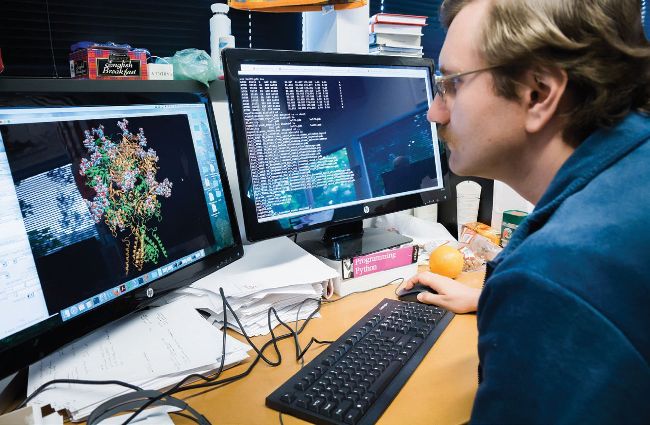
Anton Sinitsky of the Pande Lab, Stanford, works on Folding data.

Protein folding is a complicated thing to simulate—the exascale computer Folding created for its COVID paper managed to simulate just 0.1 second in the life of the virus’s proteome (all the proteins that are, or can be, expressed by a genome)— yet the benefits from doing so are huge. Protein misfolding is a causal factor in a number of diseases, including some cancers, allergies, Alzheimer’s disease, cystic fibrosis, sickle-cell anemia, Creutzfeldt-Jakob disease, and type 2 diabetes. Then there’s the way viruses, including HIV, influenza, and coronavirus, enter our cells—they have a protein on their surface that folds to be like a key, and this attaches to a lock on the surface of the cell, opening it up for infection if the key is just the right shape.

Unlock this article and much more with
You can enjoy:
Enjoy this edition in full
Instant access to 600+ titles
Thousands of back issues
No contract or commitment
Try for 99p
SUBSCRIBE NOW
30 day trial, then just £9.99 / month. Cancel anytime. New subscribers only.


Learn more
Pocketmags Plus
Pocketmags Plus

This article is from...


View Issues
Maximum PC
August 2021
VIEW IN STORE

Other Articles in this Issue


editorial
BUILDING FOR TOMORROW
IT’S DIFFICULT FOR US to really talk about
QUICKSTART
THE NEWS
AMD Starts to Stack
NEW WINDOWS VERSION DUE
WINDOWS 10 GETS AN END DATE, TOO
APPLE STRENGTHENS PRIVACY
© APPLE CORP, WESTERN DIGITAL Hides your IP
Tech Triumphs and Tragedies
A monthly snapshot of what’s good and bad in tech
CHIA BOOM HITS DRIVE MARKET
But mining trashes consumer SSDs
WEBSITES DOWNED BY ONE USER’S CHANGE
Bug crashes Fastly’s network of proxy servers
IBM Sues GlobalFoundries
IBM wants some money back on the promises
AI Chips Design AI Chips
Google is to use AI algorithms to help
Heavyweight Passive Cooling
© FASTLY, GLOBALFOUDRIES, TENSOR, NOCTUA High-end silicon throws
A DLSS Competitor That Works on Any GPU
FOR THREE YEARS, we’ve been talking about Nvidia’s DLSS tech—Deep Learning Super Sampling. The original DLSS 1.0 was a bit lacking, as it was limited in what it could do and required per-game training on Nvidia’s supercomputer. DLSS 2.0 changed the underlying algorithm and made it easier to use, with better results. Now AMD has created a competitor: FSR
Are Hard Drives Set to Return From the Dead?
YES, I KNOW THEY’RE NOT REALLY DEAD. HDDs offer an excellent source of affordable storage. But with SATA SSDs (and even M.2 drives) becoming cheaper and providing comically faster speeds, it’s not hard to see why the humble 3.5-inch hard drive has fallen out of favor for many builders
TALKING TECH
Folding@home In Practice
DOCTOR
THIS MONTH THE DOCTOR TACKLES
BUILDER’S GUIDE
BUILDER’S GUIDE
Take a peek at how we go about building PCs, as there’s always time to learn something new
Folding@home
ALPHAFOLD PREDICTS THE FUTURE
Folding@home isn’t the only group that’s interested in
GET STARTED WITH FOLDING
If your PC is connected to the Internet,
screens of tomorrow
THE SCREENS OF TOMORROW
Move over gamers, it’s time for plain old productivity panels to get in on the upgrades
MINI-LED VS. MICROLED
WHAT’S IN A NAME?
IS OLED REALLY ALL THAT?
THE TECH WE’VE BEEN WAITING FOR
GET CONNECTED
USB-C IS ABOUT TO GET EVEN BETTER
Centerfold
Samsung Galaxy Watch Active2 40mm
1 AMOLED DISPLAY With a 1.2-inch display, packing
a parent’s guide to programming
A PARENT’S GUIDE TO PROGRAMMING
Mike Bedford investigates which languages to consider if you want to help your children get a head start in coding
R&D
HOW TO STEP-BY-STEP GUIDES TO IMPROVING YOUR PC
TIP OF THE MONTH AERO SHAKE Your open
STRESSES AND STRAINS
I must confess, I planned to fix a
AUTOPSY
THIS MONTH WE DISSECT
Amp Up Your Frame Rate in Game
YOU’LL NEED THIS RAZER CORTEX Download for free
Create Surreal Spherical Art
YOU’LL NEED THIS ADOBE PHOTOSHOP CC 2018 ONWARD
Build a Better Liquid-Cooled Setup
YOU’LL NEED THIS .A SYSTEM TO BUILD Plus
Machine of the Month: Fujitsu FM Towns (1989)
YOU’LL NEED THIS TSUGARU EMULATOR AND BIOS FILES
Improve Video Calls in Nvidia Broadcast
YOU’LL NEED THIS ANY GEFORCE RTX GPU With
A Pseudo Retro Conversion
The curious case of Raijintek…
IN THE LAB
Will We Ever Get Total Ray Tracing?
The math says no
Editor’s Pick : Elgato EpocCam App and Multi Mount L
Where the iPhone meets webcam
Nvidia GeForce RTX 3080 Ti
Say hello to diminishing returns
Acer Predator Orion 3000
A small but mighty system
Asus ROG Zephyrus G15 GA503Q
With a GPU rarer than diamonds, does the G15 shine as bright?
HP E27D G4
1440p productivity at a painfully premium price
Cooler Master MasterBox 540
Striking design, but at a cost
Razer Opus
Can Razer enter a new market?
Elgato EpocCam & Multi Mounts
Repurpose what you have
SteelSeries Rival 5
Jack of all trades, master of none
Resident Evil Village
Not the towering achievement its early levels suggest
Radeon Software vs. GeForce Experience
Battle of the, uh, utility software
comments
LETTERS
WE TACKLE TOUGH READER QUESTIONS ON
blueprint
THE BUILDS
THIS MONTH’S STREET PRICES
Chat
X
Pocketmags Support