AMD Panhard 178 Armoured Car
Profiling the men and machines of armoured warfare
Tomasz Basarabowicz looks at the design and production of the Panhard 178 and its participation in the 1940 French campaign.
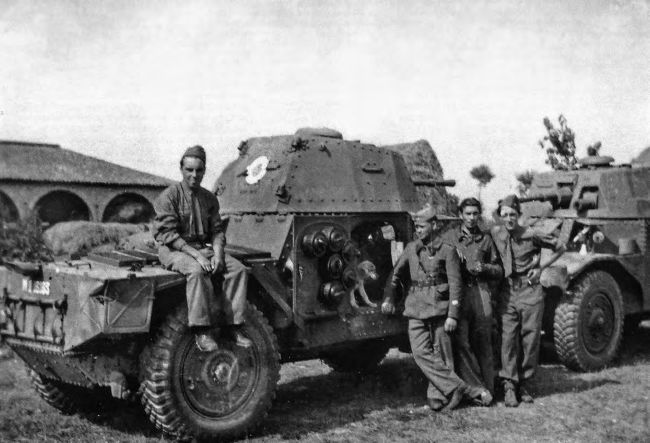
AMD 35 belonging to the 4e Régiment d’Automitrailleuses (4e RAM), Montauban, late June 1940. In the background, aspirant Henri Gentien’s car. Registration number M 15 163.
In 1905, Captain Genty mounted a machine gun on his privately owned Panhard passenger car for the first time, thus becoming the French pioneer in the use of motor vehicles for military reconnaissance. Six years later, in 1911, the Société Anonyme des Anciens Établissement Panhard et Levassor received an order from the French Ministry of War for three cars equipped with machine guns. They went to Morocco, where they took part in the pacification of rebellious villages. However, during the Great War the company did not receive government orders for wheeled vehicles, and instead it focused primarily on the production of drive units for St.
Chamond tanks. It was only in 1923 that the company was invited to participate in the competition for the automitrailleuse de combat, or AMC. The result was a vehicle known as the AMC Panhard 175 (both the number ‘175’ and the later ‘178’ were the company’s internal production codes). The prototype of the vehicle was demonstrated in 1927. As a result, the company received an order for 28 cars, all of which were transferred to Morocco.
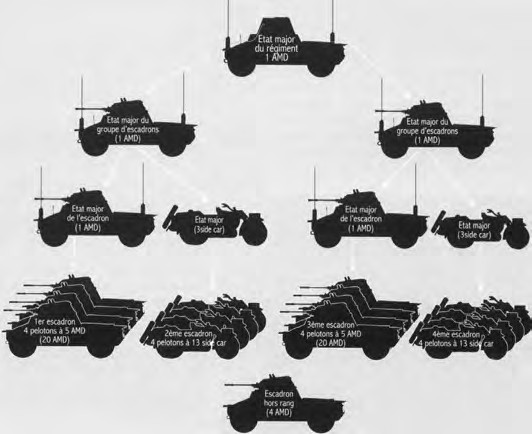
War establishment of the armoured car squadron which was a part of each reconnaissance regiment of the DLMs.
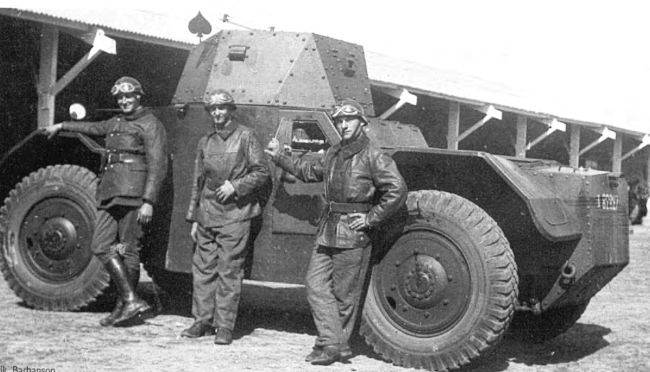
The prototype vehicle during tests in Morocco, 1935.
Concept
On 22 December 1931, the French General Staff published a document defining three classes of vehicles to be used by the cavalry. The first of these was the automitrailleuse de combat (AMC), which although in most cases was on wheels, was to perform a role of a tank. However, the term ‘tank’ was not used, as it was reserved for the infantry’s armoured vehicles. The second type of vehicle was the automitrailleuse de reconnaissance, or AMR. These were intended to be used for close reconnaissance and to protect the flanks. They included the AMR–33 and AMR–35 light tanks.
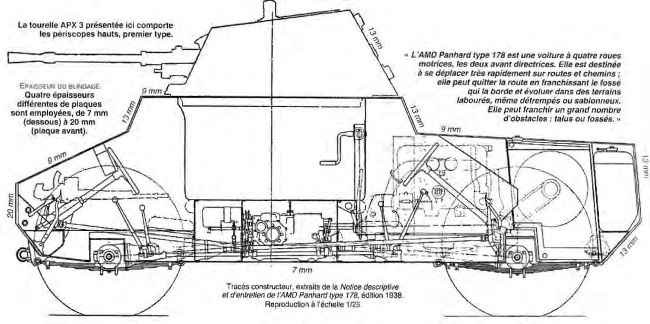
Third was the automitrailleuse de découverte, or AMD. They were intended to be scouting vehicles designed to find gaps in the enemy lines and carry out raids deep in his rear, ranging up to one hundred kilometres. The specification explanation that ‘a vehicle of this type should provide the cavalry with all the benefits related to its speed – long–range reconnaissance – but also close reconnaissance for mounted cavalry units before they come into contact with the enemy, liaison missions and the like. The car should be armed with a cannon of approximately 20mm calibre, capable of engaging enemy armoured cars … It should also be able to move across moderately difficult terrain, for example ploughed fields or meadows.’ The car’s greatest advantage was its speed, an average of 40 km/h and a maximum speed of 70 km/h. It was supposed to avoid combat, hence the proposed thin armour of between 5mm and 8mm. Although this doctrine was abandoned before the outbreak of World War II, in 1938 it had a huge impact on all designs created at that time, in fact shaping the face of French armour between 1939 and 1943.