IT HURTS ME TOO
KAREN DALTON was the real thing: a dust-bowl folk singer who astonished her ’60s peers until drugs and an allergy to the bright lights threw her music into shadow. Only now, as a bumper reissue of her key In My Own Time album hoves into view, is her voice – and those of her devotees – being properly heard. “She could do the magic,” they tell VICTORIA SEGAL
“SANTANA! SANTANA!”
It’s May 1971 and Karen Dalton is playing the biggest venues of her career, opening for Santana across Europe as they scale their commercial peak. Organised by Woodstock promoter Michael Lang, who has signed Dalton to his new record label, Just Sunshine, for her second album, In My Own Time, the tour is a disastrous mismatch. Having started out passing the basket in Greenwich Village coffeehouses alongside Bob Dylan and Fred Neil, Dalton prefers long, hazy living-room jams. On the big stage, her tarnished-silver voice cannot cut through the impatient chants of audiences expecting a different kind of Black Magic Woman.
“Her performance style was ver y introspective,” recalls guitarist Dan Hankin, who played on both her albums and in her make-or-break touring band. “She was more of a person who said, ‘Here’s what I have, take it or leave it.’ In a coffeehouse, maybe that would work, you know? But in a huge concert hall filled with young people who had no idea who Karen Dalton was? I don’t think they had any idea of what to make of it.”
This is Dalton’s second chance at success after her 1969 Capitol debut, It’s So Hard To Tell Who’s Going To Love You The Best, but it’s already slipping away.
What to make of Karen Dalton was not just an issue for Santana fans. When she died of AIDS in 1993, at the age of 55, she had not made a record for over 20 years, declining into obscurity, poverty and addiction. Yet in the early ’60s when she first hit Greenwich Village’s booming folk scene, she was acclaimed by her peers. “Karen was like a letter from home,” Fred Neil wrote in 1969, finding both solace and inspiration in her voice, while in 2004’s Chronicles, Bob Dylan recalled being struck by the “funky, lanky and sultr y” Dalton, her “voice like Billie Holiday” and her guitar playing “like Jimmy Reed”.
Towards the end of Dalton’s life, her friend, the cosmic folk guitarist Peter Walker, used to reassure her she would be famous one day. “Yeah, Peter,” she would reply in her still-detectable Oklahoma drawl. “That famous won’t do me any good because I won’t be here to enjoy it.” As she said in one of the songs nobody ever thought she wrote: “Fate sneaks up from behind/Pretty soon it’s too late.”
Carl Baron
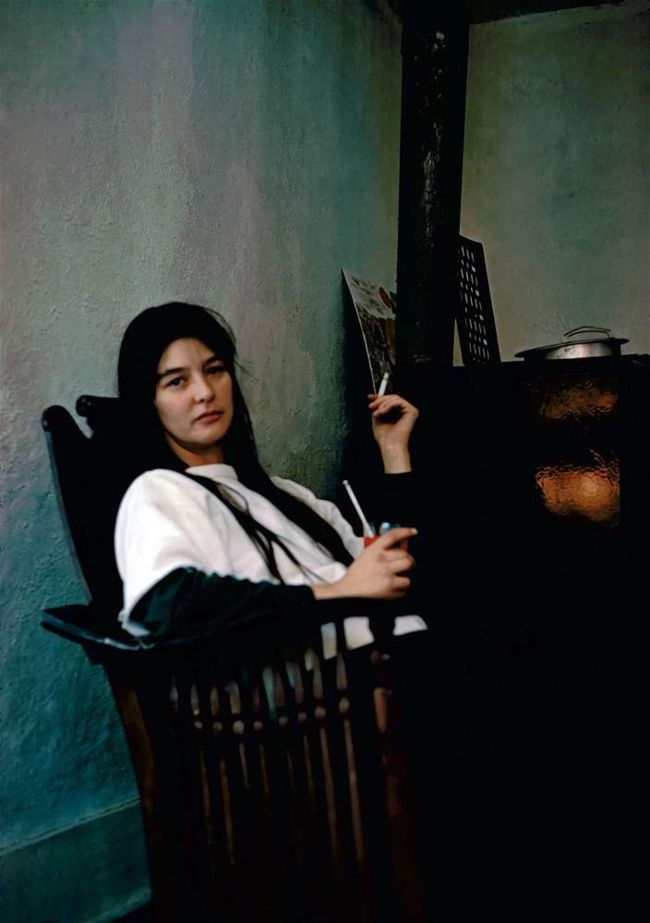
So long ago and far away: Karen Dalton in her mountain cabin, Summerville, Colorado, 1966.
Courtesy of the Estate of Karen Dalton
“KAREN COULD SING A SONG AND MAKE OTHER PEOPLE FEEL
AS THOUGH THEY’RE PART OF THE SONG.”
PETER WALKER
A PART-CHEROKEE, PART-IRISH SINGER WHO PLAYED an unusually tall banjo car ved from a bedpost, Karen Dalton lent herself to myth. When her music started to gain belated attention in the mid ’90s, it was assumed she had written no songs, given no inter views, left little in the way of photographs or tapes. She was, after all, supposed to have died alone on the New York streets, a tough place to maintain an archive. Yet as her reputation has grown, it’s become harder to see Dalton as an ethereal dustbowl heroine flitting through the frames of her life. 2007’s Cotton Eyed Joe captured a performance at Joe Loop’s Boulder coffeehouse The Attic in 1962, while 2008’s Green Rocky Road caught her playing at home on a reel-to-reel in her Colorado mining cabin (we even hear a brief conversation with her mother, Evelyn: “Did your folks let you dance?” Karen asks). Later, it transpired Karen had left a cache of her own songs and poems in the care of Walker; he allowed a handful to be recorded as 2015’s Remembering Mountains: Unheard Songs By Karen Dalton, Sharon Van Etten and Julia Holter among the artists lifting them off the page.