REBEL REBEL
From Bowie to Bolshie, Motown to the Miners’ Strike, the Army to Americana and beyond, for 40 years BILLY BR AGG’s songs have rooted for the underdog – in matters of the hear t as well as the state. A fixture on the front line, he’s also a sitting duck for haters. Luckily, he’s used to the gunfire. “As long as you know you’re not a fascist , an antisemite or a misog ynist , you can grit your teeth and get on with it,” he tells WILL HODGKINSON.
AT BILLY BRAGG’S FARMHOUSE, WHERE A glass-walled kitchen looks out onto the Dorset Ridgeway and the kestrels that swoop and glide across the rolling hills, a storm has brought the rains. “I’ve been putting out sandbags to stop the water coming in,” says Bragg, a silverhaired 65-year-old in dressed-down unifor m of grey trousers and fleece, completing an image of a practical fellow, capable of taking on anything. Then he adds, “By that, I mean my son Jack has been putting out the sandbags,” and the image is r uined somewhat. This is someone who admitted, on 2013 song Handyman Blues, it takes him half an hour to change a fuse.
Bragg may not be a natural-bor n man of the soil. As The R oaring Forty, an album and box set charting his 40 years of songwriting proves, however, he is a master at finding the poetr y in the ever yday. He’ll always be known as the pre-eminent protest singer of the Thatcher era, but that’s just the rabble-rousing tip of the iceberg. From the kitchen sink drama of Levi Stubbs’ Tears to the school days romance of The Saturday Boy, Bragg has captured the romance of the under-represented, the unseen, the less than glamorous.
“I got an English O-Level, grade A,” brags Bragg, as he digs around a for mer garage that has been turned into his archive, with ever ything from two-inch Ampex tapes to Airfix model catalogues to old tour programmes stacked neatly in plastic boxes. He pulls out a few sheets of schoolboy poetr y. “I failed ever ything else, which my parents were terribly disappointed about, but I thought, If I’m going to be a songwriter you only need the English language, don’t ya?”
Buried deep in the archive are the records he bought when he was plain old Stephen Bragg, a shy, awkward and not particularly political workingclass teenager from Barking, where the outer boroughs of London meet the green fields of Essex. “When I bought R onnie Lane’s Slim Chance, or Ooh La La by the Faces, it meant so much more to me than the albums I bought later when I had money,” he says as he pulls the records out of the boxes. “I took a copy of Aladdin Sane to the barbers and asked him to give me the same haircut. What I feel – and I know it sounds stupid – is that my identity might be hidden in those records. That might be the real Billy Bragg… or at least the real Stephen Bragg.”
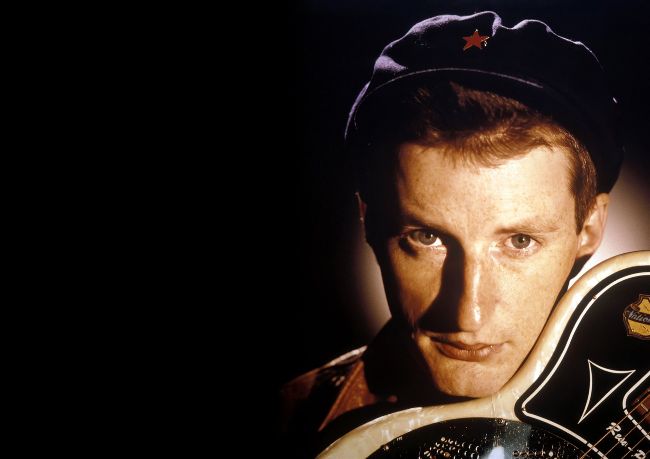
Protest and survive: Billy Bragg keeps his 1960 National ResoPhonic guitar close, Fulham, 1984.
PORTRAIT: PAUL COX
Bragg, whether Billy or Stephen, found his original inspiration in a surprising source: The Boxer by Simon & Garfunkel. “This would have been ’69, ’70, and there was something about it that gave me a feeling I had never felt before. We had the radio on all the time so I knew the pop songs of the day, but hearing The Boxer, then Motown, changed it all for me. I had a reel-to-reel tape machine, on which I managed to get the Simon & Garfunkel albums and Motown Chartbusters Volumes 3 to 5. I took them apart, put them back together again, reworked them, and that was the basis of my songwriting.”