WARNING! ADULC MACERiAL
CONTRACTUALLY AND SPIRITUALLY FREE FROM THE MOTOWN MACHINE, HOLED UP WITH TWO SWITCHED-ON BOFFINS AND THEIR MEGASYNTHESIZER, SCEVIE WONDER TURNED 21 WITH AN EXPLOSIVE BOUNTY OF SONGS AND TWO INCREDIBLE ALBUMSIN A SEISMIC 1972: MUSIC OF MY MIND AND TALKING BOOK. "IT WAS LIKE KRAKATOA!" HEARSBILLDEMAIN.
PORTRAIT: JEFFREYMAYER
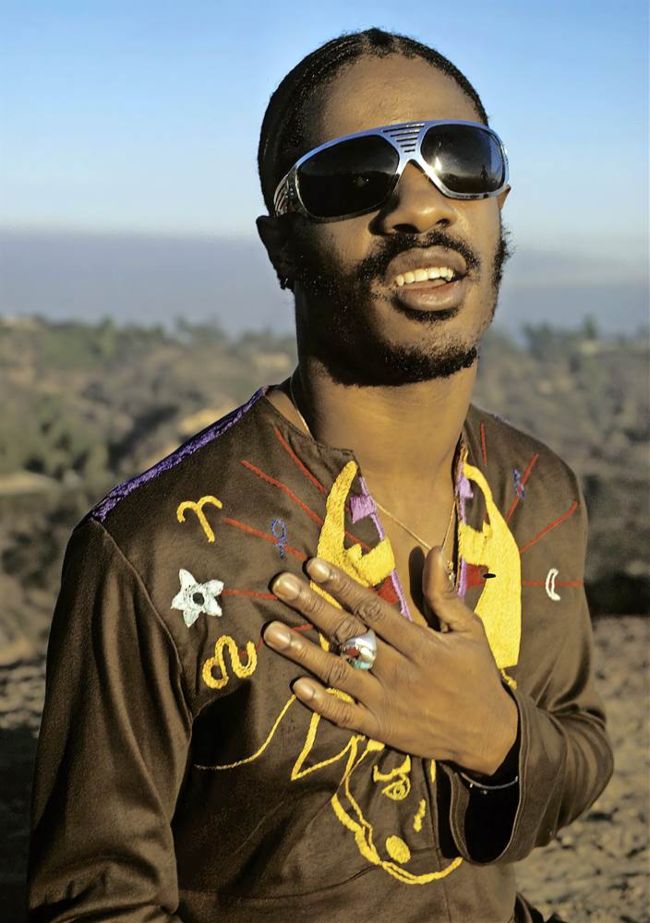
Hand on heart: Stevie Wonder, Griffith Park, LA, September 15, 1972.
Credit Jeffrey in Mayer/Rock here Negatives/MediaPunch, Alamy
“HEY, LANI! JIM! WAKE UP, I NEED you to sing a part!”
It’s three o’clock in the morning, and an excited Stevie Wonder is standing over the couch in the control room of Electric Lady studio in New York, tr ying to rouse his two sleeping backup singers, Lani Groves and Jim Gilstrap. Wonder has been working non-stop through the night, layering tracks of Fender Rhodes, drums and lead vocals on a new tune, a jazzy pledge called You Are The Sunshine Of My Life. In its first draft, the song began with Wonder singing, “I feel like this is the beginning…” But that didn’t sit right somehow. Recalling an old Motown songwriting rule – ‘When in doubt, start with the title’ – Wonder added a four-line prologue, then in a flash of inspiration decided to give it to real-life lovers Groves and Gilstrap.
“It may have been because we were a couple,” recalls Groves, with a laugh. “Then again, we were the only singers there at that hour. I just know that I was out of it and probably sounded like a frog. ‘You are the apple of my eye…’ It was kind of deep for my range, but it worked, because I just woke up!”
The dozing duo’s voices would lead off Wonder’s Talking Book, his second album in a year of musical coups. The song, a Billboard Number 1 and Grammy winner, would become a standard covered by Frank Sinatra, Liza Minnelli and lounge singers ever ywhere. But it was only one of over 150 songs Wonder wrote during a fertile 18-month period from the spring of 1971 to the fall of 1972.
“Back then, Stevie would write a song a minute,” says Groves, who went on to sing with David Bowie, Steely Dan and more. “I’ve never heard musical creativity like that in my life, from anybody.”
“BACK THEN” STARTED ON MAY 30, 1971, WHEN Wonder knocked on the imposing double doors of Mediasound in Manhattan. With his bassist friend Ronnie Blanco, he had walked the block to the studio from the Holiday Inn where he was staying. He was in good spirits. He’d just turned 21, meaning he was finally free from the Motown contract he’d signed aged 11. Motown boss Berry Gordy threw him a birthday party at his Detroit manor two weeks earlier, waxing on about family loyalty, hoping to smooth the way to renegotiations. The morning after, Wonder’s lawyer ser ved papers to Gordy, disaffirming all agreements between artist and label.
Putting a new contract on hold, Wonder had come to New York to check out the scene and meet with other labels. But his first order of business was to track down Malcolm Cecil and Bob Margouleff, the team behind his favourite album of the moment, the trippy, all-synthesized Zero Time.
British-born Cecil was a jazz bassist-turned-resident electronics wiz at Mediasound. He’d moved to New York in the late ’60s and met producer Margouleff, who was already tinkering with one of the first Moogs. The pair, one wire-skinny, the other burly, with comically big hair, looked like Robert Crumb characters come to life. Appropriately, they called themselves Tonto’s Expanding Head Band. TONTO was an acronym for the instr ument they invented – The Original New Timbral Orchestra. Inhabiting its own room at Mediasound, it was a 25ft wood-panelled behemoth of blinking lights, silver knobs and spaghetti-twined cables – the world’s largest modular synthesizer. It was so imposing that director Brian De Palma would use it as a prop in his rock-themed cult movie Phantom Of The Paradise.