REAL GONE
Standing Inside The Flame
A rediscovered songwriter of immense sensitivity, Bill Fay left us on February 22.
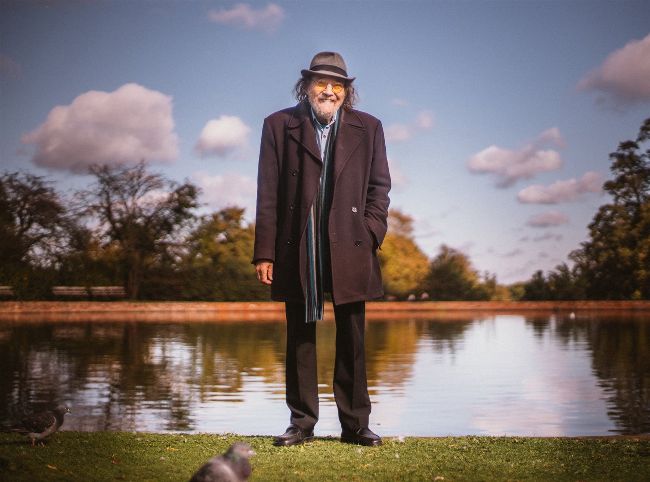
Simple folk: Bill Fay in 2019 – humility informed his music throughout his life.
Mathew Parri Thomas
A DAY OR TWO after Bill Fay made his one return to the stage, in 2007, he called to tell me about how it had gone. Fay had turned up for a Wilco gig at the Shepherd’s Bush Empire in London, where he encored with Jeff Tweedy on Be Not So Fearful, a gentle prayer of a song from his 1970 debut album.
Fay was touched by the kindness of Tweedy and Wilco, but mostly he wanted to talk about how he’d travelled to the venue by bus from his north London home. For the entire journey, he’d been transfixed by a ladybird that had hitched a lift on his jacket sleeve. It was a measure of Fay’s boundless capacity for awe, for understanding the value of small epiphanies, and for how he carefully avoided discussions of his own brilliance. “There are miracles/Everywhere you go,” as he sang on 2012’s Cosmic Concerto (Life Is People).
That sense of wonder permeated much of Fay’s music, beginning with the songs he started writing in the mid-1960s, a boy from the London suburbs studying electronics at Bangor University. His demos found their way to Peter Eden, Donovan’s former manager, who produced Fay’s Dylan-ish debut single in 1967. Some Good Advice was a meditation on single-mindedness, Zen-like in its simplification of how life could be lived: “If you want to ride a bike/ Ride your bike, if you like.” It was a message he persevered with for the rest of his life.
“I just kept looking at trees from the top deck of the bus…”
BILL FAY
It took three years for Fay to release an album. 1970’s Bill Fay was a more grandiose affair, its orch-pop closer in tone to Scott Walker or David Ackles, but the lyrics were more intimate than the arrangements signalled: tales of modest but profound British lives; of communing with nature in a different way to the prevailing hippy rhetoric. “I just kept looking at trees from the top deck of the bus,” as he told MOJO’s Andrew Male in 2012.
One of the players on that first album was jazz guitarist Ray Russell, who grew close to Fay both musically and intellectually, and it was Russell who would helm his extraordinary second album, 1971’s Time Of The Last Persecution. Fay’s appearance on the cover gave him an air of wild prophet, but for all his music’s spiritual power, the record was not a success, and Decca dropped him. Fay spent the best part of the next four decades out of the public eye, working as a gardener and fruit-picker, quietly writing and recording songs as a kind of devotional pursuit.
In the early 2000s, these songs started finally being released, most notably a collection called Tomorrow Tomorrow And Tomorrow that had been recorded in the late ’70s and early ’80s.
Fay’s songwriting practice was a constant, often private imperative, with other collections – From The Bottom Of An Old Grandfather Clock (1966-1970 demos), and Still Some Light (1970-71 and 2009 demos) – beautifully unmediated representations of his art.