REAL GONE
The Sugar Man
Mystery superstar and liberation singer Sixto Rodriguez left us on August 8.
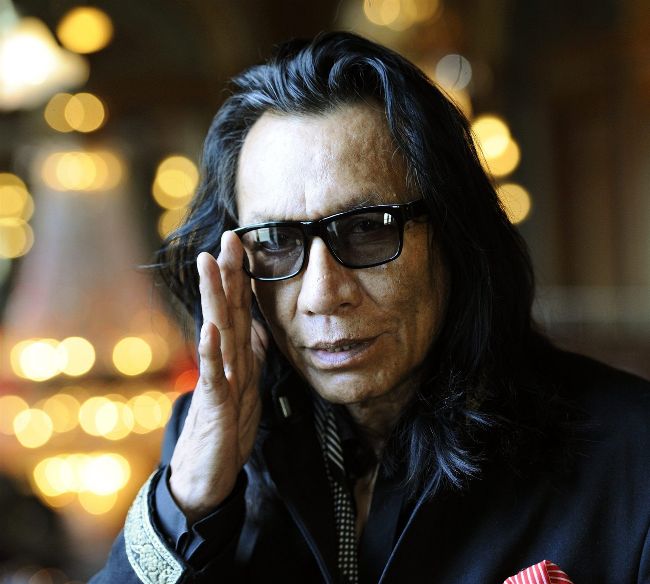
Sweet sensation: Rodriguez in 2012 – he never gave up his quest for a better world.
TT News Agency/Alamy Stock Photo
FEW PROTEST singers get to see their songs make an actual, impactful, physical social difference. In the case of Rodriguez, however, it’s arguable that without his 1970 Cold Fact album, apartheid in South Africa might have lasted a generation longer than it did.
Jesus Sixto Diaz-Rodriguez was born in Detroit to Mexican parents on July 10, 1942. Known as Sixto – he was their sixth child – his mother died when he was three, and the family lived a typically poor immigrant Motor City life. Rodriguez wasn’t like the others, however. His wife Konny later described him as “a really eccentric guy” who she first noticed at Wayne State University walking down the street with a guitar. That was 1972, and his music career had already flamed out after two albums of psychedelic folk protest: Cold Fact and 1971’s Coming From Reality. Neither had scraped much beyond three-figure sales.
“Rumours claimed he’d selfimmolated on-stage sometime in the 1970s.”
In South Africa, however, something unparalleled was unfolding. No one really knows who or how, but someone came back to South Africa carrying Cold Fact. Tapes were passed around like an underground manifesto, and eventually it sold over half a million copies. Cold Fact’s impact on a generation of white kids in a country that resisted introducing TV until 1976 because it was “communist” cannot be overstated. Children were brought up with no knowledge of dissent, yet in songs about finding hope and rising up against the decay of inner-city Detroit, such as Hate Street Dialogue, The Establishment Blues and Rich Folks Hoax, young South Africans for the first time heard a voice saying that if you don’t like what you saw, you should and actually could do something about it.
Not that Rodriguez knew anything about this. By 1972 he was working on production lines and building sites, but never gave up political agitation, standing for Detroit mayor in ’81 and ’93 and the Michigan House Of Representatives in 2000.
Rodriguez finally came to attention in the UK when David Holmes used Sugar Man as the opening track on 2002 mix LP Come Get It I Got It, before a 2009 reissue of Cold Fact led to renewed international interest. Three years later came the Searching For Sugar Man documentary, following two South African fans as they tracked down the enigma that local rumours claimed had self-immolated on-stage sometime in the ’70s. A 2013 Academy Award also finally earned Rodriguez belated recognition at home.
Even with that success, Rodriguez continued living in the same Detroit house he bought for $50 in the ’70s, where he married and raised three daughters. Even after the crushed career, the unknown success in South Africa, and the inevitable lawsuit to recover lost royalties, Rodriguez never gave up his quest for a better world. He died after a short, undisclosed illness.
Andy Fyfe
Jamie Reid
Iconoclast, Sex Pistols art guru