HOW TO BUY
Bee Gees
The awkward genius of three brothers from the Isle Of Man.
By Andrew Male.
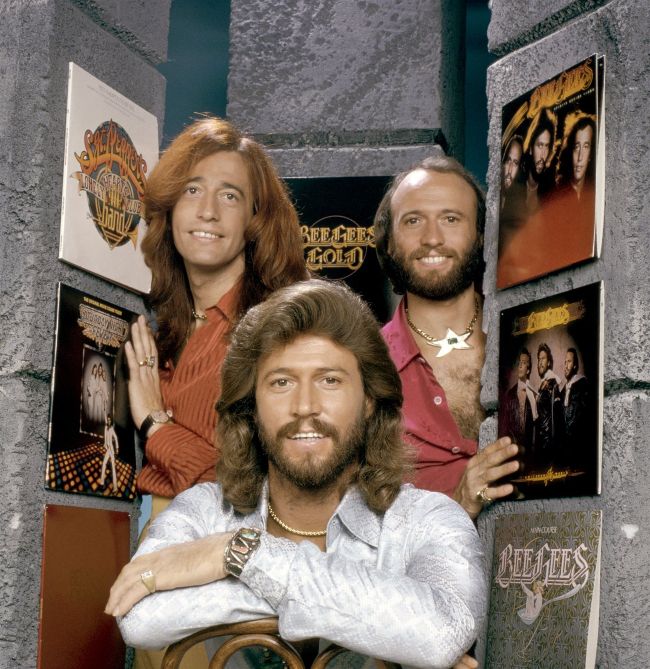
Jive mentality: Bee Gees (from left) Robin, Barry and Maurice Gibb with a selection of their multimillion-selling LPs, 1979.
Getty
WRITING IN the introduction to his recent Bee Gees biography, Children Of The World, Bob Stanley makes what might be the defining point about this deeply strange group. “They never fitted in, never really made sense.”
A trio of curious, insecure Isle Of Man-born brothers, Barry, Maurice and Robin Gibb were undeniably songwriting geniuses, part of a multimillion-selling pop group with over 20 Top 20 US hits and nine Number 1 singles between 1967 and Maurice’s death in 2003. Yet they were also regarded as figures of ridicule throughout their 35-year career. Even at the peak of their success the Bee Gees were mocked for numerous reasons (Barr y’s falsetto, their toothy smiles, the medallion-man fashions, their defensive, bruised stance in inter views) and never allowed the cachet of cool eventually accorded to their peers: The Beatles, ABBA, Fleetwood Mac. Considered dispassionately, that’s partly down to their mercurial, hubristic natures, both as artists and people, but also their creative approach, which was as much dependent on a genius for assimilation as innovation.
“Barry, Maurice and Robin Gibb were undeniably songwriting geniuses.”
You might define their ’60s sound as orchestral, existential and baroque, their ’70s pomp as vertiginous, harmony-drenched R&B, but neither fully captures the group’s magpie eclecticism or stylistic incoherence. They also had a habit of bestowing their best work to other bands or artists (the Saturday Night Fever soundtrack, Dionne War wick’s Heartbreaker, Barbra Streisand’s Guilty) sticking it on Bsides or shit-canning it all together. A deep-archive Bee Gees compilation is needed along the lines of The Beatles’ Anthology series or The Monkees’ Missing Links.