Cry One More Time
Half a century ago, Eram Parsons met his maker, but not before two solo albums, rich in country soul, fulfilled a portion of his promise. The tragedy and, perhaps, the inevitability of that loss is still felt by friends and fellow musicians. “There was a transgressive aspect to Gram,” they tell Erayson Haver (Currin. “He crossed lines and crossed borders, even when it was really irresponsible.”
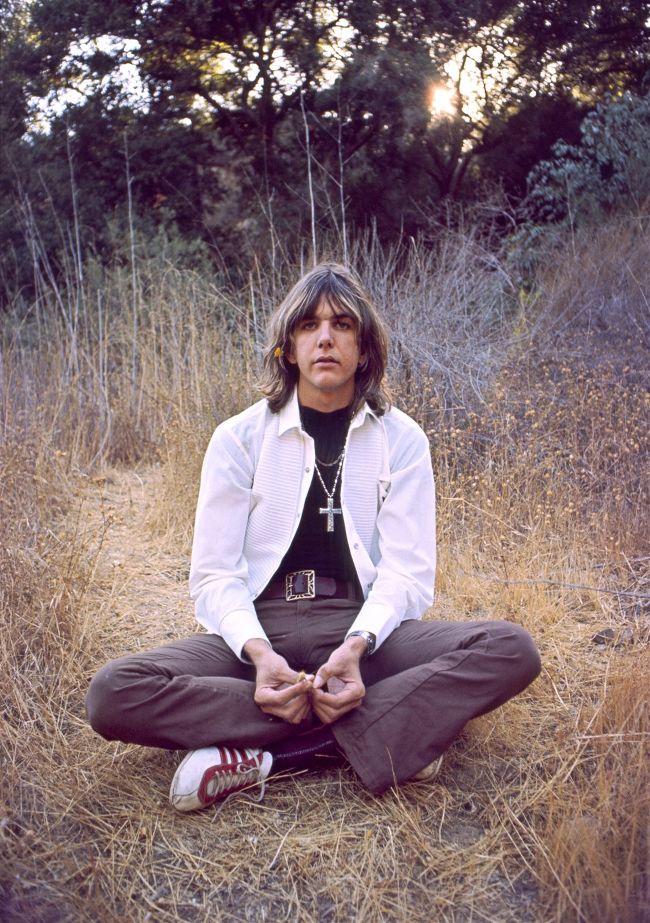
Take this boy away: Gram Parsons, 1969.
Photograph by Ed Caraeff
IN THE BRIGHT LIGHT OF A NASHVILLE SPRING AFTERNOON, GLEN Dee Hardin pushes the papers, pill bottles, and paper weights to the side of the bulky brown desk he has owned for nearly 60 years. Hardin, 84, leans in close, inspecting the woodgrain and running his fingers over ever y scuff and stain. He is looking for the remains of one specific spill: the first night Gram Parsons came to visit Shipwreck Lounge, the home office Hardin kept at the corner of Ethel and Sarah, just outside Hollywood.
“Phil Kaufman and Gram came over to my house, another hang-out session. We were doing cocaine and whiskey right off my desk there,” Hardin explains as he peers down, referring to the road manager and singer since joined in musical infamy.
Hardin pushes through a cloud of cigarette smoke and sighs. “It was so many years ago,” he says. “It might have finally diminished.”
Hardin’s desk was not just a party pad; it is something of a prized possession. When his family left that spacious ranch home in California’s Studio City for Nashville, it came with him. He’d used it, after all, to arrange five dozen Elvis songs, not to mention tunes by Nancy Sinatra, John Denver, and Linda Ronstadt. “I’ve probably made $1 million at that desk,” he says, beaming in his living room, tousled white hair suggesting a mischievous halo.
Hardin and Parsons had first met earlier that year, when the latter had crossed the Mojave to seek out Hardin in Las Vegas, where he was backing Elvis as a recent addition to the TCB Band.
The enfant terrible of an emerging admixture of countr y and rock, Parsons had been kicked out of The Byrds, fled his own Flying Burrito Brothers, and been booted from a Rolling Stones bacchanal in France. He had a proven new manager, a major label record deal, and a set of songs that had wooed Warner Brothers. But he didn’t have a producer, let alone a band. He was hoping one of the world’s best backing units – that is, Elvis’s – might help. Hardin signed on, as did sizzling guitarist James Burton and steadfast drummer Ronnie Tutt.
When Parsons and Kaufman arrived at Studio City months later, the trio had so much fun the singer woke up in Hardin’s flower bed, the manager by a tree near Parsons’ Jaguar. His daughters, Laurie and Karen, saw strange men sleeping in the yard as they left for school. Parsons and Hardin’s musical rapport, however, was slower to gel.

Ed Caraeff/Iconic Images
“I was ready to write charts, and he wasn’t ver y well prepared at all. The songs weren’t finished,” Hardin says. “I told him it was time to jump on it now.”
Hardin’s encouragement and the arrangements he subsequently built for Parsons’ heartsick beauties helped jumpstart not only the most productive part of Gram’s career but also a musical sea change. GP and Grievous Angel helped return countr y music to its rightful place as an American lingua franca. If those LPs were not the start of alt-countr y, countr y rock, or what Parsons sometimes called Cosmic American Music, they were a crucial flashpoint.
They also provided the capstone for a brief life beset by tragedy, animated by ambition, and guided by the love of a good harmony. Less than two years after Parsons crossed the Mojave, Kaufman would burn his body, dead from an overdose at 26, in that ver y desert.
“I don’t want to call it fatalism, but it was sort of like that. There was a transgressive aspect to Gram, pushing beyond the norm,” admits Jet Thomas, Parsons’ resident adviser during his three-month stint in Har vard University’s Pennypacker Hall and a confidant for the rest of his life. He bailed Parsons out of jail at Har vard and again in Los Angeles. He was there when he picked up his sacrilegious Nudie suit, bejewelled with crosses, pills, and weed. “He crossed lines and crossed borders,” concludes Thomas, “even when it was really irresponsible.”
PARSONS’ LAS VEGAS TREK was not his first communion with Elvis.
In Februar y 1956, a month before Presley released his debut LP, Parsons – then, the nine-year-old Gram Connor – begged his friends to see the soon-to-be King in their small town’s auditorium. On a bill with the Louvin Brothers and the Carter Sisters, Mother Maybelle in the lead, Presley became rock’n’roll incarnate. For Parsons, tucked into the front row, the night was a lightning bolt. “It all penetrated my mind,” he recalled.