HOW TO BUY
Jethro Tull
The unclassifiable ’70s sensation.
By Jim Wirth.
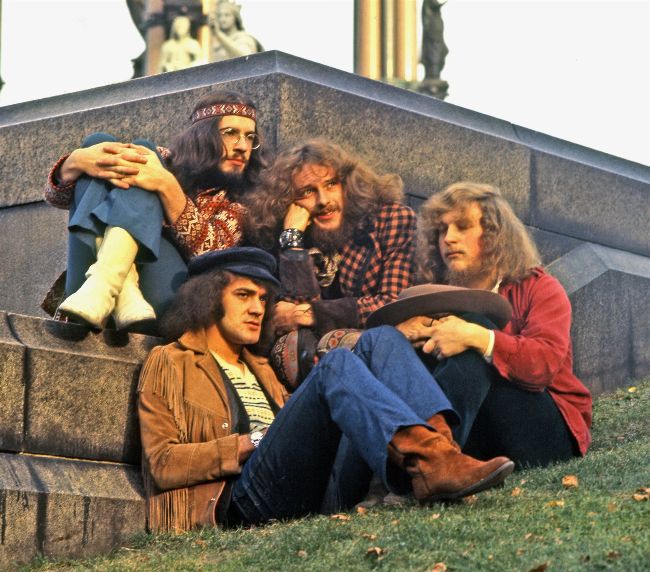
Seeds of greatness: Jethro Tull in 1969 (from left) Glenn Cornick, Clive Bunker, Ian Anderson, Martin Barre.
DEMYSTIFYING Jethro Tull’s magic formula in a 1978 interview, frontman Ian Anderson said: “Stylistically, I’ve always said that we can’t be a heavy riff group because Led Zeppelin are the best in the world. We can’t be a blues-influenced R&B rock’n’roll group because the Stones are the best in the world. We can’t be a slightly sort of airy-fairy mystical sci-fi synthesizing abstract freak-out group because Pink Floyd are the best in the world. And so what’s left? And that’s what we’ve always done. We’ve filled the gap.”
Thin-skinned and curmudgeonly, Anderson rarely made being in one of the most successful bands of the 1970s seem like much of a joy, while his antagonistic relationship with the music press has not perhaps helped secure Tull the kind of kudos legacy their massive record sales both sides of the Atlantic might have warranted.
Born in Dunfermline, Anderson ended up at grammar school in Blackpool, where he initially played in the Blades alongside future Tull members John Evan, Jeffrey Hammond and Barrie Barlow. However, the ex-art student made waves after he moved south to Luton, a line-up featuring guitarist Mick Abrahams, bassist Glenn Cornick and drummer Clive Bunker – and a name borrowed from the inventor of the seed drill – turning heads on the London blues scene.
A debut single miscredited to Jethro Toe augured ill, and Anderson arguably mastered marketing before he became a top songwriter, his signature overcoat, one-legged flute playing stance and mad-eyed deadbeat look probably more arresting than Tull’s 1968 debut This Was. “The stage thing seems to be very important to the public and consequently it is a little worrying when people think I am an extreme ‘randy’, homosexual or drug addict,” Anderson complained at the time. “I’m not like that.”