LOST IN MUSIC
NUSRAT FATEH ALI KHAN WAS ONE OF THE GREATEST SINGERS THE WORLD HAS EVER KNOWN, IDOLISED BY WESTERN ROCK STARS AND MILLIONS OF FANS ACROSS THE GLOBE. IN 2024, NEWLY UNEARTHED MUSIC FROM HIS RICHEST PERIOD UNDERLINES THE QAWWALI MASTER'S ECSTATIC POWER AND THE TRAGEDY OF HIS EARLY DEATH IN 1997. "HE WAS WORKING TOO HARD," DISCOVERS DAVID HUTCHEON. "HE SAID HE ONLY LIVED FOR QAWWALI."
PORTRAIT BY RICO D'ROZARIO
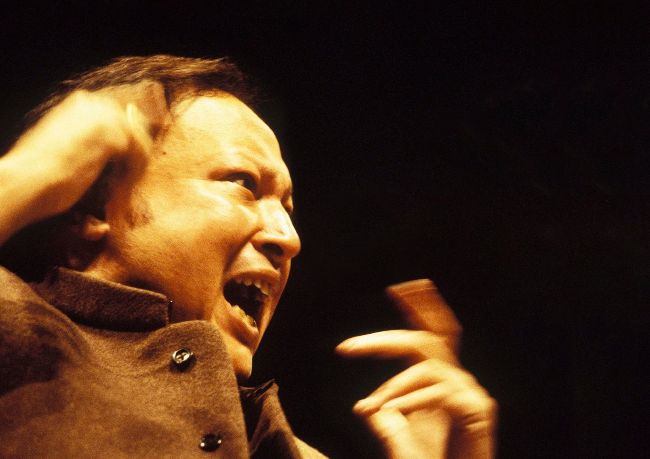
Natural mystic: the ‘Emperor of Qawwali’, Nusrat Fateh Ali Khan, early-’90s.
Rico D’Rozario/Getty
THE HARMONIUM BEGINS, WHEEZING A FEW aimless notes into the air. Then the tabla player joins in and we have a tune. It’s the WOMAD festival in Reading, July 1993. MOJO is sitting crosslegged on the ground, second or third row. Another harmonium joins in, then Nusrat Fateh Ali Khan, sitting left of centre as we watch, his hair matted with sweat, starts tapping a rhythm. The second line of seated performers behind him start clapping in unison. He sings a long, keening note, they pick up and run with it. Raising both arms, Khan serves notice that he’s about to take command. The chorus of Mustt Mustt begins – many here will recognise it from the Massive Attack remix that has recently become Britain’s first chart entry in Urdu. That had a drowsy dub feel, but now the handbrake is off.
Mustt Mustt, which translates as “Lost In His Work”, is one of the best known of Khan’s songs, which makes it a contender for the most famous of all qawwali hymns, devotional music from southern Asia. By the 1990s, Khan had been spreading the word for 20 years; the past decade had seen him reach audiences no other qawwali singer has been able to touch. Yet his music, some of it centuries old, has been attacked by more conservative strands of Islam in which there is no place for music; qawwali had also fallen out of favour with the youth of Pakistan, at least until Massive Attack picked up on it. “I made my own style,” explained Khan when criticised for allowing the Bristol crew free rein. “We updated qawwali with the times.”
Sitting on that stage, he looks an unlikely figure to have a Marley-like aura, but as he lets the song build, deviate, return to the chorus and gradually increase in power, his charisma is unmistakable. To his left, his brother Farrukh sits behind his harmonium, a study in concentration, his eyes fixed ahead, his voice shadowing his sibling. They weave a pattern for 10 minutes, improvising when the feeling takes hold, using the chorus as their anchor. Fifteen minutes… and then it happens, Nusrat hits a note, his vibrato off the scale. Electricity surges from the stage. Involuntarily, your correspondent is off his feet – practically levitating. And I’m not alone. Onlookers all around stand and gawp, amazed, overcome by the power of qawwali.
JEFF BUCKLEY SPOKE TO KHAN FOR THE MAGAZINE Interview, a piece published in 1996, the year before both men departed this mortal coil. “You’ve got to sing from the depths of the heart; without heart you cannot be a qawwal [singer of Getty (3), Jo Ann Toy qawwali],” Khan told him. “The audience goes crazy. In qawwali we have this effect, even back home. When people start dancing, they dance like they don’t know they are doing it. So they just get lost in it and it is very difficult to calm them down. It’s like something inside them is pushing them.”