BACK TO BASICS
Everything you need to know about starting out – or restarting – in mountain biking
Words Vicky Balfour
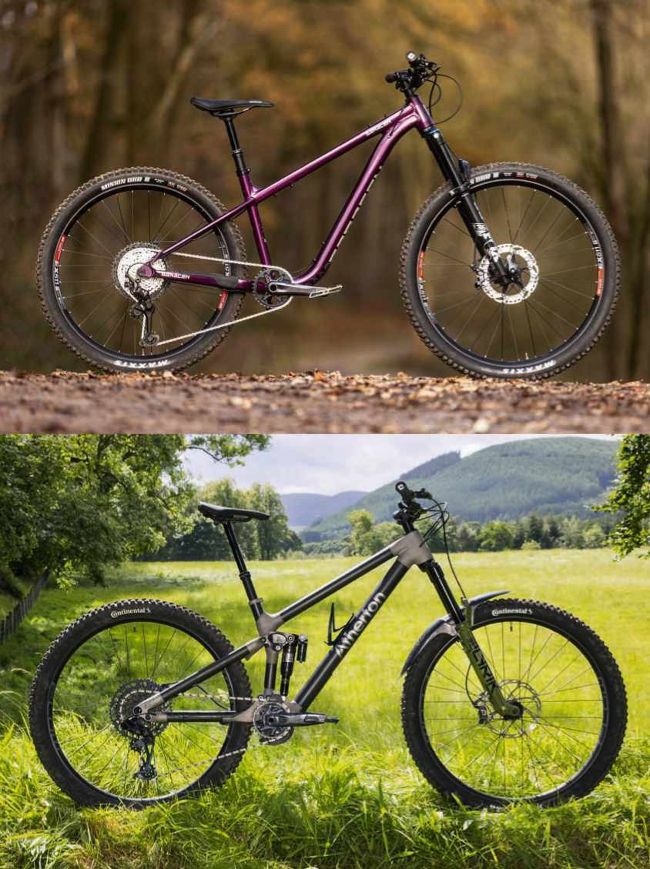
HARDTAIL
VS
FULL-SUS
If you’re new to the sport or returning after a few years away, all the kit, tech and jargon can be confusing. In this guide, we’ll walk you through everything you need to know, from choosing a bike to the essential kit you’ll need and where to ride. If you’re an old hand, who knows, you might even learn something new! Or you can pass it on to a mate.
BUDGET TIP
Hiring or borrowing a bike enables you to try the sport without the up-front cost. Then, if you want to buy your own, scour the second-hand market for bargains or shop the sales.
WHAT BIKE SHOULD I GET?
At their most basic, mountain bikes (MTBs) can be split into two forms – hardtail and full-suspension
Scott Windsor, Andy Lloyd, Steve Behr, Mick Kirkman, Ian Linton
1 HARDTAIL
A hardtail is a mountain bike that has a suspension fork (the bit that holds the front wheel) but a ‘rigid’ frame and unsuspended rear wheel.
There are different types of hardtail, with the amount of suspension movement (‘travel’) provided by the fork, combined with the geometry (frame shape) of the bike, denoting what style of riding it’s designed for.
Thanks to their comparative simplicity, hardtails are generally less expensive than full-suspension bikes. Having only a suspension fork also means they’re easier to maintain. This makes them a popular choice with those who are new to mountain biking, but also more experienced riders who don’t want to trash their main bike riding through wet UK winters.
2 FULL-SUSPENSION
Full-sus bikes have a suspended rear wheel as well as a suspension fork. The rear triangle, sometimes replaced by a one-piece swingarm, can move up and down, generally via a system of links and pivots (‘linkage’), with a shock absorber (‘rear shock’) controlling (‘damping’) that movement.
Full-suspension bikes are more comfortable to ride than hardtails – the extra squish takes the strain off your joints, and can make rocky and rooty terrain far less impactful. More importantly, they offer significant performance advantages, improving grip, stability and control.
However, they’re pricier, heavier and harder to set up and maintain, with the fork and shock needing semi-regular specialist servicing.
SUB-GENRES
Mountain bikes are divided into a huge variety of sub-disciplines, with each type designed for different styles of riding. Here’s a top-line explainer of the seven key categories…
CROSS-COUNTRY (XC)
Lightweight and with between 100 and 120mm of travel, these are designed to be fast and efficient to pedal.
DOWNCOUNTRY (DC)
Typically with 110 to 130mm of travel, these are comfortable on more rugged terrain than XC bikes, but are still fast and easy to ride.
DOWNHILL (DH)
Designed purely for descending the steepest and roughest terrain, DH bikes have a small range of gears and a large amount of suspension – typically around 200mm. They even have a different style of suspension fork (dual-crown) from other MTBs. They’re designed to be slung in a ski lift or on a trailer, not pedalled to the top.
TRAIL
These have 130 to 150mm of travel and are the ultimate all-rounders, designed to be easy to pedal uphill, but to also feel comfortable and controlled going down.
ELECTRIC (E-MTB)
A growing sector, which is helping many MTBers ride for longer (both in hours and age), these bikes fall into two main categories – ‘lightweight’ ones with smaller batteries that feel more like a conventional bike when riding, and ‘full fat’ bikes with a larger battery and, generally, a more powerful motor, but also a heavier overall weight.
ENDURO (EDR)
Generally sporting 150 to 175mm of travel, these bikes are strong and robust. They can handle steep, rough descents and a wide range of terrain, but can still be pedalled uphill.
ADAPTIVE
These make the sport accessible to riders with disabilities and those who struggle to balance.