Celebrating 50 years Porsche Turbos
USING THE FORCE
It’s 50 years since Porsche launched the 911 Turbo. Octane takes a five-decade joyride
Words Matthew Hayward
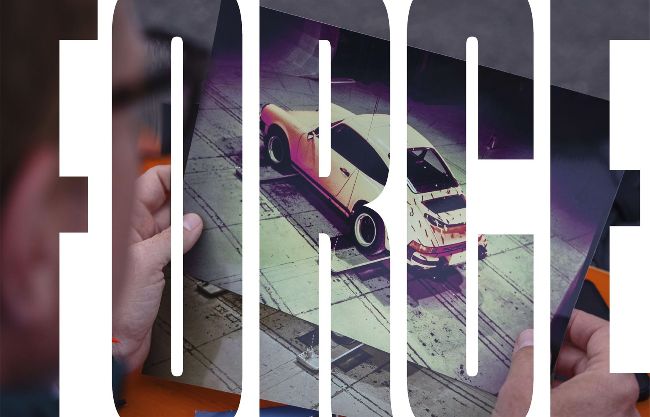
Photography Porsche
Porsche has been at the sharp end of turbo technology since its inception, and this year has marked the 50th anniversary of its first turbocharged road car, the 911 Turbo (or ‘930’ in Porschespeak). Launched at the end of 1974, it became a legend in its own right and laid a path for future models to follow. Right now we’re in Stuttgart to celebrate its legacy, driving in a convoy of Turbo models from those five decades to meet some of the people who built that legend.
Just being behind the wheel of an early 930, straight out of Porsche’s own collection, is an incredible privilege. One of the first 30 off the production line, it’s beautifully preserved, features the original 3.0-litre engine and four-speed transmission, and intimidates immediately with its ‘widow-maker’ reputation. It’s just started raining… Present and correct are intergalactic gearing, hefty unassisted steering, and the usual difficulty in working out how to turn on the demister. We barely get out of second gear around town, but once the roads open up we can stretch it a little more. Modern electronics and improved turbo technology have taken away much of what made old-school turbos like this tricky to drive fast; let’s just say it’s a healthy reminder of how exhilarating a burst of turbo boost can be! Keeping the 930 on the boil is part of the fun. It takes some planning, but even when it’s off-boost the flat-six is extremely tractable, and as soon as the rev-counter hits 2500rpm the compressor spools into life and provides you with an addictive hit of 260bhp. This is why we love Turbos.
We arrive at Flugplatz Donzdorf, a small airstrip about an hour east of Stuttgart, where we’re greeted by the sight of a 956 racer. We’ve come here to celebrate this rich history of forced induction and, like so many great innovations, Porsche’s journey with turbos began in motor racing. Engineer Hermann Burst joined Porsche’s motorsport department in 1969, taken on by racing boss Peter Falk to improve the aerodynamics of the 917, 917 Can Am, 908-03 and 908-02 long-tail models. Burst explains why Porsche developed its first turbocharged racer, following its legendary Le Mans win in 1970. ‘Turbocharging gives you two options: either use the same displacement and increase power, or maintain the power and reduce displacement,’ he says. ‘For the CanAm series, there was a kind of internal competition at Porsche between two engines: a naturally aspirated 16-cylinder and a 12-cylinder turbo. The turbo engine was used, as we could reduce the weight and dimensions of the car. It had a swept volume of 5.4 litres, and delivered more than 1000bhp.’ The results in 1972 and 1973 were extraordinary: ‘Porsche won two succ essive CanAm championships, winning almost all the races.’ So successful was Porsche, in fact, that in 1974 the organising body changed its regulations. ‘Porsche was then unable to compete there anymore.’ Burst’s team was called in to help with the Carrera RS 2.7, developing its ducktail spoiler, but for the 930 the aerodynamic changes were considerably more radical. As well as the huge whale tail, there was also a front spoiler to reduce lift and aid high-speed stability.