FEATURE
ON ICE
Rowan Clarke finds out why so many swimmers sit in backyard baths, barrels and tubs
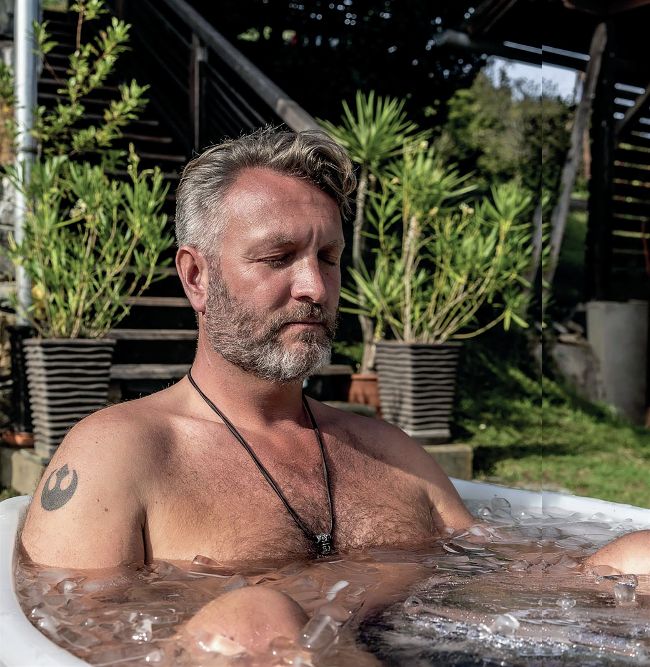
Image: Gus Hoyt
Remember lockdown when we couldn’t go swimming and so we got in our wheelie bins instead? Aside from making fun Insta photos, those makeshift tubs played a serious role in helping us cope with being locked down.
But even once we were released, our backyard bathing rituals stuck. So much so that specialist companies are now selling more tubs and barrels than ever. Why is this? And how can they support cold water swimming?
ANCIENT TRADITION
We’ve been using cold water therapeutically for millennia. The earliest documented use is in the Edwin Smith Papyrus, an Ancient Egyptian medical text from 3500BC. References to cold immersion, often steeped in rites and rituals, can be found in every civilisation and every religion since.
Hippocrates, the ‘father of Western medicine’, commended ocean dips as a curative therapy. But it was 17th-century physicians like Richard Russell and John Floyer who really started promoting cold baths in medical papers. In 1697, Floyer wrote a rather wonderful guide called An Enquiry into the Right Use and Abuses of the Hot, Cold, and Temperate Baths in England. He wrote:
“I do not persuade my Reader to change those Errors of living, without having first done so my self; for by leaving off strong Liquors, and all hot Diet, Teas, Coffee, & c. and by Water-drinking, and bathing at Buxton, I have procured to my self better Health, and more Hardiness, than I have enjoy’d for many Years before.”
This rich and ancient history, imbued with rites, rituals and remedies, underpins our approach certainly to wild swimming. But what about ice baths and cold showers, which seem more sterile, more contrived? Often associated with sports therapy, they feel medicalised, controlled and less connected to spirituality and nature. So, what’s the appeal?
REMEDIES AND RITUALS
The most obvious advantage is exactly what might put you off: that they are controllable environments. Having control over cold water allows creativity, a freedom to play and experiment with it in a way that you couldn’t in the river or sea.