GB
  
You are currently viewing the United Kingdom version of the site.
Would you like to switch to your local site?
13 MIN READ TIME

The Oriental fire-bellied toad

If you are searching for an attractive amphibian that is easy to look after and can become surprisingly tame, ready to take food from your hand, then why not consider these colourful toads?

There are now reckoned to be six species of fire-bellied toad, grouped in the genus Bombina, of which the best-known is the Oriental fire-bellied toad (B. orientalis). It grows to about 6cm (2.5in) long, and ranges from Korea northwards to parts of Russia and north-east China.

Oriental fire-bellied toads are widely bred, and occur in two different colour variants. The traditional form, sometimes described as the Korean, has mainly lime green upperparts, broken with variable black patterning. This creates an attractive contrast with the individual fiery orange markings on the underparts.

There is another distinctive type though, which originates from further north. These individuals, which have brown rather than green colouration, are often referred to as Russian or “golden” fire-bellied toads. Nevertheless, there is some variation between these two extremes, and you can sometimes see individuals that have areas of both green and brown colouration on their bodies.

Protection
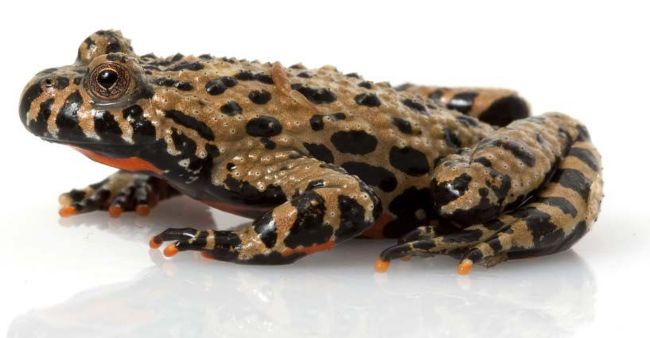
Russian or “golden” example of the Oriental fire-bellied toad.

As with most things in nature that are conspicuous and brightly coloured, the orange underparts of these toads serve as a warning. In common with many amphibians, fire-bellied toads have skin toxins that help to protect them from predators.

When threatened, these toads will adopt a very distinctive posture, known as the ‘unken reflex’ which is derived from their German name of unke. The toad flips over on to its back, arching and contorting its body to emphasise the bright colouration on its belly. It swallows more air, which will inflate its body, causing it to appear larger, while at the same time, it releases toxins from glands over its body, which give it a foul taste.

Lifestyle

These toads are found in relatively shallow stretches of water, and are quite opportunistic in their habits. They readily colonise and breed in artificial areas of water, such as paddy fields, and may even spawn occasionally in puddles, although they prefer larger areas of standing water, including ditches. In northern parts of their range, they may hibernate in streams, although more commonly, they seek out piles of leaves or retreat under tree roots for this purpose, often congregating in groups in suitable localities of this type.

Read the complete article and many more in this issue of Practical Reptile Keeping
Purchase options below
If you own the issue, Login to read the full article now.
Single Digital Issue Issue 127
 
£3.99 / issue
This issue and other back issues are not included in a new subscription. Subscriptions include the latest regular issue and new issues released during your subscription. Practical Reptile Keeping
Annual Digital Subscription £32.99 billed annually
Save
31%
£2.75 / issue
6 Month Digital Subscription £17.99 billed twice a year
Save
25%
£3.00 / issue
PRINT SUBSCRIPTION? Available at magazine.co.uk, the best magazine subscription offers online.
 

This article is from...


View Issues
Practical Reptile Keeping
Issue 127
VIEW IN STORE

Other Articles in this Issue


Practical Reptile Keeping
Welcome
What influenced your decision as to which reptiles
Regulars
Stunning species of pit viper found in India
Featuring stories this month about why snake bites
Why snake bites are more deadly for dogs
Cats are twice as likely to survive a venomous snakebite
A new jewel discovered in Madagascar
Despite the increased advances in knowledge that have
New iguana needs protection
The recently discovered Saban black iguana (Iguana
Scaling the heights for knowledge!
A Russian palaeontologist visiting the Natural History
How the adder causes confusion
Research by the University of Jyväskylä in Finland
New insights into venom
Caecilians are limbless amphibians that, to the untrained
Environmental monitoring
Australian tiger snakes (Notechis scutatus) living
Double take: the phenomenon of multiple-tailed lizards
It is well-known that some lizards have the ability
Changing vision
Sea snakes first entered the marine environment some
Out of Africa Make it snappy!
Paul Donovan investigates the biting power of crocodilians and turtles, and what this is revealing, based on recent scientific studies. Be prepared for some unexpected outcomes!
REPTILE FOCUS
The spotted turtle (Clemmys guttata) is a North American
QUESTIONS & ANSWERS
DO YOU NEED A HELPING HAND OR ADVICE?
Supplements for millipedes
I can’t seem to find much information about calcium
Hunting mystery crocodiles
Is it possible that there could still be crocodilians unrecognised by science? Dr Karl Shuker investigates reports of such creatures from Africa and Asia, and explains how the most recent new species to be discovered was found in a most unlikely way, just a few years ago.
YOU & YOUR Reptiles
If you have a favourite photograph of one of your reptiles
Features
Tortoises in the summer
Allowing your tortoises outdoors over the summer is a good idea, but you need ensure they will be safe. Also, bear in mind that females may nest in garden surroundings, and you may find yourself with an unexpected clutch of eggs, explains David Alderton.
The green tree python
Green tree pythons - or GTPs as they’re often described - rank amongst the most beautiful of all snakes, with their young undergoing a stunning transformation in colouration. But as Joel Smith reports, they’re only suitable for experienced owners.
Insights into spiny-tailed lizards
While many herp enthusiasts enjoy keeping a range of different species, some people become fascinated by a particular genus, or even an individual species, and as a result, they can frequently make a very significant contribution to advancing our knowledge about the care, behaviour and breeding of their chosen type of reptile. Here Kamiel Hamers of HammerHead Reptiles, based in the Netherlands, tells his story.
Chat
X
Pocketmags Support