Forever Afternoon
In 1967, a new line-up of The Moody Blues embraced their symphonic influences to create a groundbreaking album that not only pushed them in a new musical direction but also brought about the birth of progressive rock. As the lavish Days Of Future Passed turns 55, John Lodge, Justin Hayward and other key players take us on a journey into a past that has helped forge the band’s future
Words: Jo Kendall
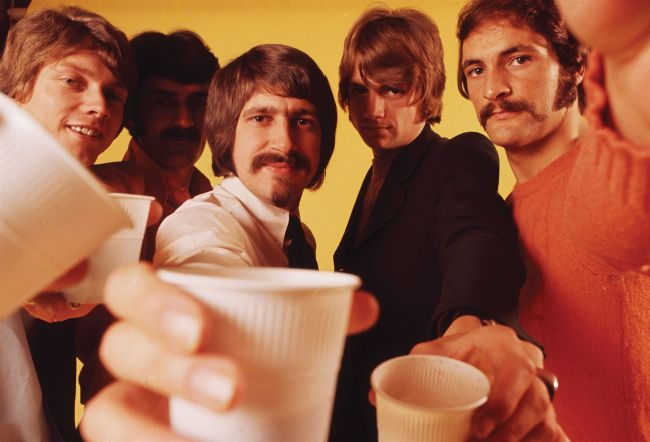
Inventing prog rock? We’ll drink to that!
Image: Tony Gale/Pictorial Press Ltd /Alamy Stock Photo
“One night, after our set at the Fiesta club in Stockton, one of the crowd came and knocked on our dressing room door. It was a man who said, ‘I’ve brought my wife for a night out and you’re the worst band I’ve seen in my life. You’re crap.’”
John Lodge
It’s 1966, and pop culture is in transformation. Fashion, art, spirituality and politics make up the UK’s Swinging 60s scene where societal norms are shifting and minds are expanding on a yearly, monthly and weekly basis. In the music world, boundaries are being busted thanks to acts such as The Beatles’ and The Beach Boys’ imaginative compositions and voracious appetite for new recording techniques and equipment.
But one band in particular aren’t swinging. One band, who’d been riding the crest of a popular wave just two years earlier with their international hit cover of Bessie Banks’ R&B song, Go Now!, are decidedly static. Birmingham five-piece The Moody Blues – featuring Denny Laine (vocals, guitar, harmonica), Mike Pinder (keyboards, vocals), Ray Thomas (vocals, flute, harmonica), Graeme Edge (drums, vocals) and Clint Warwick (bass, backing vocals) – seemed to strike it lucky with their second single release, scoring a British No.1, then a US No.10 followed by a slot on a successful British Invasion package tour and an album on the Decca label, The Magnificent Moodies.
Having relocated to London, by the end of ’65 the band played the NME Poll Winners concert to 10,000 excitable youngsters and supported The Beatles on their December UK tour. Less than a year on, their management company had folded and disappeared with all the Go Now! royalties and record advance money – leaving the band in debt to Decca – and follow-up singles weren’t connecting so well with the media or the audience. The Moodies definitely had the Blues – and even being managed (very briefly) by Brian Epstein wasn’t making much of a difference.
Warwick was the first to make a change, leaving the group in July to spend more time with his wife and young kid. Next was Laine, in September. Prompted by the Decca debt that they’d inherited and the sense that they should soldier on, Pinder, Thomas and Edge immediately sought two replacements. The first was easily found: Thomas’ friend John Lodge, a young bassist who had fleetingly been in the earliest Moodies line-up, formed by himself, Pinder and Thomas from the ashes of Thomas’ Mexicansuited Brumbeat rock’n’rollers El Riot And The Rebels. Lodge – nicknamed Rocker because of his fast playing and love of boogie-woogie – left the band to finish a course in engineering with a view to going into car design. “They’d said, ‘We’re going to London, do you want to come with us?’” recalls Lodge, speaking from his current home in the US. “But I wanted to complete my studies, so I said no. Eighteen months later Ray called me up and said, ‘Rocker, have you finished your course?’ and I said yes. He then said, ‘Denny’s left the band, could you come and join us? Get down to London straight away and bring your songs!’ So I went down, re-met Graeme, who I knew from Gerry Levene And The Avengers, and that was the start of something new…”
Next they needed a lead guitarist, and possibly a lead vocalist too. One night Thomas was in Soho club the Bag O’ Nails with Eric Burdon, who was recruiting for a new Animals line-up. Burdon put a stack of rejected applications Thomas’ way, and a few stood out. But one in particular made an impression – ayounger musician, Swindon-born songwriter and guitarist Justin Hayward.
Since his mid-teens, Hayward had worked with rock’n’roll star Marty Wilde and his wife Joyce in The Wilde Three, and he was published and managed as a solo act by Lonnie Donegan. His style came more from folk clubs and a love of The Everly Brothers; the 19-year-old had a countrytinged troubadour sensibility. Hayward had been based in Blackheath, south London, but without a steady income had part-time moved back home.
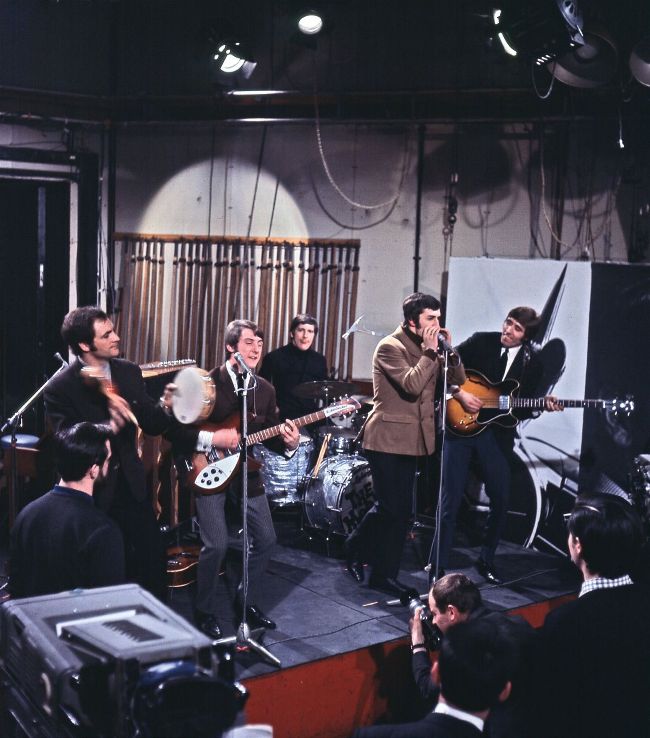
Moody Blues circa 1964, before John Lodge and Justin Hayward joined the ranks.
MICHAEL OCHS ARCHIVES/GETTY IMAGES
“I’d fired off a demo and a letter to Eric Burdon, because I knew his secretary,” Hayward tells us over Zoom from a tour break in France. “I didn’t expect to hear back, it was just on the off-chance. But then I was in a music shop in Swindon, Duck Son & Pinker’s, and the guy behind the counter said, ‘This bloke says he’s from The Moody Blues and wants to talk to you.’ And it was Mike Pinder. I said, ‘How did you find me?’ And he said, ‘Your phone number’s on the letter you sent to Eric. I spoke to your mum and she said you’d be down here.’”
DAYS OF INSPIRATION
WITH STEVE HACKETT
Conducted by JO KENDALL
“I’d heard about the Moodies’ Days Of Future Passed, but I was particularly aware of Nights In White Satin. I actually used to play it with a band I was trying to get off the ground at the time. I loved the song and its moving, symphonic atmosphere. I noticed the Mellotron and I thought it had a particularly powerful sound. It also mixed very well with the guitar.
“I realised that Nights In White Satin had a strong influence on King Crimson’s Epitaph, another Mellotron-driven tune of distinction. In Genesis we were all very taken with the Mellotron with its spooky Frankenstein’s Monster of a sound assembled from disembodied parts. To have the sound of an orchestra at your fingertips was heady stuff indeed and took the sound palate on to a whole new level.”