ETERNAL VIGILANCE
Facts on the ground
Israel may, for now, have backed off from the outright annexation of Palestinian land it has occupied for half a century. But it is burying any hope for a negotiated peace in concrete and tarmac
DONALD MACINTYRE
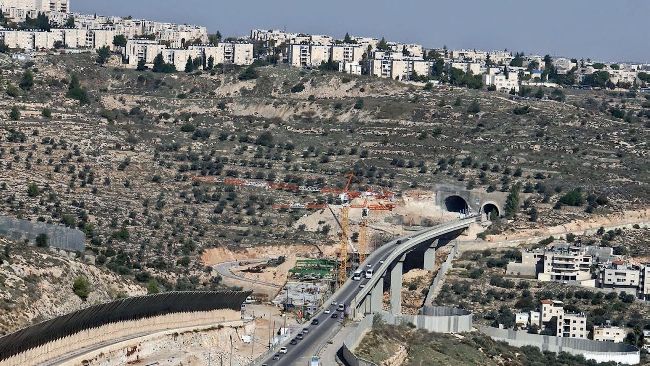
Tunnel vision: Highway 60, looking north towards Gilo and Jerusalem, is part of a burgeoning West Bank road network that’s being used to entrench Greater Israel
QUIQUE KIERSZENBAUM
You’re driving south from Jerusalem towards Hebron, the biggest Palestinian city in the occupied West Bank, revered in both Islam and Judaism as the site of Abraham’s grave. The journey will take you along a 28km section of Highway 60, which follows the biblical “Way of the Patriarchs” from Nazareth to Beersheba. But this venerable history is less in evidence than the fact that the road is-once again-being re-developed, as it has often been over the last 35 years.
Ahead to your left, you can make out the minarets and spires of Bethlehem. To the right, you can see bulldozers and cranes adding extra lanes to the road. Soon you will enter first one and then a second tunnel of nearly a kilometre. After that the road briefly widens before what initially looks like the toll station on an Italian autostrada.
But as you get closer, it’s not toll collectors but soldiers that you can see under the canopies between the lanes. This is the Tunnels Checkpoint, one of a ring of similar terminals on the main roads into Jerusalem. It is the last point that northward-bound vehicles bearing Palestinian green and white registration plates will be allowed to pass. Heading down from Jerusalem you will have seen only yellow and black Israeli number plates, despite the fact that you have already crossed, nearly 5km back and without noticing, from Israel proper into the occupied West Bank.
It is not for the Palestinian motorists, of course, that Highway 60 is being re-engineered at an estimated cost of £197m. This is the “Tunnels Road,” plans for which first emerged in 1991, during the First Intifada. Its one purpose was to ensure that Israeli settlers in the West Bank could avoid the stones and Molotov cocktails they had faced as they drove on the old Road 60 through the middle of Bethlehem and the adjacent Palestinian Christian town of Beit Jala, deep under which the long tunnel now passes.
It was the former general and future prime minister, Ariel Sharon, who eventually opened the Tunnels Road in 1996. He was then infrastructure minister in the first government of Benjamin Netanyahu, the man who-a full quarter of a century on-is about to face his seventh election as the nation’s leader, on 23rd March. Sharon grasped how a lack of secure roads stymied the growth of settlements, 60 per cent of whose working population have jobs in Israel proper. But build them, and they would come.
And indeed, the new Road 60 is no longer big enough for the settlers in places like the burgeoning Gush Etzion bloc, whose distinctively red roofs you can see on either side of it. Beyond the checkpoint, the old road winds between military watchtowers and through the orchards and olive groves of the Judaean Hills abuts the sprawling refugee camp of Al Arroub and cuts through Palestinian Beit Ummar. A brand new dual carriageway road will soon bypass both and cut the commute between Jerusalem and the further out settlement of Kiryat Arba to an easy 30 minutes.
There are few more dynamic built environments in the world than the one Israel operates in occupied territory. The separation barrier-sometimes an eight-metre wall, sometimes a fence with electronic sensors-often goes way beyond the internationally recognised border. In the 60 per cent of West Bank territory classed as “Area C”-where the settlers all live, and where the Palestinian Authority’s writ does not run-there is continuous construction. But it is overwhelmingly Israeli, because 98 per cent of Palestinian applications for building permits are rejected, and it is accompanied by the demolition of overwhelmingly Palestinian buildings.