BEYOND BORDERS
We reap what we sow
Industrial farming has fed the world. But as it destroys our ecology, it runs into diminishing returns. Brexit Britain has a rare chance to rewrite the rules-but only if we can find the will to seize it
WENDELL STEVENSON
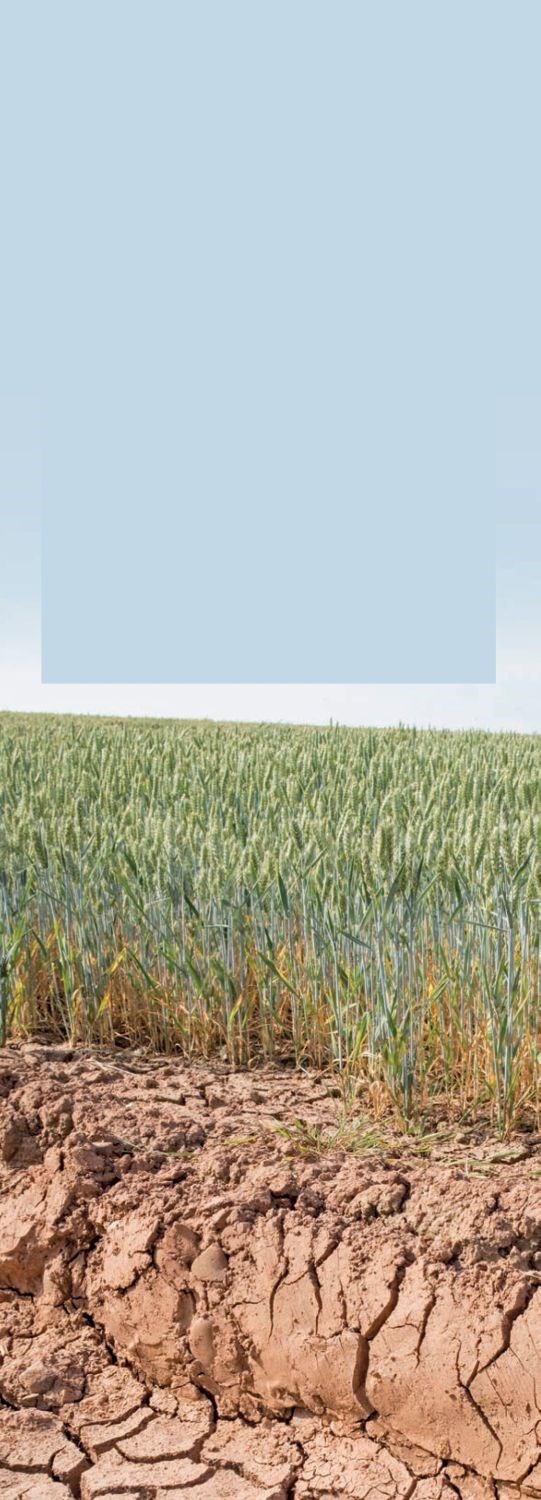
Deep-rooted problems: intensive agriculture degrades the soil on which future food production depends
PAUL WESTON / ALAMY STOCK PHOTO
When Stéphane Quere took over his parents’ farm in Brittany 16 years ago, he didn’t have any particular desire to turn it organic. He had grown up seeing his parents labour to grow broccoli and shallots and caulifl ower on their 30 hectares, helping out from the age of seven, working through the summer holidays as a teenager. His main thought was: I have to fi nd a diff erent way to farm, one that isn’t so hard.
Stéphane’s dilemma is perhaps the fundamental question of all life since the dawn of time: how can we get enough food to sustain ourselves? In the Anthropocene era, it is a newly urgent question. Climate change is upon us and our dominion on Earth has become the planet’s most determining environmental factor. Agriculture and the food industry account for a quarter of global greenhouse emissions. How do we produce food and eat in a way that is not only sustaining for our own body and soul, but also the planet?
For nearly all of human history, the main concern was to cultivate enough food to feed everyone. But more than two hundred years on from the predictions of Malthus-in a world with roughly eight times as many mouths to feed-we live in an era of cheap and abundant food. Perhaps for the first time in history, we now produce more calories globally than we need per person. (About 800m people worldwide are still considered to be undernourished, but this is mostly as a result of conflict. Hunger is now a problem of distribution, not of production.) The price of food has been falling for decades. In Britain, household food spending now accounts for less than 10 per cent of the average disposable income; in the 1950s it was around 40 per cent.
But this spectacular achievement has come at a cost. The methods that have been so successful in increasing yield- intensive farming and aquaculture, larger and larger fi elds of monocultured crops, the use of pesticides and herbicides- have proved environmentally catastrophic. Chemical fertilisers degrade soil health and contribute to global warming. Using more and more chemicals creates a vicious cycle: more intensive farming leads to more degradation of productive land. This creates a greater need to push yields to their maximum with chemical inputs. Meanwhile, pathogens and pests continue to plague animals and ravage crops despite the continued development of new pesticides and herbicides to deploy against them. It’s an arms race that the pathogens are always going to win. And along the way small family farms, like Stéphane’s, have been squeezed into penury by falling food prices and falling incomes.
The EAT-Lancet Commission on Food, Planet and Health, published in 2019, was the fi rst scientifi c review to ask: can we feed a future population of 10bn people on a healthy diet, and within planetary boundaries? In February of this year Chatham House published a landmark review concluding that agriculture is now the main threat posed to biodiversity. The issue is not only urgent, but mainstream.